Facts
The Appellant was convicted by the Trial Court under Sections 363, 366, and 376 of the IPC and sentenced to life imprisonment.
Source reference: para. 1The prosecution alleged that on 05.11.1997, the Appellant kidnapped a 15-year-old girl and raped her in a sugarcane field.
Source reference: para. 2The victim was recovered by the police on 06.11.1997, and her statement was recorded by the Investigating Officer under Section 161 CrPC.
Source reference: para. 2, 6Following the recovery, the victim was handed over to her father's custody; however, she committed suicide by hanging that same night, purportedly due to the disgrace caused by the rape.
Source reference: para. 2, 6The Trial Court relied upon the Section 161 statement as a dying declaration to convict the Appellant.
Source reference: para. 14, 18Issues
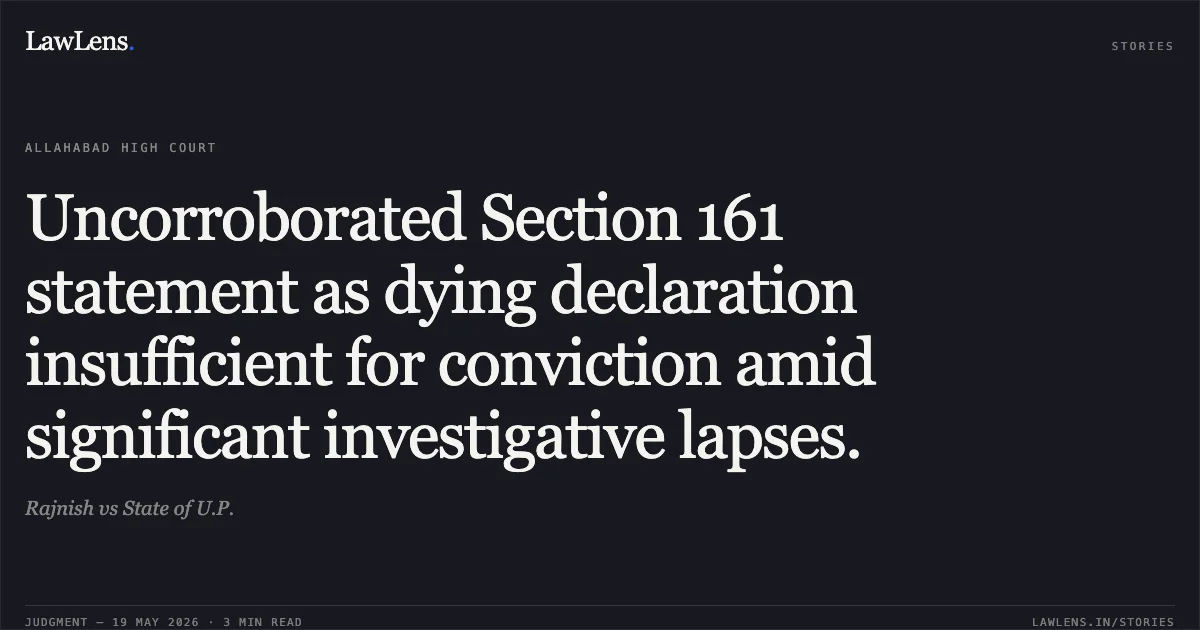
1. Whether a statement recorded by a police officer under Section 161 CrPC can be treated as a dying declaration under Section 32(1) of the Indian Evidence Act.
Source reference: para. 18, 242. Whether the uncorroborated statement of the deceased, in the absence of medical evidence and amid procedural lapses, is sufficient to sustain a conviction.
Source reference: para. 25, 32Law Applied
The Court applied Section 32(1) of the Indian Evidence Act, 1872, which renders statements regarding the cause of death or circumstances of the transaction resulting in death admissible.
Source reference: para. 19It relied on Sudhakar v. State of Maharashtra and Rattan Singh v. State of H.P. to establish that "circumstances of the transaction" need not have a direct nexus but must have a link to the death.
Source reference: para. 21Under Section 162(2) CrPC, the Court noted that the general bar against using police statements as evidence does not apply to statements falling under Section 32(1) of the Evidence Act, as affirmed in Dharmendra Kumar v. State of M.P.
Source reference: para. 27The "Rule of Prudence" dictates that such declarations must be truthful, voluntary, and corroborated if surrounding circumstances are suspicious.
Source reference: para. 29, 32Reasoning
The Court first determined that the victim’s statement regarding the rape was admissible as a dying declaration because her expressed trauma created a proximate link to her subsequent suicide.
Source reference: para. 23-25However, the Court subjected the declaration to a "Rule of Caution" due to significant investigative infirmities.
Source reference: para. 32It noted an unexplained delay in lodging the FIR and recording witness statements, which raised the possibility of tutoring.
Source reference: para. 30Critically, the Court found a total lack of medical corroboration: no medical examination was conducted while the victim was alive, and the post-mortem report showed no signs of sexual assault.
Source reference: para. 31-32Furthermore, the prosecution failed to send allegedly blood-stained clothes for FSL analysis and did not record the statement of the victim’s father.
Source reference: para. 32The Court reasoned that a dying declaration recorded by police can only be the sole basis of conviction if it is "wholly unblemished," which was not the case here.
Source reference: para. 32Holding
The High Court allowed the appeal and set aside the conviction.
The Court held that while a Section 161 CrPC statement is admissible as a dying declaration, the cumulative effect of delayed reporting, lack of medical evidence, and procedural lapses made it legally unsafe to rely solely on that statement.
Source reference: para. 32-33Finding that the prosecution failed to establish guilt beyond a reasonable doubt, the Court granted the Appellant the benefit of the doubt and ordered his immediate release.
Source reference: para. 33, 35Acts & Sections Cited
7 provisions across 2 statutes referred to in this judgment. Each provision opens on LawLens.
Indian Penal Code, 18604
Code of Criminal Procedure, 19733
Original Court PDF
RajnishvsState of U.P.
Click to open original judgment
Original judgment, available to read, download and summarize on LawLens.in