Facts
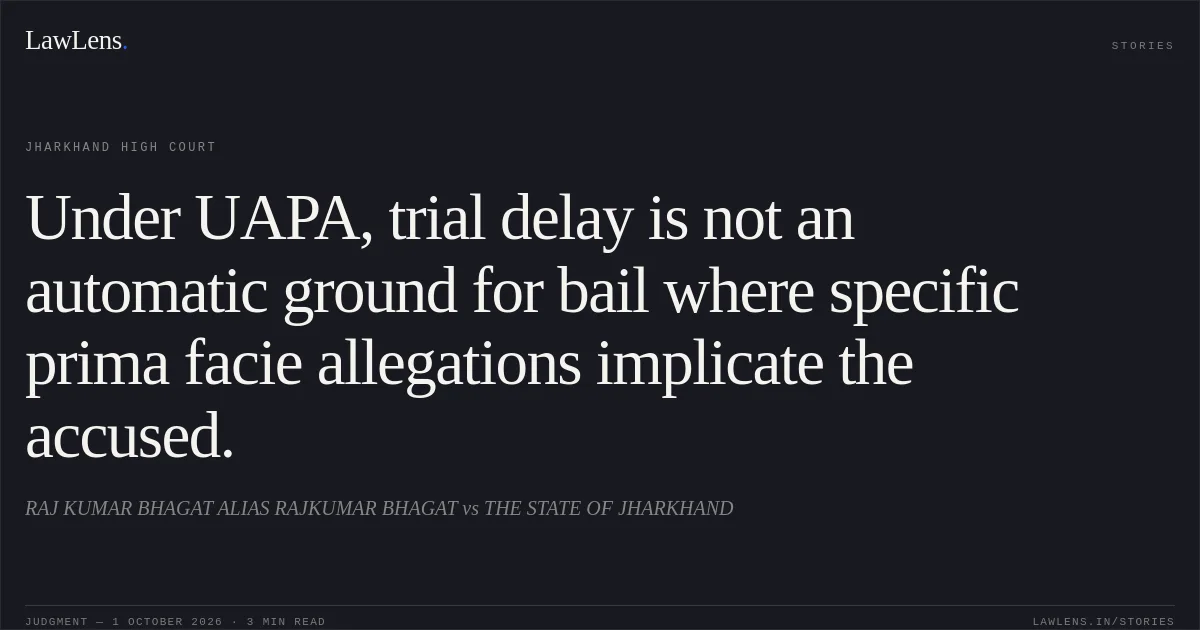
The appellant was arrested on 07.11.2022 in connection with a police ambush attributed to members of the banned MCC, in which five police personnel, including the Superintendent of Police, Pakur, were killed.
Source reference: para. 2–4, 19, 39He was not named in the FIR, but the prosecution relied on case-diary statements identifying him as having attended a meeting on 29.06.2013 to plan a major crime.
Source reference: para. 2–4, 19, 39The case involved offences under the IPC, Arms Act, CLA Act and Sections 16(1)(a), 17, 18 and 21 of the UAPA.
Source reference: para. 2–4, 19, 39His earlier bail appeal was dismissed on merits on 20.07.2023, with the Court considering the alleged conspiracy and the case-diary material.
Source reference: para. 5, 18–22In this appeal under Section 21(4) of the National Investigation Agency Act, 2008, he relied principally on prolonged custody, trial delay and parity with co-accused who had been granted bail.
Source reference: para. 1, 12–15, 36The State submitted that 12 of 47 prosecution witnesses had been examined and that the trial remained in progress.
Source reference: para. 61–63Issues
1. Whether the appellant was entitled to bail on the ground of parity with co-accused who had been released on bail.
Source reference: para. 36, 40–492. Whether the appellant’s custody of approximately three years and ten months, and the anticipated delay in concluding trial, justified bail under Article 21 notwithstanding Section 43D(5) of the UAPA.
Source reference: para. 36, 50–60, 65–683. Whether the order rejecting bail required appellate interference in light of the grounds raised and the material already considered in the appellant’s earlier bail appeal.
Source reference: para. 18–22, 60, 68–70Law Applied
Under Section 43D(5) of the UAPA, where the Court finds reasonable grounds for believing that an accusation under Chapter IV or VI is prima facie true, the statutory restriction weighs against granting bail; the assessment is made on the case diary or charge-sheet material at the prescribed prima facie threshold, without a detailed examination of evidence (NIA v. Zahoor Ahmad Shah Watali, as applied at paras. 30–34, 37–38).
Source reference: para. 30–34, 37–38Gurwinder Singh v. State of Punjab cautions that the ordinary “bail is the rule” approach is restricted under the UAPA and that delay alone does not automatically warrant bail in grave cases.
Source reference: para. 30–34, 52Article 21 nevertheless requires a contextual assessment of prolonged detention; Union of India v. K.A. Najeeb recognises that constitutional courts may grant bail where detention becomes unconscionable, while Gulfisha Fatima v. State (NCT of Delhi) requires proportional scrutiny of the offence, attributed role, prima facie case and cumulative effect of incarceration.
Source reference: para. 51–52The Court also referred to Syed Iftikhar Andrabi v. National Investigation Agency for the proposition that the UAPA’s restrictions operate subject to Articles 21 and 22, and that bail may still be denied on the facts of an appropriate case.
Source reference: para. 65Parity requires comparison of the accused’s role and circumstances, not merely the fact that another accused obtained bail (Ramesh Bhavan Rathod v. Vishanbhai Hirabhai Makwana and Tarun Kumar v. Assistant Director, Directorate of Enforcement).
Source reference: para. 40–42Reasoning
The Court held that the appellant’s case was materially distinguishable from those of the co-accused granted bail: the latter were implicated through different circumstances and/or had undergone substantially longer custody, whereas independent witnesses had specifically placed the appellant at the alleged conspiracy meeting.
Source reference: para. 39, 44–49, 60The Court had already assessed that material and rejected his bail appeal on merits in 2023, and found no material change in circumstances.
Source reference: para. 39, 44–49, 60Although the appellant had been in custody for about three years and ten months and 35 of the 47 cited witnesses remained to be examined, the Court considered the alleged role, the gravity of the offences and the continuing trial.
Source reference: para. 47, 50–57, 61–68It concluded that, on these facts, the period of custody and anticipated delay did not justify overriding the statutory restraint or granting bail under Article 21.
Source reference: para. 47, 50–57, 61–68Holding
The High Court dismissed the appeal and declined to interfere with the order dated 02.02.2026 rejecting bail.
It reserved liberty to the appellant to seek release before the appropriate court if the trial is not concluded within a reasonable period; it also clarified that its observations were confined to the appeal and would not prejudice the trial.
Source reference: para. 71–72Acts & Sections Cited
25 provisions across 5 statutes referred to in this judgment. Each provision opens on LawLens.
National Investigation Agency Act, 20081
Indian Penal Code, 1860
Unlawful Activities (Prevention) Act, 19677
Arms Act, 19591
Code of Criminal Procedure, 19733
Original Court PDF
RAJ KUMAR BHAGAT ALIAS RAJKUMAR BHAGATvsTHE STATE OF JHARKHAND
Click to open original judgment
Original judgment, available to read, download and summarize on LawLens.in