Facts
The State appealed against a trial court judgment dated 17.01.2013, which acquitted the respondents of charges under Sections 147, 148, 323, and 325 read with Section 149 of the IPC
Source reference: para. 1The prosecution alleged that on 10.11.2009, during a marriage at Village Paneya, the accused beat Lekh Raj (PW5) and subsequently assaulted the informant, Babu Ram (PW1), and Jagdish (PW2) with sticks when they intervened
Source reference: para. 2Although the incident occurred on 10.11.2009 at 9:30 PM, the FIR was not registered until 13.11.2009
Source reference: para. 6, 15Medical evidence characterized PW1’s injuries as simple, while PW2 sustained a fracture to his left index finger
Source reference: para. 2The trial court acquitted the accused citing an unexplained three-day delay in lodging the FIR, the inability of witnesses to identify the assailants due to a power cut at the scene, and the informant disowning his signature on the police complaint
Source reference: para. 6Issues
1. Whether the appellate court is warranted in interfering with a judgment of acquittal when the trial court has taken a "reasonable view" based on the evidence
Source reference: para. 12-132. Whether the unexplained delay in lodging the FIR and the absence of a Test Identification Parade (TIP) for accused persons previously unknown to the witnesses are fatal to the prosecution’s case
Source reference: para. 15-18, 23-263. Whether generalized/omnibus statements by witnesses regarding the "accused persons" are sufficient to sustain a conviction
Source reference: para. 20-21Law Applied
The court applied the settled principle that interference with an acquittal is only permissible if the judgment is patently perverse, based on a misreading of evidence, or if no reasonable person could have reached such a conclusion, as established in Surendra Singh v. State of Uttarakhand (2025)
Source reference: para. 12State of M.P. v. Ramveer Singh (2025)
Source reference: para. 13Regarding FIR delays, the court relied on Mehraj Singh v. State of U.P. (1994), holding that unexplained delays suggest embellishment and fabrication
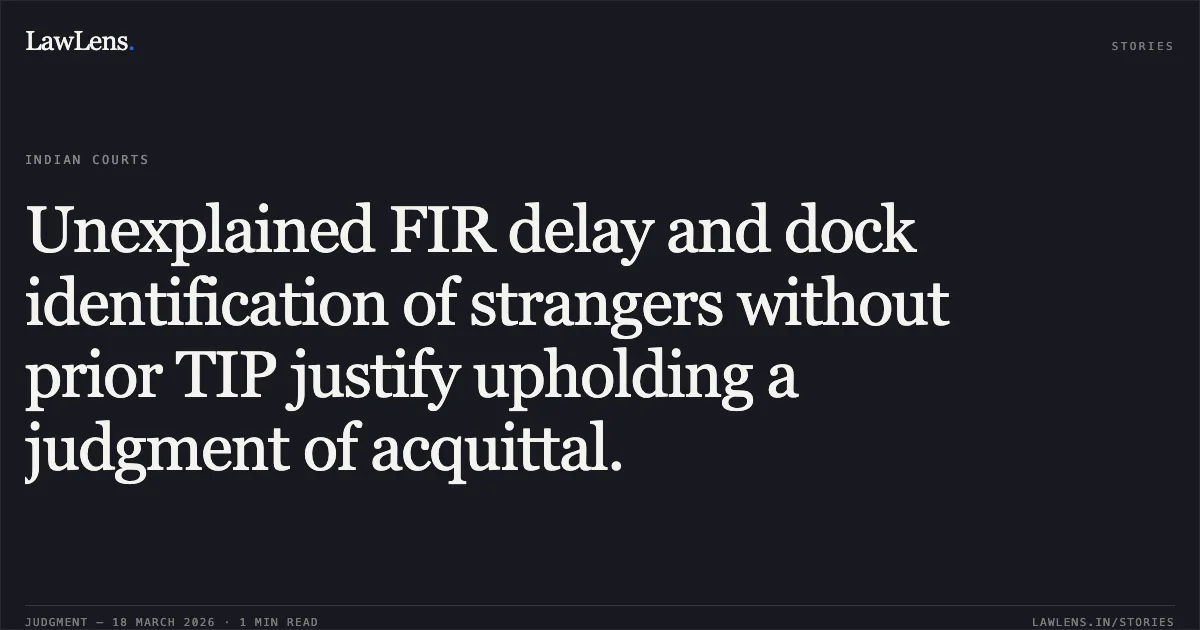
Source reference: para. 15On identification, the court applied P. Sasikumar v. State of T.N. (2024), which mandates that dock identification of strangers without a prior Test Identification Parade (TIP) is a weak piece of evidence
Source reference: para. 26the court cited Pandurang v. State of Hyderabad (1955) to emphasize that omnibus inclusions of "all accused" without specific acts are unsafe for conviction
Source reference: para. 20Reasoning
The High Court observed that the three-day delay in reporting the matter was not satisfactorily explained; while the informant claimed physical inability to move, medical evidence (MLC Ext.PW8/A) showed only simple injuries, contradicting his claim
Source reference: para. 15The court noted that the witnesses admitted to a power cut and the presence of a large crowd (200-300 people), making identification in the darkness nearly impossible
Source reference: para. 22Since the accused were strangers, the failure of the Investigating Officer (PW11) to conduct a TIP rendered the subsequent dock identification unreliable
Source reference: para. 23, 27the court found the genesis of the FIR suspect because the informant (PW1) disowned his signature on the written complaint (Ext.PW1/A) and claimed the police dictated it
Source reference: para. 31-32The medical evidence also failed to provide unequivocal corroboration, as the examining doctor (PW8) admitted the injuries could have resulted from a fall and noted an absence of patterned wounds typical of stick impacts
Source reference: para. 29Holding
The High Court dismissed the State’s appeal, holding that the trial court’s view was reasonable and supported by the material on record
The Court affirmed that the prosecution failed to prove its case beyond a reasonable doubt due to the unexplained delay, lack of reliable identification, and contradictions in the informant's testimony
Source reference: para. 32The respondents were directed to furnish personal bonds of ₹25,000 each pursuant to Section 437-A of the Cr.P.C. (Section 481 of BNSS, 2023) to ensure their appearance should further legal proceedings arise
Source reference: para. 35Acts & Sections Cited
6 provisions across 2 statutes referred to in this judgment. Each provision opens on LawLens.
Indian Penal Code, 18605
Bharatiya Nagarik Suraksha Sanhita, 20231
Original Court PDF
STATE OF HPvsNARESH KUMAR @ RINKU
Click to open original judgment
Original judgment, available to read, download and summarize on LawLens.in