Facts
On 13 August 2017 at approximately 8:00 p.m., Satish Kumar was allegedly shot at a bathan by a group of accused persons after a dispute concerning the consumption of liquor.
Source reference: paras. 3–4; pp. 3–5The written information was submitted by Amira Rai at 9:00 a.m. on 14 August 2017, approximately 13 hours after the occurrence, and the FIR was registered thereafter.
Source reference: paras. 3–4; pp. 11–13After investigation, charges were submitted against Panchu Rai, Jagbali Ray, Manoj Ray and Dinesh Roy, while Dashrath Rai was shown as absconding; his name was subsequently expunged after his death.
Source reference: paras. 5–8; pp. 5–6The trial court convicted the appellants under Sections 323 and 302/34 IPC and Section 27 of the Arms Act, sentencing them to life imprisonment for murder, along with concurrent sentences for the other offences.
Source reference: paras. 2, 12–15; pp. 2–9Issues
Whether the prosecution proved beyond reasonable doubt that the appellants, in furtherance of their common intention, caused the death of Satish Kumar, thereby attracting Section 302 read with Section 34 IPC.
Source reference: paras. 24–38; pp. 11–23Whether the unexplained delay of approximately 13 hours in lodging the FIR, together with the absence of the FIR details from the inquest and post-mortem materials, undermined the authenticity of the prosecution case.
Source reference: paras. 28–31; pp. 15–20Whether the material contradictions, improvements, delayed examination of witnesses and lack of physical evidence at the alleged place of occurrence created a reasonable doubt warranting acquittal.
Source reference: paras. 26–27, 32–38; pp. 13–23Whether the convictions under Sections 323 IPC and 27 of the Arms Act could be sustained on the evidence led by the prosecution.
Source reference: paras. 2, 15, 32–38; pp. 2–3, 9, 20–23Law Applied
The Court applied Sections 302 and 323 of the Indian Penal Code concerning murder and voluntarily causing hurt, Section 34 IPC concerning acts done in furtherance of common intention, and Section 27 of the Arms Act concerning use of arms.
Source reference: no citationThe prosecution was required to establish the appellants’ guilt beyond reasonable doubt, and material infirmities in the prosecution evidence had to be resolved in favour of the accused.
Source reference: no citationThe Court relied on Chotkau v. State of U.P. , (2023) 6 SCC 742, which reiterated the principle in Meharaj Singh (L/Nk.) v. State of U.P. , (1994) 5 SCC 188, that prompt registration of an FIR is particularly important in a murder case because delay may facilitate embellishment, afterthought and introduction of a coloured version.
Source reference: para. 31; pp. 18–20The Court also considered the evidentiary significance of the inquest proceedings under Section 174 CrPC and the requirement that the prosecution prove the place, manner and authorship of the occurrence through reliable evidence.
Source reference: paras. 28–32; pp. 15–20Reasoning
The Court found that the informant, PW-6, materially improved his version during trial by introducing the presence of Shyamchandar Rai at the bathan and alleging that Manoj Ray and Dinesh Roy had caught hold of Satish, facts not stated in the written information.
Source reference: para. 26; pp. 13–15Although the occurrence allegedly took place at 8:00 p.m., the informant did not submit information even when Satish was taken to a hospital adjacent to the police station.
Source reference: paras. 27–30; pp. 15–18The inquest was prepared at 5:45 a.m., before the written information or FIR was available, and the post-mortem report did not mention a police case number.
Source reference: paras. 27–30; pp. 15–18The investigating officer also found no blood, empty cartridge cases, liquor bottles or signs of liquor consumption at the alleged place of occurrence, contradicting the informant’s account.
Source reference: para. 32; pp. 20–21Further, several alleged eyewitnesses were examined by the investigating agency only after considerable delay, including PW-1 after about one and a half months and PW-2 after approximately eight months; the investigating officer stated that the witnesses had not disclosed at the earliest stage that they had seen the occurrence.
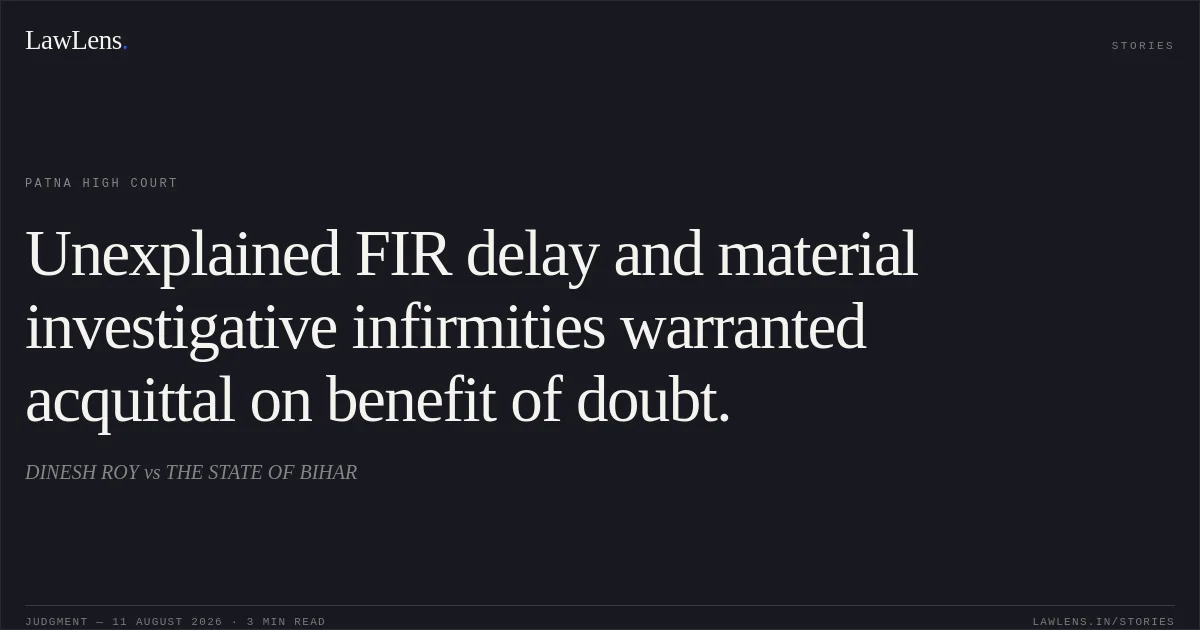
Source reference: paras. 34–36; pp. 21–22Accordingly, the Court held that the eyewitness testimony was unreliable and that the cumulative discrepancies, delayed FIR, evidentiary improvements and lack of corroborative physical evidence created a reasonable doubt regarding the prosecution case.
Source reference: paras. 37–38; pp. 22–23Holding
The Court answered the issues in favour of the appellants and held that the prosecution had failed to prove the charges under Sections 302/34 and 323 IPC and Section 27 of the Arms Act beyond reasonable doubt.
The judgment of conviction dated 31 January 2023 and the order of sentence dated 7 February 2023 were set aside.
Source reference: paras. 39–40; p. 23The four appellants were acquitted by extending to them the benefit of doubt and were directed to be released forthwith, unless required in any other case.
Source reference: paras. 39–40; p. 23Acts & Sections Cited
8 provisions across 4 statutes referred to in this judgment. Each provision opens on LawLens.
Indian Penal Code, 18604
Arms Act, 19591
BIHAR PROHIBITION AND EXCISE ACT, 20161
Code of Criminal Procedure, 19732
Original Court PDF
DINESH ROYvsTHE STATE OF BIHAR
Click to open original judgment
Original judgment, available to read, download and summarize on LawLens.in