Facts
The prosecution alleged that on 9 May 2008, the complainant, Prasanta Barui (PW 1), was intercepted while travelling by motorcycle near Markha village and assaulted by the petitioner, Anil Barui, with a lathi, causing injuries to his head, neck and left hand. He was initially taken to Beliatore Primary Health Centre and thereafter referred to Govindanagar Hospital, Bankura.
Source reference: para. 3Although the occurrence was alleged to have taken place on 9 May 2008, the FIR was registered only on 15 August 2008 pursuant to a petition under Section 156(3) CrPC. The prosecution claimed that a complaint had earlier been sent by registered post to the Superintendent of Police on 30 May 2008, but produced neither the postal receipt nor a copy of that complaint.
Source reference: paras. 4, 22–23After investigation, a chargesheet was filed under Section 326 IPC. The trial court acquitted the petitioner of the Section 326 charge but convicted him under Section 323 IPC and sentenced him to three months’ rigorous imprisonment.
Source reference: para. 5The appellate court affirmed the conviction and sentence on 29 August 2017.
Source reference: para. 6Issues
Whether the unexplained delay of more than three months in registering the FIR, coupled with the admitted land dispute between the parties, rendered the prosecution case a belated afterthought and a case of false implication?
Source reference: para. 20; paras. 21–30Whether reliance on the testimony of PW 2, who was allegedly not examined by the Investigating Officer during investigation, violated the safeguards associated with Section 162 CrPC and prejudiced the defence?
Source reference: para. 20; paras. 31–39Whether the prosecution proved that the injuries were voluntarily caused by the petitioner, particularly in view of the incomplete injury report, non-recovery of the lathi, and the medical possibility that the injuries resulted from a fall from the motorcycle?
Source reference: para. 20; paras. 40–46Whether the courts below improperly shifted the burden of proof onto the petitioner to explain the delay or establish the alternative theory of accidental injury?
Source reference: para. 20; paras. 47–53Law Applied
The Court applied Section 323 IPC, which requires proof that the accused voluntarily caused hurt, read with Section 319 IPC defining “hurt” as bodily pain, disease or infirmity.
Source reference: paras. 41–42It relied on Sections 154(1) and 154(3) CrPC concerning the recording of information relating to a cognizable offence and escalation to the Superintendent of Police where the police station refuses to act, and Sections 161–162 CrPC concerning police examination of witnesses and the accused’s right to use prior statements for contradiction.
Source reference: paras. 22, 31–34The Court invoked Sections 101–103 of the Indian Evidence Act, 1872, holding that the prosecution bears the burden of proving the charge and explaining suspicious delay.
Source reference: para. 29Relying on Thulia Kali v. State of Tamil Nadu , (1972) 3 SCC 393, Darshan Singh v. State of Punjab , (2024) 3 SCC 164, and K.A. Kotarappa Reddy v. Rayara Manjunatha Reddy , (2016) 14 SCC 729, it held that unexplained delay may permit suspicion of embellishment or false implication.
Source reference: paras. 24–25It further relied on Ram Lakhan Singh v. State of Uttar Pradesh , (1977) 3 SCC 268, and Rajesh Patel v. State of Jharkhand , (2013) 3 SCC 791, regarding the evidentiary risk of relying on material witnesses not examined during investigation.
Source reference: paras. 35–37The Court also applied the principle that where medical evidence leaves a plausible alternative cause of injury and the prosecution fails to exclude it, the accused is entitled to benefit of doubt.
Source reference: paras. 44–45Reasoning
The Court held that the three-month delay was not satisfactorily explained because the alleged prior complaint to the Superintendent of Police was unsupported by postal or documentary evidence, and the Investigating Officer admitted that he had not verified the claim.
Source reference: paras. 22–30In the Court’s view, the delay assumed greater significance because of the pre-existing land dispute.
Source reference: paras. 22–30It further found that PW 2, projected as an eyewitness and co-rider, had not been examined during investigation, depriving the defence of an effective opportunity to test his account through prior statements and contradictions.
Source reference: paras. 31–39The medical and physical evidence also created reasonable doubt: the injury report was materially deficient, the alleged lathi was never recovered, and PW 13 accepted that the injuries could have resulted from a fall from a moving motorcycle, which was found lying near the injured complainant.
Source reference: paras. 40–46The courts below were therefore held to have improperly relied on the defence’s failure to establish the accident theory instead of requiring the prosecution to prove assault beyond reasonable doubt.
Source reference: paras. 47–53The principle in Edakkandi Dineshan v. State of Kerala , (2025) 3 SCC 273, was distinguished because that case involved otherwise strong eyewitness, medical and recovery evidence, which the Court found absent here.
Source reference: para. 51Holding
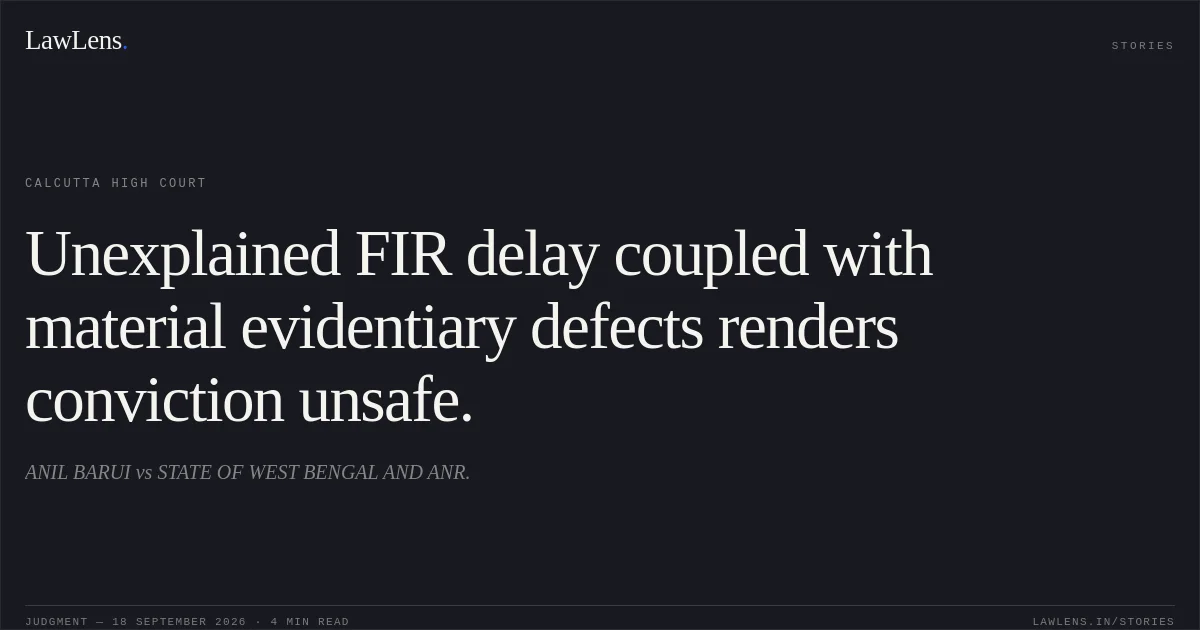
The Court answered all four issues in favour of the petitioner.
It held that the unexplained delay, unreliable investigative process, legally unsafe reliance on PW 2, deficient medical evidence, non-recovery of the alleged weapon, and the unexcluded possibility of accidental injury created substantial doubt regarding the prosecution case.
Source reference: paras. 52–55The revision petition was allowed; the judgments of the trial court and appellate court were set aside; and the petitioner was acquitted of the offence under Section 323 IPC by extending the benefit of doubt.
Source reference: paras. 56–59The petitioner was discharged from his bail bonds, with no order as to costs.
Source reference: paras. 59–61Acts & Sections Cited
15 provisions across 4 statutes referred to in this judgment. Each provision opens on LawLens.
Indian Penal Code, 18604
Code of Criminal Procedure, 19738
Bharatiya Nagarik Suraksha Sanhita, 20232
Bharatiya Sakshya Adhiniyam, 20231
Original Court PDF
ANIL BARUIvsSTATE OF WEST BENGAL AND ANR.
Click to open original judgment
Original judgment, available to read, download and summarize on LawLens.in