Facts
The applicant, an Inspector of Central Excise (later promoted to Superintendent), was accused of misconduct for allegedly failing to scrutinize 89 fraudulent rebate claims involving approximately ₹2.66 crores during 2003–2004.
Source reference: para. 2.1, 5.3A major penalty Charge Memorandum was issued on April 4, 2008, four years after the alleged incidents.
Source reference: para. 2.2During the inquiry, the Disciplinary Authority (DA) issued an Addendum on June 10, 2014, adding a new Article of Charge (Article IX) six years after the initial charge sheet.
Source reference: para. 2.5The Inquiry Officer (IO) eventually found Article I partially proved and Articles II to IX not proved.
Source reference: para. 2.7However, the DA disagreed with the IO, holding Articles I, IV, and IX proved, and imposed a penalty of reduction in pay by three stages for one year.
Source reference: para. 5.6The Appellate Authority reduced this to a two-stage reduction for six months.
Source reference: para. 5.7The applicant challenged these orders citing inordinate delay, procedural illegalities, and the argument that the lapses constituted mere negligence, not misconduct.
Source reference: para. 4Issues
1. Whether the inordinate delay in the initiation and conclusion of disciplinary proceedings vitiates the inquiry?
Source reference: para. 9(a)2. Whether the issuance of an Addendum introducing a new charge six years after the original charge sheet is legally sustainable?
Source reference: para. 9(b)3. Whether the findings of guilt recorded by the Disciplinary Authority, in disagreement with the Inquiry Officer, were perverse or violated principles of natural justice?
Source reference: para. 9(c)4. Whether the alleged acts of the applicant constitute "misconduct" or mere negligence/error of judgment?
Source reference: para. 9(d)Law Applied
The Tribunal applied the Central Civil Services (Classification, Control and Appeal) Rules, 1965, specifically Rule 14 (inquiry procedure) and Rule 11 (penalties).
Source reference: para. 2.3, 5.6It relied on P.V. Mahadevan v. MD, Tamil Nadu Housing Board, which established that unexplained delay in proceedings causes mental distress and vitiates the inquiry.
Source reference: para. 10.1The principles from Union of India v. Udai Bhan Singh were applied to determine if delay caused real prejudice.
Source reference: para. 10.3Regarding disagreement with inquiry reports, it followed Punjab National Bank v. Kunj Behari Misra, requiring the DA to provide tentative reasons and a fair opportunity to represent.
Source reference: para. 12.1, 12.3On the definition of misconduct, it applied Union of India v. J. Ahmed and Zunjarrao Bhikaji Nagarkar v. Union of India, which distinguish "culpable negligence" from mere "error of judgment" or "negligence simplicitor," holding that the latter does not constitute misconduct.
Source reference: para. 13, 13.2Reasoning
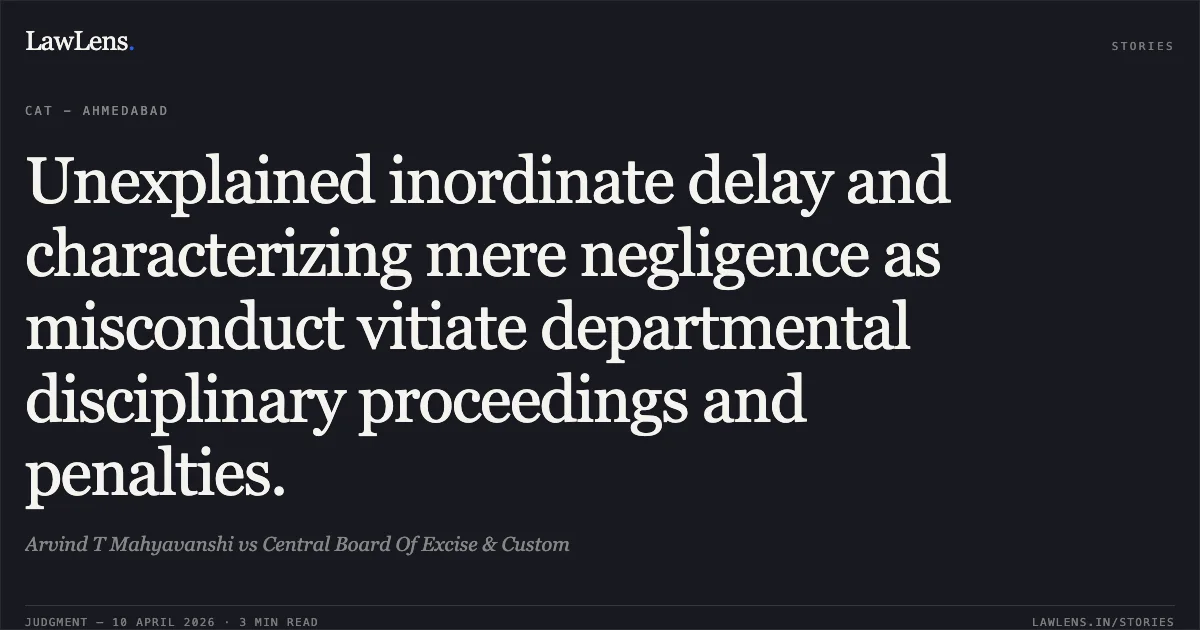
The Tribunal found that the four-year delay in initiating the charge sheet and the subsequent seven-year delay in concluding the inquiry were unexplained and prejudiced the applicant's ability to defend himself.
Source reference: para. 10.4, 10.5It ruled the 2014 Addendum was an impermissible attempt to "fill lacunae" at a belated stage.
Source reference: para. 11.4Regarding the DA’s disagreement with the IO, the Tribunal noted that the DA failed to provide cogent reasons or demonstrate how the IO’s findings were perverse, essentially substituting its opinion for the IO's quasi-judicial findings without proper basis.
Source reference: para. 12.4, 12.6The Tribunal concluded that since the applicant was a junior officer (Inspector) whose processing of files was reviewed by a Superintendent and sanctioned by an Assistant Commissioner, his failure to detect sophisticated forgery was a "lapse in judgment" or "inadvertence" rather than "culpable negligence" or "mala fide misconduct".
Source reference: para. 13.4Holding
The Tribunal allowed the Original Application, quashing the Charge Memorandum, Addendum, IO Report, Penalty Order, and Revisional Order.
It held that the proceedings were vitiated by inordinate delay, procedural impropriety (the Addendum), and a lack of evidence of "misconduct" beyond simple negligence.
Source reference: para. 10.5, 11.5, 13.6The respondents were directed to restore the applicant’s pay, grant all consequential benefits, and regularize his suspension period (2004–2005) within six weeks.
Source reference: para. 15Acts & Sections Cited
3 provisions across 3 statutes referred to in this judgment. Each provision opens on LawLens.
Administrative Tribunals Act, 19851
Central Excise Act, 19441
Indian Penal Code, 18601
Original Court PDF
Arvind T MahyavanshivsCentral Board Of Excise & Custom
Click to open original judgment
Original judgment, available to read, download and summarize on LawLens.in