Facts
The Respondent was provisionally appointed as a Beldar (ST) in the CPWD in 2014 based on a School Transfer Certificate and Caste Certificate
Source reference: para. 3-4In 2017, following a vigilance inquiry initiated after allegations of fraud in recruitment, the Petitioner sought verification of the Respondent’s School Transfer Certificate from the District Magistrate, Karauli
Source reference: para. 5-6Reports from the Addl. District Collector and a two-member team concluded that the certificate details did not match school records
Source reference: para. 6Consequently, disciplinary proceedings were initiated under Rule 14 of the CCS (CCA) Rules, 1965
Source reference: para. 8Despite the Respondent’s denial, the Inquiry Officer (IO) concluded the charges were established based on the official reports, though no witnesses were called to prove said reports
Source reference: para. 10, 26The Respondent was dismissed from service on 16.02.2023
Source reference: para. 12The Central Administrative Tribunal (CAT) set aside the dismissal, directing reinstatement
Source reference: para. 1, 16The Union of India challenged this before the High Court.
Source reference: no citationIssues
1. Whether a departmental inquiry can be sustained and charges deemed proved solely on the basis of documentary reports if the documents are not proved through oral evidence and the delinquent employee is denied the opportunity to cross-examine witnesses.
Source reference: para. 31, 33Law Applied
The court primarily applied the principles of natural justice and the procedure for departmental inquiries under the CCS (CCA) Rules, 1965
Source reference: para. 9It relied heavily on the Supreme Court precedents of Roop Singh Negi v. Punjab National Bank, which held that documents must be proved through witnesses and that evidence collected during investigation is not evidence unless proven
Source reference: para. 19, 38Jai Prakash Saini v. Managing Director, U.P. Cooperative Federation Ltd. & Ors., which established that even in cases based on documentary evidence, a witness must prove the documents and be available for cross-examination unless the employee unequivocally admits guilt
Source reference: para. 24, 33-34Reasoning
The Court rejected the Petitioner's argument that official reports from the District Magistrate and School Principal were sufficient "per se" to prove forgery
Source reference: para. 29, 35The Court observed that in an inquiry, the burden of proof lies on the employer/department unless the charge is admitted
Source reference: para. 36Applying the Jai Prakash Saini doctrine, the Court noted that since the Respondent denied the charges, the department was obligated to produce the authors of the verification reports as witnesses
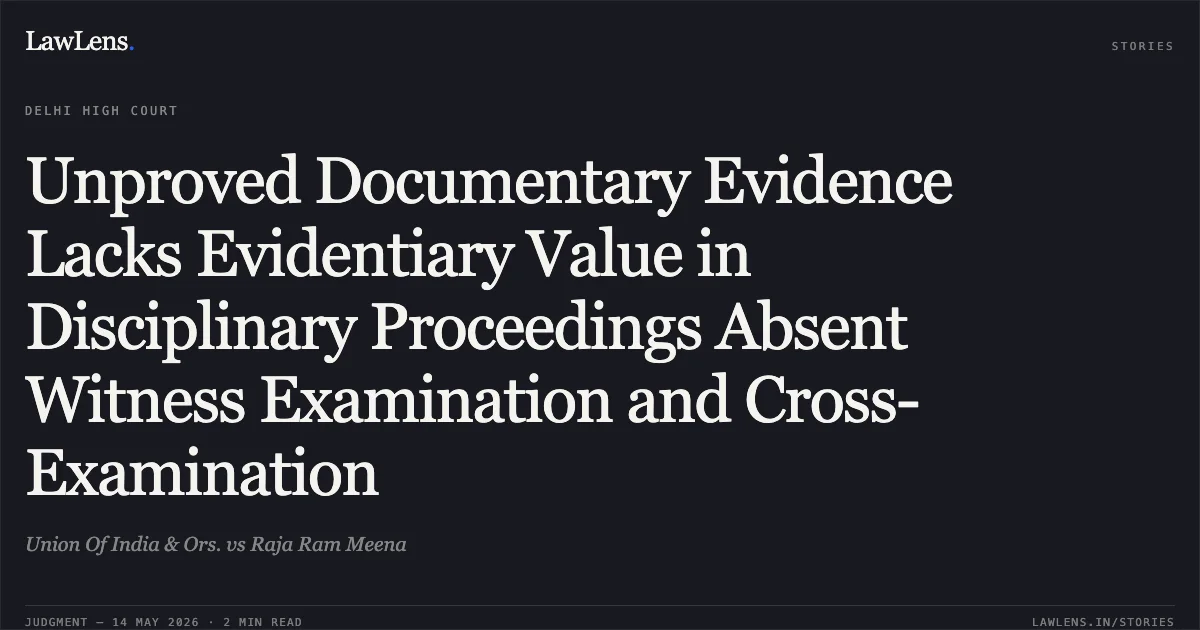
Source reference: para. 34-37Because none of the four proposed witnesses were produced or made available for cross-examination, the underlying documents remained "unproved" in the eyes of the law
Source reference: para. 26, 37The Court held that reliance on unproven documents collected during an investigation violates the fundamental right of a delinquent employee to cross-examine the evidence against them
Source reference: para. 28, 38-39Holding
The Court held that a charge cannot be treated as proved based on unproved documents where the respondent was deprived of cross-examination
The High Court dismissed the Writ Petition in limine and upheld the Tribunal's decision to set aside the dismissal and order reinstatement with consequential benefits; however, the Petitioners remain at liberty to proceed against the Respondent pursuant to the charge memo in accordance with the prescribed rules
Source reference: para. 40-41, para. 16/direction 14Original Court PDF
Union Of India & Ors.vsRaja Ram Meena
Click to open original judgment
Original judgment, available to read, download and summarize on LawLens.in