Facts
The appellant was convicted by the Upper Sessions Judge, Khairagarh, in Special Case No. 07 of 2014 for offences under Sections 363, 366 and 376 of the IPC and Section 6 of the POCSO Act.
Source reference: p.1; para. 1He was sentenced to rigorous imprisonment for four years each under Sections 363 and 366 IPC and ten years under Section 376 IPC, with the sentences to run concurrently; no separate sentence was imposed under Section 6 of the POCSO Act.
Source reference: p.1; para. 2The prosecution alleged that the victim was kidnapped by the appellant on 21 May 2014.
Source reference: p.2; para. 3She was recovered approximately one month later after returning to her family.
Source reference: p.2; para. 3Medical examination revealed no external injuries, while the ossification examination assessed her age as between 16 and 18 years, with the doctor admitting a possible variation of three years on either side.
Source reference: p.2; para. 3Semen and sperm were detected on the victim’s vaginal slides and underwear, but not on the appellant’s underwear.
Source reference: p.3; para. 3The prosecution relied upon a school register recording the victim’s date of birth as 7 September 1997.
Source reference: p.6; para. 12However, the relevant entry was based on a transfer certificate from her earlier school, which was not produced, and the prosecution did not produce the record of her initial schooling.
Source reference: p.6; para. 12The victim testified that she accompanied the appellant to Surat after he promised to marry her, lived there for about a month, and had repeated physical relations with him.
Source reference: p.10; para. 16In cross-examination, she admitted that she did not raise an alarm or complain during the journey or while residing in Surat.
Source reference: p.11; para. 16Issues
Whether the prosecution proved beyond reasonable doubt that the victim was below 18 years of age on the date of the incident, thereby attracting the provisions of the POCSO Act and affecting the offences under the IPC?
Source reference: pp.6–10; paras. 11–15Whether the appellant “took” or kidnapped the victim from the keeping of her lawful guardian so as to attract Sections 363 and 366 IPC?
Source reference: pp.12–14; paras. 20–22Whether the sexual relationship between the appellant and the victim constituted rape under Section 376 IPC, or was consensual in the circumstances proved by the evidence?
Source reference: pp.10–15; paras. 16–24Law Applied
The Court applied Sections 363, 366 and 376 of the IPC and the relevant provisions of the POCSO Act concerning sexual offences against children.
Source reference: pp.6–10; paras. 11–15, 24–25The prosecution bears the burden of proving the victim’s minority and the accused’s guilt beyond reasonable doubt.
Source reference: pp.6–10; paras. 11–15, 24–25In assessing age, the Court relied on Alamelu v. State , Rishipal Singh Solanki v. State of Uttar Pradesh and P. Yuvaprakash v. State , which emphasize the evidentiary value and proper source of school or birth records and treat medical age estimation as subject to an error margin.
Source reference: pp.7–10; paras. 13–15For kidnapping, the Court applied S. Varadarajan v. State of Madras , holding that mere voluntary accompanying of a girl is not necessarily “taking” from lawful guardianship unless the accused induced or actively participated in causing her to leave.
Source reference: pp.12–13; para. 20The Court also referred to Tilku @ Tilak Singh v. State of Uttarakhand regarding voluntary travel and residence with the accused as relevant to determining whether kidnapping was established.
Source reference: p.13; para. 22Although the testimony of a rape victim may, if wholly reliable, sustain a conviction without corroboration, the Court held that conviction cannot rest on testimony that does not inspire confidence or is materially doubtful.
Source reference: pp.14–15; para. 24Reasoning
The Court found that the school register did not reliably establish the victim’s date of birth because the entry was based on an unavailable transfer certificate and there was no evidence from the school first attended or from the original admission record.
Source reference: pp.6–7; para. 12The ossification report placed her age between 16 and 18 years, and the examining doctor admitted a possible variation of three years on either side; consequently, the prosecution failed to prove that she was below 18 years on the date of the incident.
Source reference: p.10; para. 15The victim’s conduct—accompanying the appellant to Surat, travelling for approximately 22 hours without raising an alarm, residing there for about a month, and failing to complain to other persons—was treated as demonstrating voluntary accompaniment and consensual sexual relations.
Source reference: pp.10–13; paras. 16–19, 23Applying S. Varadarajan , the Court held that the evidence did not establish inducement or active “taking” sufficient for Sections 363 and 366 IPC.
Source reference: pp.12–13; para. 20The absence of injuries and the inconsistencies or omissions in the victim’s and her parents’ evidence further created reasonable doubt regarding forcible sexual intercourse.
Source reference: pp.12–15; paras. 19–24Holding
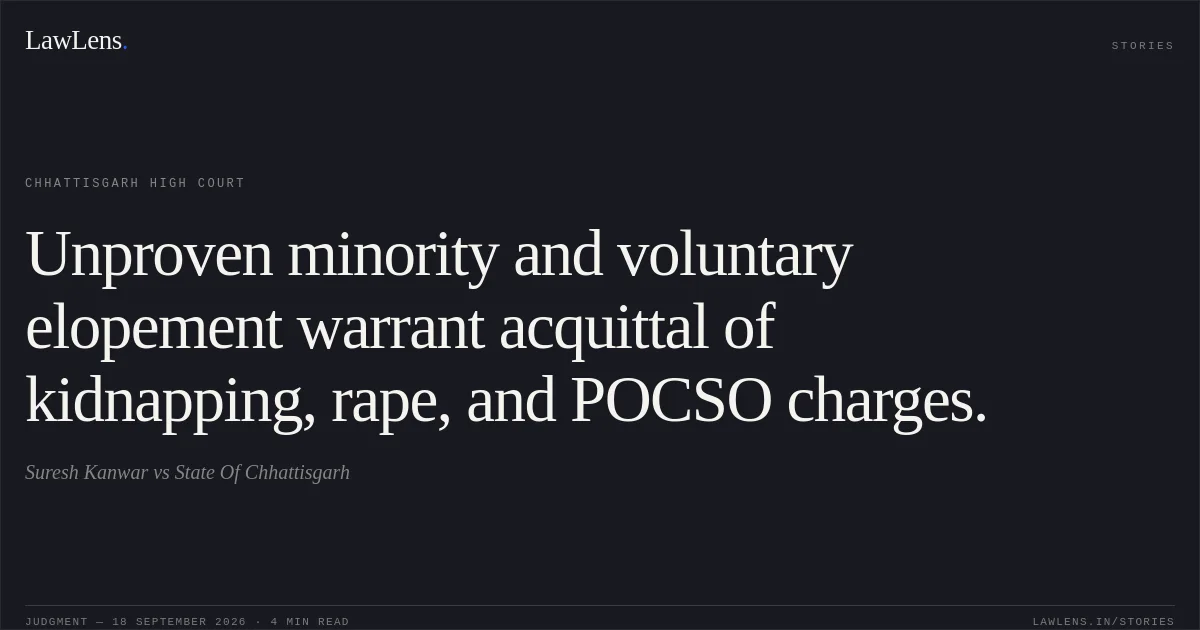
The Court held that the prosecution failed to prove that the victim was below 18 years of age and also failed to establish kidnapping, procuration or rape beyond reasonable doubt.
The appeal was allowed, the conviction and sentences under Sections 363, 366 and 376 IPC and Section 6 of the POCSO Act were set aside, and the appellant was acquitted of all charges.
Source reference: p.15; para. 26As the appellant was on bail, his bail bonds were directed to continue for a further period of six months under Section 481 of the BNSS, 2023.
Source reference: p.15; para. 27Acts & Sections Cited
12 provisions across 5 statutes referred to in this judgment. Each provision opens on LawLens.
Code of Criminal Procedure, 19734
Indian Penal Code, 18603
Juvenile Justice (Care and Protection of Children) Act, 2015.1
Bharatiya Nagarik Suraksha Sanhita, 20231
Original Court PDF
Suresh KanwarvsState Of Chhattisgarh
Click to open original judgment
Original judgment, available to read, download and summarize on LawLens.in