Facts
The appellant was prosecuted in Special (POCSO) Case No. 142/2019 for allegedly taking the informant’s minor daughter to Delhi, confining her there, and sexually exploiting her.
Source reference: pp. 3, 9–10; paras. 3–5, 27, 30The FIR was lodged on 8 May 2019, approximately seven months after the alleged occurrence, under Sections 365 and 376 IPC read with Section 8 of the POCSO Act; the charge-sheet was ultimately filed under Sections 365/376 IPC read with Section 4 of the POCSO Act.
Source reference: pp. 3, 9–10; paras. 3–5, 27, 30The victim’s father alleged that she was about 14 years old when she went missing.
Source reference: pp. 7–8; para. 23The victim, however, testified that she was in a relationship with the appellant, went with him to Delhi, stayed with him for six or seven months, and thereafter continued to stay with him for approximately four months after their return to Assam.
Source reference: pp. 7–8; para. 23The medical evidence indicated previous sexual intercourse, with no recent injuries, and assessed her age as above 16 and below 18 years at the time of examination.
Source reference: p. 8; para. 26No birth certificate, school certificate, or other documentary proof of age was produced.
Source reference: pp. 9–11; paras. 27, 32–36The Trial Court convicted the appellant under Section 4 of the POCSO Act and Section 363 IPC, sentencing him to seven years’ rigorous imprisonment with fine under Section 4 and two years’ rigorous imprisonment under Section 363 IPC.
Source reference: pp. 2–4; paras. 2, 8The appellant challenged the conviction under Section 374(2) CrPC.
Source reference: p. 3; para. 2Issues
Whether the prosecution proved beyond reasonable doubt that the victim was below 18 years of age at the time of the alleged occurrence, so as to attract the POCSO Act?
Source reference: pp. 10–12; paras. 32–36Whether the evidence established that the appellant kidnapped or forcibly confined the victim and had forcible sexual intercourse with her, thereby proving the offences under the IPC and Section 4 of the POCSO Act?
Source reference: pp. 9–12; paras. 28–31, 37–38Whether the conviction and sentences imposed by the Trial Court required interference in appeal?
Source reference: pp. 3–5, 12; paras. 2, 8–15, 39–40Law Applied
The Court exercised appellate jurisdiction under Section 374(2) CrPC and examined the convictions under Section 4 of the POCSO Act and Section 363 IPC.
Source reference: p. 3; para. 2Section 4 of the POCSO Act applies where penetrative sexual assault is committed against a “child”, requiring proof that the victim was below 18 years of age at the relevant time.
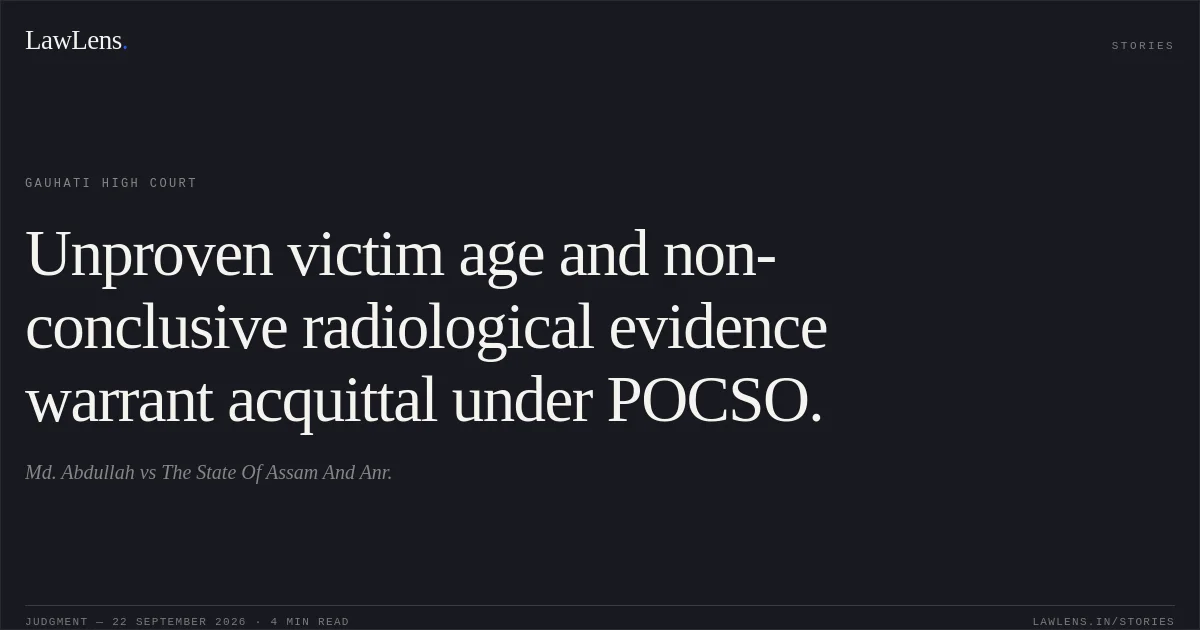
Source reference: no citationIn the absence of a birth certificate, school certificate, or matriculation certificate, medical or radiological evidence may be considered for age determination, but such evidence is not conclusive and carries a margin of error of approximately two years; the benefit of reasonable doubt regarding age must go to the accused.
Source reference: pp. 10–12; paras. 33–36The Court also relied on Shiva Chautal v. State of Assam, Crl.A.(J) No. 24/2021, decided on 8 August 2023, for the proposition that ossification or other medical age assessment is only a guiding factor and is not incontrovertible.
Source reference: p. 5; para. 13Although the testimony of a prosecutrix may by itself sustain a conviction if wholly reliable, the Court held that the evidence must establish the essential ingredients of the charged offences.
Source reference: pp. 6–10; paras. 17, 20, 28–31Reasoning
The Court found that the prosecution failed to establish either the victim’s minority or forcible conduct beyond reasonable doubt.
Source reference: no citationThe prosecution produced no documentary proof of age, while the medical assessment placed the victim between 16 and 18 years, subject to the recognised margin of error; consequently, the Court held that she could not conclusively be treated as a child at the time of the occurrence.
Source reference: pp. 10–12; paras. 32–36On the allegation of kidnapping and forcible sexual assault, the victim’s own testimony indicated that she had a relationship with the appellant, voluntarily accompanied him to Delhi, remained with him there for six or seven months, returned with him, and continued living with him for a further four months without making any complaint or attempting to leave.
Source reference: pp. 7–8, 9–11; paras. 23, 30–31, 37Although the medical evidence established prior sexual intercourse, it did not establish recent or forcible intercourse, and no injuries were found.
Source reference: p. 8; para. 26The Court therefore concluded that the prosecution had not proved kidnapping, confinement, forcible sexual intercourse, or the victim’s status as a child under the POCSO Act.
Source reference: pp. 10–12; paras. 31, 38–39Holding
The High Court held that the prosecution failed to prove the charges under Section 4 of the POCSO Act and Section 363 IPC beyond reasonable doubt.
The judgment of conviction and order of sentence dated 29 February 2024 were accordingly set aside and quashed.
Source reference: p. 12; para. 39The appeal was allowed, and the appellant was acquitted and directed to be released forthwith unless required in another case; the jail authorities were directed to take necessary action and the Trial Court Record was ordered to be returned.
Source reference: p. 12; paras. 40–42Acts & Sections Cited
9 provisions across 3 statutes referred to in this judgment. Each provision opens on LawLens.
Code of Criminal Procedure, 19733
Indian Penal Code, 18603
Original Court PDF
Md. AbdullahvsThe State Of Assam And Anr.
Click to open original judgment
Original judgment, available to read, download and summarize on LawLens.in