Facts
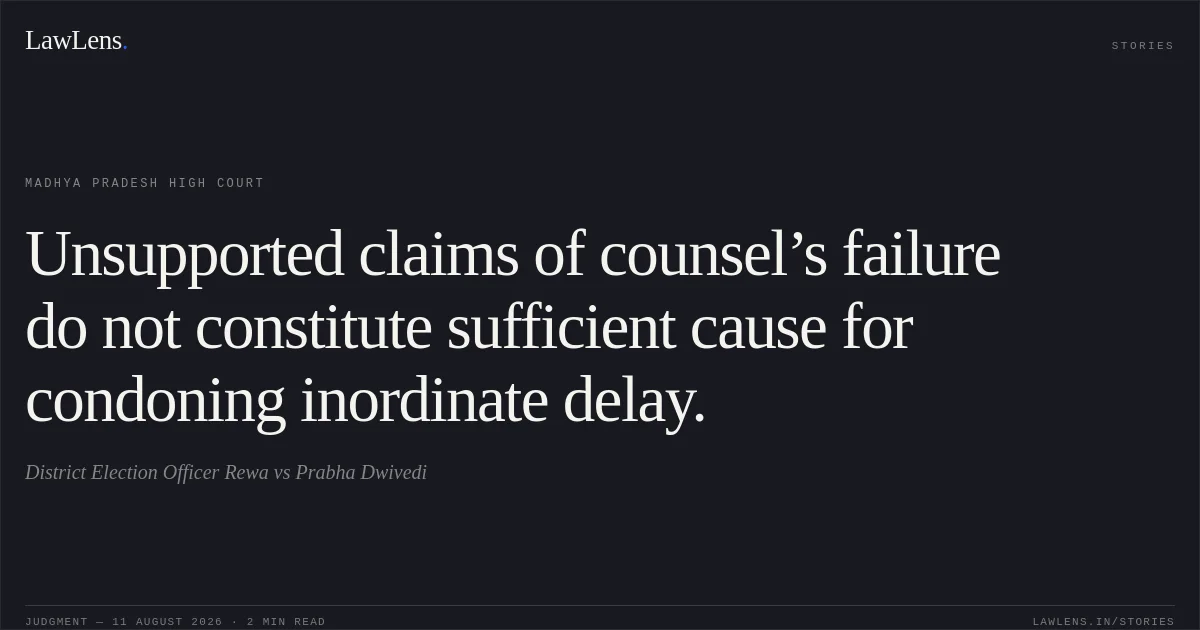
The appellant, District Election Officer, Rewa, filed a miscellaneous appeal challenging an award after a delay of approximately 1,737 days.
Source reference: no citationThe appellant contended that its local counsel had not informed it about the award and that it believed the proceedings were still pending before the Tribunal.
Source reference: para. 2It claimed to have learned of the award only upon receiving notice in execution proceedings in May 2022, after which it promptly applied for a certified copy and filed the appeal.
Source reference: para. 2The respondents opposed condonation, submitting that the delay was approximately five years and had not been properly explained.
Source reference: para. 3The High Court considered the application for condonation of delay, I.A. No. 9373/2022.
Source reference: para. 1Issues
Whether the appellant had established sufficient cause for condoning the delay of approximately 1,737 days in filing the miscellaneous appeal?
Source reference: paras. 2–5Whether the appeal should be dismissed where the delay was attributable to the alleged failure of the appellant’s counsel to communicate the award, without supporting material or explanation for the appellant’s prolonged inaction?
Source reference: paras. 5–8Law Applied
An inordinate delay may be condoned only when the applicant establishes “sufficient cause” through a reasonable and adequately supported explanation.
Source reference: no citationThe Court relied on Pundlik Jalam Patil v. Executive Engineer, Jalgaon Medium Project, (2008) 17 SCC 448, which holds that courts should not entertain belated and stale claims merely on grounds of equity; “delay defeats equity,” and the law assists those who are vigilant rather than those who sleep over their rights.
Source reference: para. 6The Court also relied on Majji Sannemma @ Sanyasirao v. Reddy Sridevi, AIR 2022 SC 332, and Shivamma (dead) by LRs v. Karnataka Housing Board, Civil Appeal No. 11794/2025, wherein the Supreme Court held that administrative lethargy and laxity do not constitute sufficient cause, particularly when the applicant is a State authority; courts must not legitimise governmental inaction or become surrogates for State laxity.
Source reference: paras. 6–7Reasoning
The Court found that the appellant merely asserted that its lawyer had failed to inform it about the award, but produced no document or other material substantiating that assertion.
Source reference: para. 5It also failed to explain why it did not make any inquiry regarding the status of the case for nearly five years.
Source reference: para. 5Applying the principles that limitation promotes finality and that State authorities must demonstrate bona fide and vigilant conduct, the Court held that the explanation did not constitute sufficient cause for condoning the delay of 1,737 days.
Source reference: paras. 6–8The alleged communication lapse by counsel, unsupported by evidence and accompanied by prolonged inaction, was therefore insufficient to justify reopening the matter.
Source reference: no citationHolding
The High Court held that the appellant had failed to provide a reasonable or proper explanation for the delay of approximately 1,737 days.
Accordingly, I.A. No. 9373/2022 seeking condonation of delay was dismissed, and, consequently, the miscellaneous appeal was also dismissed.
Source reference: paras. 8–9Acts & Sections Cited
1 provisions across 1 statute referred to in this judgment. Each provision opens on LawLens.
Code of Civil Procedure, 19081
Original Court PDF
District Election Officer RewavsPrabha Dwivedi
Click to open original judgment
Original judgment, available to read, download and summarize on LawLens.in