01Facts
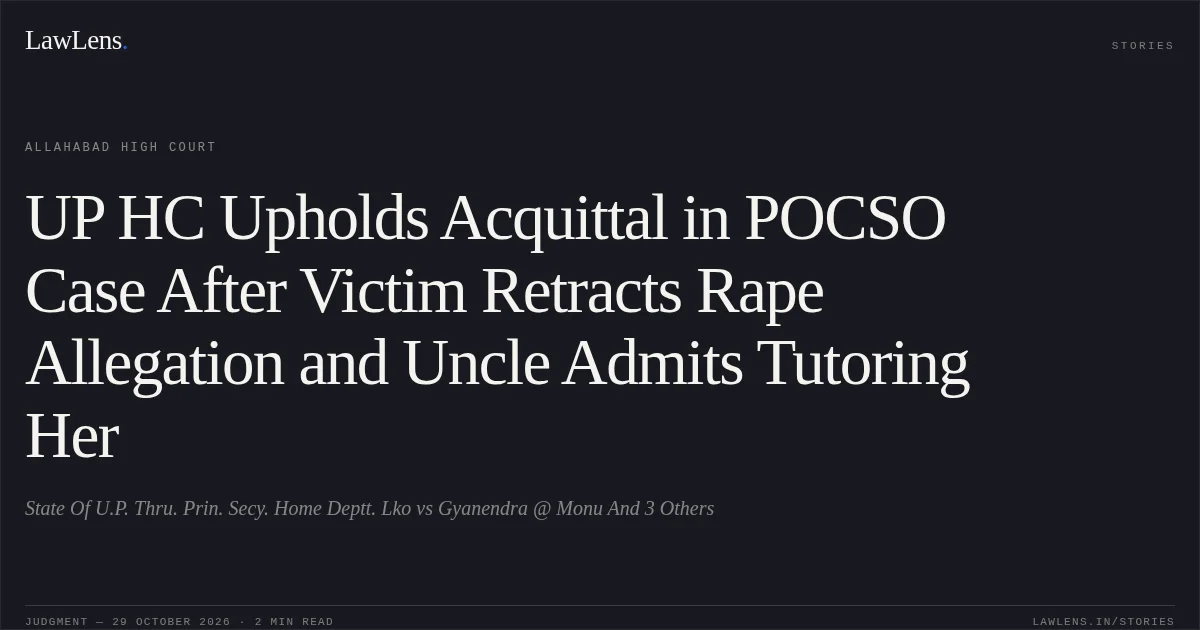
The State appealed the acquittal of the respondents in Sessions Trial No. 199 of 2017, arising from charges under Sections 341, 504, 506 and 376 IPC, Sections 3/4 of the POCSO Act, and Section 3(2)(v) of the SC/ST (Prevention of Atrocities) Act.
¶ 2The prosecution alleged that the victim was accosted while returning from school and that the accused attempted to take her to an orchard; she later made a statement under Section 164 CrPC alleging rape.
¶ 13–15At trial, the victim’s maternal uncle (PW-1) said he had tutored her and that the FIR arose from a dispute with the accused.
¶ 16–18The victim (PW-2) testified that her bicycle had collided with the accused’s motorcycle, that he had not misbehaved with her, and that her earlier statement was made out of fear.
¶ 16–18The trial court acquitted the accused; the State’s appeal was dismissed summarily.
¶ 2, 2602Issues
i.Whether the trial court’s acquittal was perverse, illegal, or otherwise based on an unsustainable assessment of the evidence so as to warrant appellate interference
¶ 10–12, 19–23ii.Whether the prosecution evidence established the charged offences beyond reasonable doubt despite the testimony of PW-1 and the victim’s retraction at trial
¶ 16–2203Law Applied
Under Section 378 CrPC, an appellate court may review and reappreciate the evidence in an appeal against acquittal, but must give due weight to the trial court’s assessment and the strengthened presumption of innocence following acquittal; where two reasonable views are possible, the acquittal should not be disturbed absent perversity, material misreading of evidence, or other compelling grounds (Chandrappa v. State of Karnataka; Babu v. State of Kerala; Jayamma v. State of Karnataka; Ramesh Babulal Doshi v. State of Gujarat; Dhanapal v. State by Public Prosecutor, Madras).
¶ 4–9, 24The prosecution was required to establish the charges beyond reasonable doubt.
¶ 22Provisions in the judgment · 9 · Linked ones open on LawLens
Indian Penal Code, 1860 Section 341Section 504Section 506Section 376
Protection of Children from Sexual Offences Act, 2012 Section 3Section 4
Scheduled Castes and the Scheduled Tribes (Prevention of Atrocities) Act, 1989 Section 3
Code of Criminal Procedure, 1973 Section 378Section 164
04Reasoning
The High Court found no reliable evidence requiring reversal of the acquittal.
PW-1’s evidence undermined the prosecution account: he admitted tutoring the victim, described the FIR as arising from a prior dispute, and contradicted the allegation that she had been cycling to school.
¶ 16, 18, 20The victim did not support the essential allegations at trial and instead described an accidental collision and argument, denied wrongdoing by the accused, and explained her earlier statement as having been made out of fear.
¶ 17, 21In light of this evidence, the trial court’s view was at least a reasonable one and was neither perverse nor legally unsustainable.
¶ 22–2505Holding
The High Court held that no ground for appellate interference with the acquittal had been made out.
¶ 25–27It dismissed the State’s appeal summarily and directed that the trial-court record, if any, be returned in accordance with the rules.
¶ 25–27Original Court PDF
State Of U.P. Thru. Prin. Secy. Home Deptt. LkovsGyanendra @ Monu And 3 Others
Click to open original judgment
Original judgment, available to read, download and summarize on LawLens.in