01Facts
The parties married on 14 July 2021.
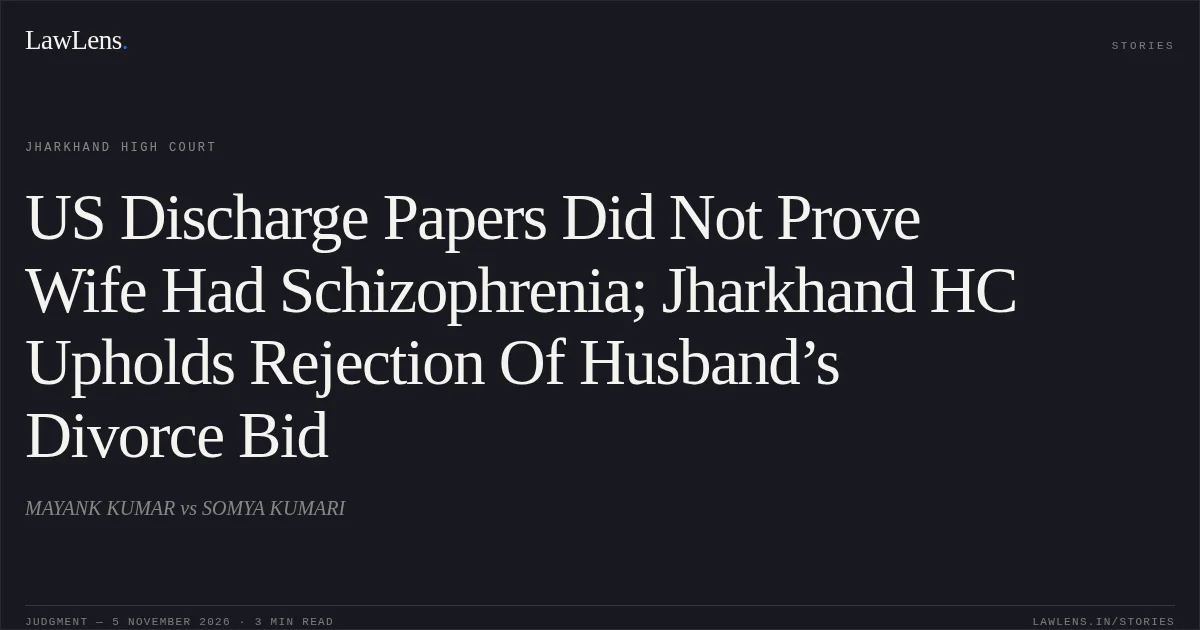
¶ 1–7The husband filed a petition under Sections 13(1)(ia) and 13(1)(iii) of the Hindu Marriage Act, 1955, alleging cruelty and that the wife suffered from a serious mental disorder, including paranoid schizophrenia.
¶ 1–7The wife denied the allegations and sought to continue the marriage.
¶ 1–7The Family Court dismissed the petition, finding neither ground proved; the husband appealed under Section 19(1) of the Family Courts Act, 1984.
¶ 1–7In appeal, the High Court reviewed the pleadings, testimony and documentary evidence, including the husband’s admission that the hospital discharge papers recorded “Altered Mental Status Unspecified,” not schizophrenia, and that he had produced no medical certificate or treating doctor’s records.
¶ 11, 17–18, 82–8402Issues
i.1. Whether the husband proved cruelty under Section 13(1)(ia) of the Hindu Marriage Act warranting dissolution of the marriage.
¶ 12–14, 47ii.2. Whether the wife was incurably of unsound mind, or suffered from a mental disorder of such kind and extent that the husband could not reasonably be expected to live with her, under Section 13(1)(iii).
¶ 12–14, 4703Law Applied
Section 19(1) of the Family Courts Act permits an appeal to the High Court on facts and law, with the appellate court empowered to reappraise the evidence.
¶ 38–41Under Section 13(1)(ia) of the Hindu Marriage Act, cruelty is assessed contextually and must be conduct sufficiently grave to make continued cohabitation unreasonable; ordinary marital friction is insufficient.
¶ 48–57The Court relied on Dr. N.G. Dastane v. S. Dastane for the reasonable-apprehension test and Joydeep Majumdar v. Bharti Jaiswal Majumdar for the requirement of grave and weighty conduct.
¶ 48–57Under Section 13(1)(iii), the petitioner must prove incurable unsoundness of mind or a mental disorder of such kind and degree that cohabitation cannot reasonably be expected; the mere existence of a mental abnormality is insufficient.
¶ 71–80The Court applied Kollam Chandra Sekhar v. Kollam Padma Latha and the principle in Ram Narain Gupta v. Rameshwari Gupta that the disorder’s degree and effect on married life must be established.
¶ 71–80Matrimonial proceedings are decided on the balance of probabilities, and expert medical evidence may be assessed alongside other evidence.
¶ 65, 77Provisions in the judgment · 4 · Linked ones open on LawLens
Family Courts Act, 1984 Section 19Section 7
Hindu Marriage Act, 1955 Section 13
Code of Civil Procedure, 1908 Section 96
04Reasoning
The alleged knife attacks, suicide attempts and violent conduct were unsupported by independent witnesses, medical records, police reports or contemporaneous documents; the husband’s witness had not seen the incidents and relied on what he had heard.
¶ 66, 68The parties’ continued contact, cohabitation and travel to the United States with the husband’s consent also did not support the allegation of cruelty of a degree making the marriage untenable.
¶ 67On mental disorder, the husband produced no expert evidence or treating-doctor records, and the discharge papers did not diagnose schizophrenia.
¶ 82–85The witness evidence did not establish either a longstanding illness or a disorder of sufficient severity to make cohabitation unreasonable.
¶ 82–85The High Court therefore found no basis to disturb the Family Court’s assessment.
¶ 86–9005Holding
The High Court held that the husband failed to prove cruelty under Section 13(1)(ia) or the statutory ground of incurable unsoundness of mind or qualifying mental disorder under Section 13(1)(iii).
¶ 87–92It found no perversity or other error warranting appellate interference, affirmed the Family Court’s judgment and decree, and dismissed the appeal; pending interlocutory applications were disposed of.
¶ 87–92Original Court PDF
MAYANK KUMARvsSOMYA KUMARI
Click to open original judgment
Original judgment, available to read, download and summarize on LawLens.in