01Facts
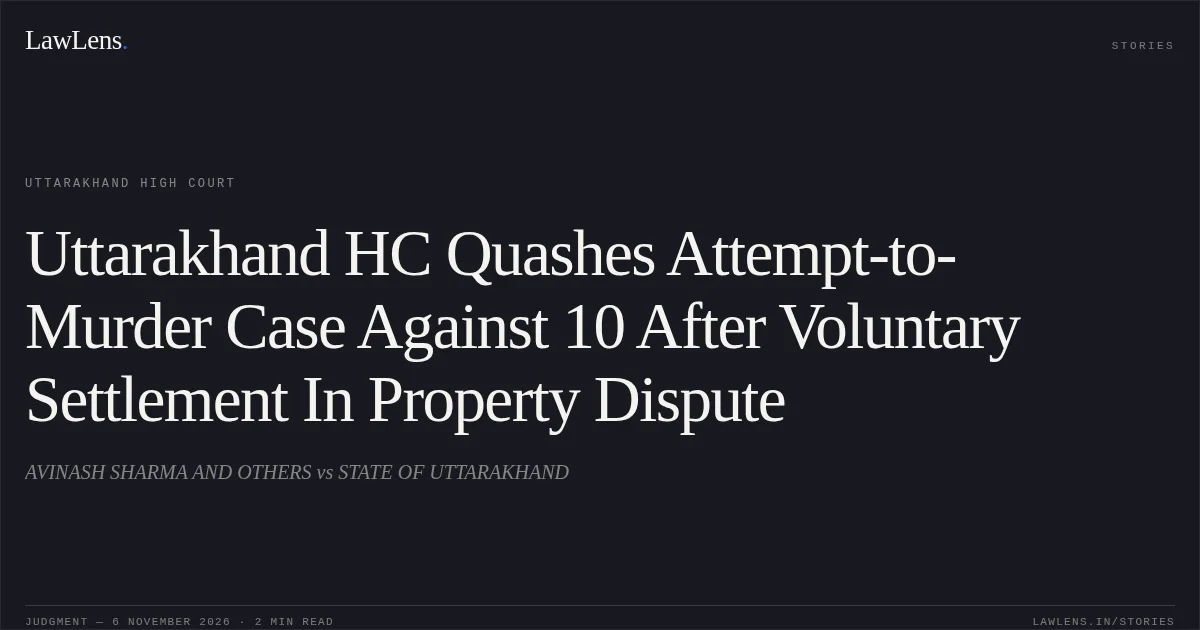
The applicants challenged the charge-sheet, cognizance/summoning order and ensuing criminal proceedings arising from an FIR alleging that they and others fired shots, forcibly entered the complainant’s home, assaulted family members, took cash and jewellery, and issued threats.
¶ 4–9The case included charges under Sections 147, 148, 149, 307, 384, 449, 504 and 506 IPC.
¶ 4–9The applicants and complainant, who lived in the same locality, said the dispute arose from a property-related disagreement and had been amicably settled.
¶ 4–9The complainant confirmed the settlement before the Court and stated that he did not wish to pursue the prosecution.
¶ 4–9The State opposed quashing on the ground that the offences were non-compoundable.
¶ 4–902Issues
i.Whether the High Court could quash proceedings for non-compoundable offences under Section 528 BNSS on the basis of a compromise between the parties.
¶ 12–14ii.Whether, in light of the nature and circumstances of the dispute and the complainant’s position, continuing the proceedings would serve a useful purpose or amount to an abuse of process.
¶ 11, 14–1503Law Applied
Section 528 of the Bharatiya Nagarik Suraksha Sanhita, 2023 preserves the High Court’s inherent jurisdiction to quash proceedings to secure the ends of justice or prevent abuse of process; that jurisdiction is distinct from the statutory power to compound offences under Section 320 CrPC.
¶ 12–14Under Gian Singh v. State of Punjab, (2012) 10 SCC 303, and Narinder Singh v. State of Punjab, (2014) 6 SCC 466, proceedings involving non-compoundable offences may be quashed where a genuine and voluntary settlement resolves a predominantly private or personal dispute, subject to consideration of the offences’ nature and gravity and their impact on society.
¶ 12–14A compromise alone does not justify quashing serious offences.
¶ 12–14Provisions in the judgment · 10 · Linked ones open on LawLens
Indian Penal Code, 1860 Section 147Section 148Section 149Section 307Section 384Section 449Section 504Section 506
Bharatiya Nagarik Suraksha Sanhita, 2023 Section 528
Code of Criminal Procedure, 1973 Section 320
04Reasoning
The Court found that the dispute arose from a property-related conflict between parties from the same locality and that their settlement, supported by affidavits and confirmed by the complainant in Court, was voluntary and genuine.
¶ 11Although the allegations included serious offences under Sections 307, 384 and 449 IPC, the Court considered the overall circumstances and concluded that, in this case, continuation of the prosecution would serve no useful purpose. It therefore found that quashing would secure the ends of justice and prevent abuse of process.
¶ 14–1505Holding
The Court allowed the joint compounding application and exercised its inherent jurisdiction under Section 528 BNSS.
¶ 16–17It quashed the charge-sheet, cognizance/summoning order and consequential proceedings in Sessions Trial No. 24 of 2023 qua the applicants; the C-528 application was allowed accordingly.
¶ 16–17Original Court PDF
AVINASH SHARMA AND OTHERSvsSTATE OF UTTARAKHAND
Click to open original judgment
Original judgment, available to read, download and summarize on LawLens.in