Facts
The marriage between petitioner no. 1 and opposite party no. 2 was solemnized under the Special Marriage Act on 11 November 2019, followed by a Hindu ceremony on 11 December 2019. The wife alleged dowry demands, cruelty, assault during pregnancy resulting in medical termination, and an attempt to suffocate her; she left the matrimonial home on 11 June 2020 and lodged an FIR on 4 July 2020
Source reference: paras. 2–3The police filed a charge-sheet under Sections 498A, 325, 406 and 506 read with Section 34 IPC and Sections 3 and 4 of the Dowry Prohibition Act; charges were framed and trial commenced
Source reference: para. 3The husband and his relatives sought quashing under Section 482 CrPC, relying, among other matters, on the alleged vagueness of the accusations against relatives, the husband’s medical records, and discrepancies in the wife’s financial claims
Source reference: paras. 1, 4Issues
1. Whether the FIR and charge-sheet, taken at face value, disclosed the essential ingredients of the alleged offences, particularly against the husband’s relatives in light of the assertedly vague and omnibus allegations
Source reference: paras. 6, 82. Whether the husband’s medical records relating to his illness and hospitalisation undermined the prosecution’s account of physical assault
Source reference: paras. 6, 93. Whether continuation of the criminal proceedings amounted to an abuse of process warranting quashing under Section 482 CrPC
Source reference: paras. 6, 10Law Applied
Section 482 CrPC (corresponding to Section 528 of the BNSS, as identified in the judgment) confers inherent power to quash proceedings to prevent abuse of process or secure the ends of justice
Source reference: para. 1Under State of Haryana v. Bhajan Lal, proceedings may be quashed, illustratively, where the allegations do not prima facie constitute an offence or where they are manifestly mala fide and instituted with an ulterior motive
Source reference: para. 7Geeta Mehrotra v. State of Uttar Pradesh was cited for the principle that casual references to family members, without specific and distinct allegations, do not by themselves justify prosecution under Section 498A IPC
Source reference: para. 7Preeti Gupta v. State of Jharkhand was cited regarding the risk of exaggerated matrimonial complaints and the injustice of implicating relatives without specific allegations
Source reference: para. 8Reasoning
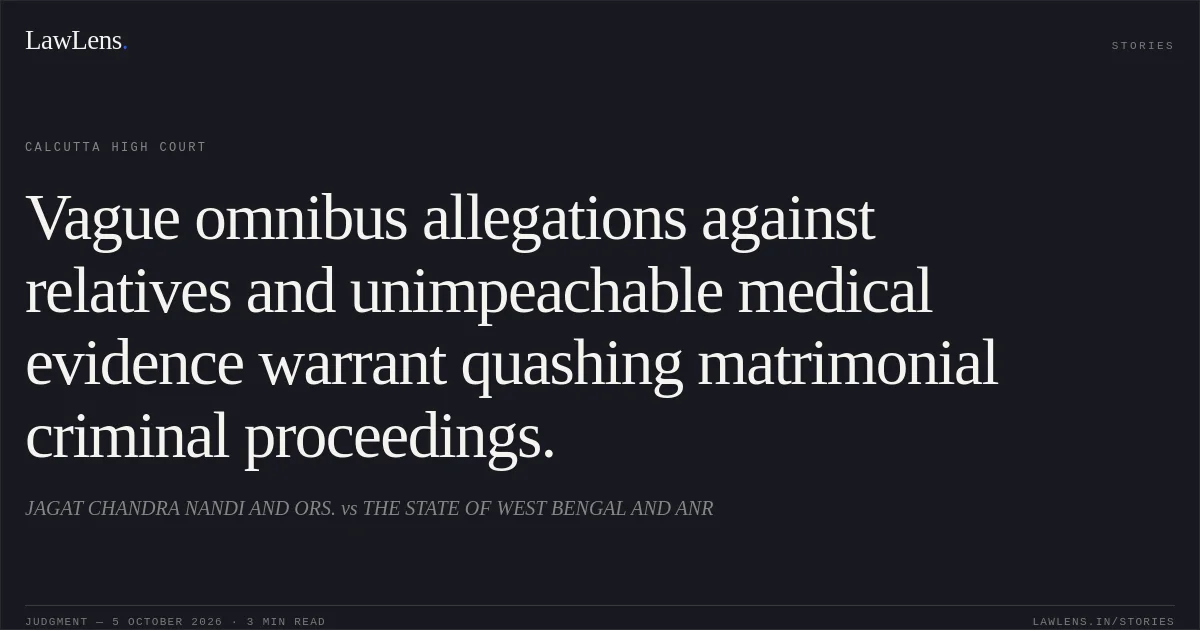
The Court considered the allegations against petitioners nos. 2 to 5 to be general and lacking specific acts, dates or times, and concluded that they did not prima facie satisfy the ingredients of the charged offences as against those relatives
Source reference: para. 8It treated the husband’s medical records as unimpeachable evidence of serious illness and hospitalisation and held that they undermined the allegation that he had inflicted the described physical violence
Source reference: para. 9The Court also relied on the asserted discrepancy between the financial claims and the 23-day interval between the wife’s departure and the FIR to infer that the proceedings were retaliatory and intended to exert pressure
Source reference: para. 10On that basis, it found continuation of the prosecution to be an abuse of process
Source reference: paras. 10–11Holding
The Court answered the first issue against the prosecution and the second and third issues in favour of the petitioners
It allowed the application and quashed the entire proceeding arising from Arambagh Women Police Station Case No. 40 of 2020, corresponding to G.R. No. 648 of 2020, as against all petitioners
Source reference: paras. 11–12Connected applications were disposed of, any interim order was vacated, and no order as to costs was made
Source reference: paras. 13–15Acts & Sections Cited
10 provisions across 4 statutes referred to in this judgment. Each provision opens on LawLens.
Code of Criminal Procedure, 19731
Bharatiya Nagarik Suraksha Sanhita, 20231
Indian Penal Code, 18606
Original Court PDF
JAGAT CHANDRA NANDI AND ORS.vsTHE STATE OF WEST BENGAL AND ANR
Click to open original judgment
Original judgment, available to read, download and summarize on LawLens.in