Facts
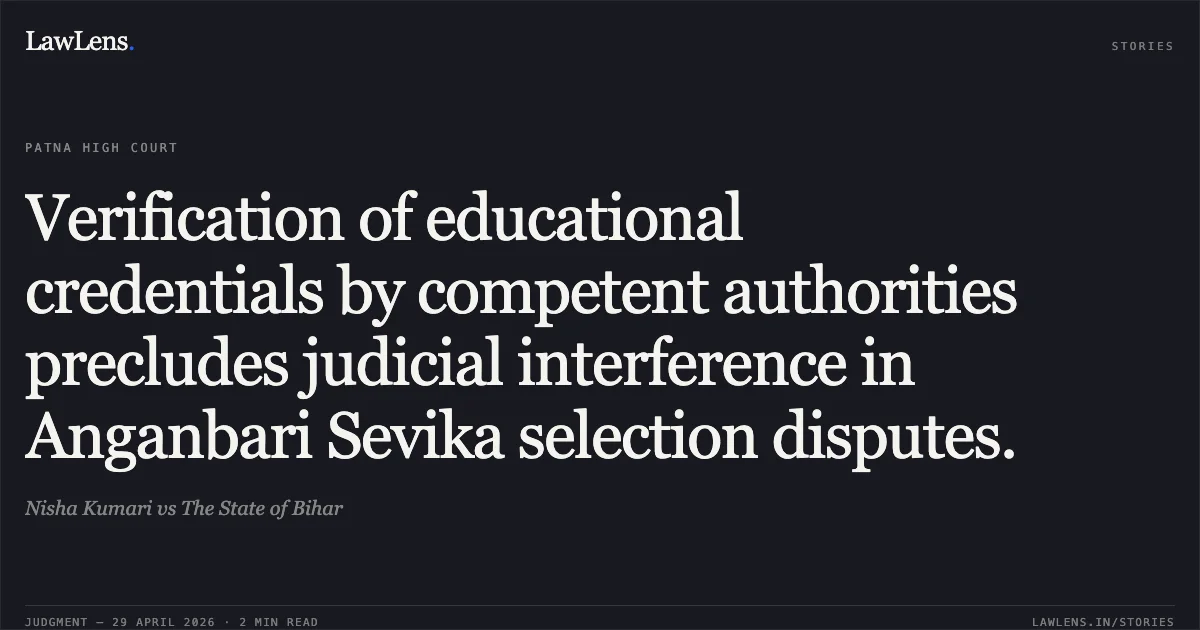
The petitioner challenged the selection of Respondent No. 5 as an Anganbari Sevika at Centre No. 230, Samastipur, alleging that Respondent No. 5 relied on a fake educational certificate.
Source reference: para. 2-3This matter reached the High Court previously in CWJC No. 6711 of 2020, where the Court directed the Collector, Samastipur, to pass a reasoned order after hearing both parties.
Source reference: para. 4Consequently, the Collector conducted an inquiry and passed an order dated 24.06.2023 in Anganbari Appeal Case No. 47 of 2017, upholding the selection.
Source reference: para. 5The petitioner filed the present writ seeking certiorari to quash the appellate and original orders.
Source reference: para. 2Issues
1. Whether the selection of Respondent No. 5 was vitiated by the use of a fraudulent educational certificate
Source reference: para. 32. Whether the appellate order passed by the Collector, Samastipur, suffered from perversity or lack of due process
Source reference: para. 3-5Law Applied
The Court applied the principles of administrative law regarding the scope of judicial review under Article 226 of the Constitution of India, focusing on whether a "reasoned and speaking order" was passed in accordance with law.
Source reference: para. 4It relied on the evidentiary value of verification reports issued by statutory bodies—specifically the Bihar Sanskrit Shiksha Board—as the conclusive authority for validating educational credentials.
Source reference: para. 5Reasoning
The Court examined the reasoning assigned by the Collector in the impugned order.
Source reference: para. 5It noted that the Child Development Project Officer (CDPO) had referred the educational marksheet of Respondent No. 5 to the Examination Controller of the Bihar Sanskrit Shiksha Board, Patna, for verification.
Source reference: para. 5The Board’s verification report (Letter No. 5269 dated 24.11.2008) confirmed that the respondent’s marks and first-class division were genuine.
Source reference: para. 5The Court observed that since the competent authority had conducted a factual inquiry, called for official reports, and verified the documents through the concerned Board, the petitioner's claim of the certificate being "fake" was factually unsubstantiated.
Source reference: para. 6Consequently, the Court found that the appellate authority had complied with previous judicial directions by passing a substantive, evidence-based order.
Source reference: para. 6Holding
The Court held that the Collector’s findings were based on solid evidence and verification from the relevant educational board, leaving no room for judicial interference.
The direct answer to the issues is that the certificate was genuine and the appellate process was legally sound. The writ petition was dismissed.
Source reference: para. 8Acts & Sections Cited
1 provisions across 1 statute referred to in this judgment. Linked provisions open on LawLens.
Johannesburg Declaration On Sustainable Development1
Original Court PDF
Nisha KumarivsThe State of Bihar
Click to open original judgment
Original judgment, available to read, download and summarize on LawLens.in