Facts
The Petitioner, a landlord, was accused of involvement in a land transaction fraud. The Informant (a tenant of the Petitioner) alleged that he paid Rs. 9,50,000 in cash to a co-accused, Dr. Bhagirath Chowdhary, at the Petitioner’s residence for the purchase of land
Source reference: p. 2-3When the land was found to be disputed, the co-accused issued a cheque for repayment which was subsequently dishonored
Source reference: p. 3Following a police investigation, a charge-sheet was filed against the co-accused, but the Petitioner was found innocent and a closure report was submitted in his favor
Source reference: p. 4However, the Chief Judicial Magistrate, Muzaffarpur, rejected the police finding and took cognizance against the Petitioner for offenses under Sections 120-B, 420, and 406 of the IPC
Source reference: p. 1-2The Petitioner moved the High Court seeking quashing of the cognizance order.
Source reference: p. 1-2Issues
1. Whether the Magistrate’s order taking cognizance against the Petitioner was mechanical and lacked judicial application of mind
Source reference: p. 1-22. Whether the criminal proceedings against the Petitioner constitute an abuse of the process of law when no prima facie role was attributed to him in the dishonor of the cheque or the transaction
Source reference: p. 6, 8-9Law Applied
The court primarily applied the inherent powers under Section 482 of the CrPC to prevent the abuse of the process of any court.
Source reference: no citationIt relied on the landmark precedent of State of Haryana v. Bhajan Lal [1992 Supp. (1) SCC 335], specifically categories (1), (3), and (7), which mandate quashing of proceedings where allegations/evidence do not disclose an offense or where the proceeding is maliciously instituted with an ulterior motive
Source reference: p. 6-8It further considered the specific liabilities under Section 138 of the Negotiable Instruments Act, noting that liability primarily rests on the drawer of the cheque
Source reference: p. 4-5Reasoning
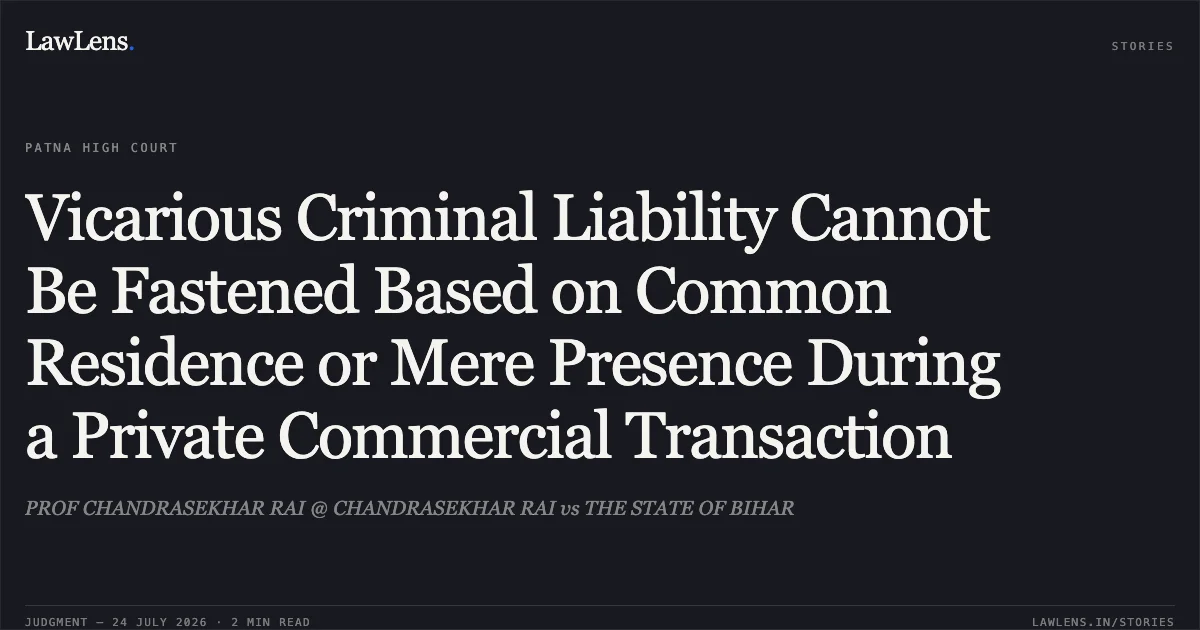
The court observed that the dispute was essentially related to a land deal between the Informant and the co-accused, Dr. Bhagirath Chowdhary. The only link to the Petitioner was that the deal was negotiated at his house because the Informant was his tenant
Source reference: p. 4-5The court noted that the cheque in question was issued solely by the co-accused, who had since passed away, and no criminal liability could be extended to the Petitioner simply for being a mutual acquaintance or the landlord
Source reference: p. 5, 8-9The court found that the Magistrate took cognizance in a non-speaking manner, ignoring the police's final report which exonerated the Petitioner
Source reference: p. 8Applying the Bhajan Lal principles, the court reasoned that allowing the prosecution to continue against the Petitioner would be a manifest injustice as the allegations, even if accepted at face value, failed to constitute a prima facie case of conspiracy (120-B), cheating (420), or criminal breach of trust (406) against him
Source reference: p. 9Holding
The court held that the materials on record suggested no criminal liability against the Petitioner, as he was neither the drawer of the dishonored cheque nor a direct beneficiary of the land transaction
The court allowed the application and quashed the cognizance order dated 18.07.2016 and all consequential proceedings against the Petitioner. The court directed that the judgment be communicated to the trial court forthwith
Source reference: p. 9Acts & Sections Cited
6 provisions across 3 statutes referred to in this judgment. Each provision opens on LawLens.
Indian Penal Code, 18602
Negotiable Instruments Act, 18811
Code of Criminal Procedure, 19733
Original Court PDF
PROF CHANDRASEKHAR RAI @ CHANDRASEKHAR RAIvsTHE STATE OF BIHAR
Click to open original judgment
Original judgment, available to read, download and summarize on LawLens.in