Facts
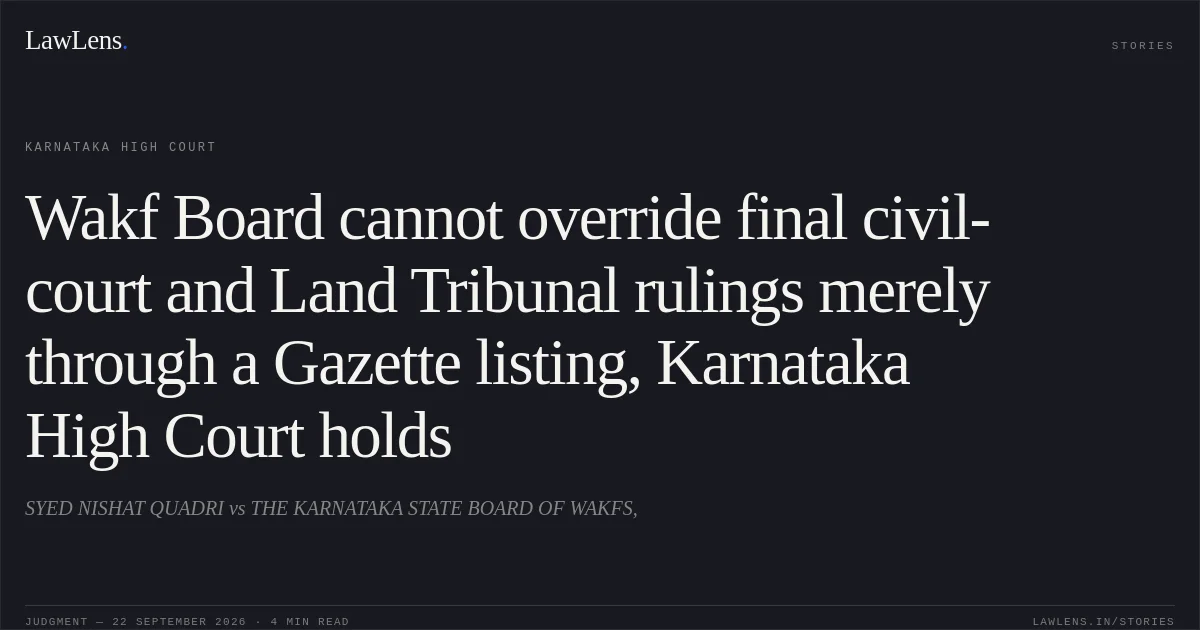
The petitioners challenged the order dated 12 January 2016 by which the Wakf authorities appointed an Administrator for Dargah Hazarath Syed Noorulla Shah Khadri at Kamalapur, including land bearing Survey No.164 measuring 4.62 acres.
Source reference: para. 1The petitioners claimed that the Dargah and its properties formed part of a private family endowment and that the lands were personal inams granted to their ancestors, subject to an obligation to perform religious service.
Source reference: paras. 2–6In O.S. No.10/1960, instituted by predecessors of the private respondents, the District Court held after trial that the grant was a “personal inam burdened…with service,” and that the properties were neither Wakf nor trust properties.
Source reference: paras. 8–16The suit was dismissed, and the appeal in RFA No.106/1970 was dismissed for non-prosecution; the decree was not set aside.
Source reference: paras. 18–19Subsequently, under the Karnataka Certain Inams Abolition Act, 1977, the Land Tribunal granted occupancy rights over the relevant lands to the petitioners’ ancestors by order dated 23 December 1981.
Source reference: para. 7Despite these adjudications, the Wakf authorities relied on a Gazette notification and appointed an Administrator.
Source reference: para. 20Issues
1. Whether the judgment and decree in O.S. No.10/1960 could be disregarded merely because the Wakf Board was not formally impleaded, particularly when it had knowledge of the litigation.
Source reference: para. 34(i)2. Whether Section 57(3) of the Wakf Act, 1954 rendered the decree in O.S. No.10/1960 void.
Source reference: para. 34(ii)3. Whether Section 55-C of the Wakf Act, introduced in 1984, could retrospectively divest the Civil Court of jurisdiction over a suit instituted and decided before its enactment.
Source reference: para. 34(iii)4. Whether the Gazette notification could override the prior civil-court adjudication and the subsequent statutory proceedings under the Karnataka Certain Inams Abolition Act, 1977.
Source reference: para. 34(iv)5. Whether the original grant was a personal inam burdened by service, rather than a dedication of the property to the Dargah as Wakf property.
Source reference: para. 34(v)6. What was the legal effect of abolition of the inam and the subsequent grant of occupancy rights by the Land Tribunal.
Source reference: para. 34(vi)7. Whether the principles stated in W.P. No.103351/2022, following W.A. No.5591/2011 c/w W.A. No.379/2012, supported the petitioners’ case.
Source reference: para. 34(vii)8. Whether the impugned order appointing an Administrator was legally sustainable.
Source reference: para. 34(viii)Law Applied
The Court applied Sections 4 and 5 of the Wakf Act, 1954, concerning survey and Gazette publication of Wakf properties, holding that a Gazette notification cannot by itself create title or nullify a binding judicial adjudication.
Source reference: paras. 29, 47–50Section 57(3) was treated as a procedural safeguard requiring timely action by the Wakf Board upon knowledge of litigation, not as a mechanism for creating substantive Wakf rights decades later.
Source reference: paras. 31–32, 38–43Section 55-C, introduced in 1984, could not retrospectively invalidate a decree rendered in 1970 because jurisdiction is determined by the law applicable when proceedings were instituted and adjudicated.
Source reference: paras. 44–46Sections 3(f) and 3(k) of the Karnataka Certain Inams Abolition Act, 1977 recognise the distinction between personal inams and religious or charitable inams.
Source reference: para. 33Under the statutory scheme of inam abolition, the inam tenure vested in the State and occupancy rights thereafter had to be determined by the competent statutory authority; a final Land Tribunal order could not be indirectly annulled by administrative action.
Source reference: paras. 54–58The Court also applied the doctrines of finality of litigation and res judicata-like conclusiveness, holding that parties claiming through unsuccessful litigants could not reopen an issue already directly adjudicated.
Source reference: paras. 59–62The power to appoint an Administrator is ancillary to the existence of Wakf property and cannot be exercised where the property has been judicially held not to be Wakf property.
Source reference: para. 66Reasoning
The Court held that the Wakf Board had actual knowledge of O.S. No.10/1960 because the plaintiffs had obtained its permission to institute the suit and had served it with an impleadment application.
Source reference: paras. 36–42Therefore, the Board could not invoke Section 57(3) decades later to defeat a decree rendered after a full trial.
Source reference: paras. 36–43Section 55-C was inapplicable retrospectively and could not erase the Civil Court’s jurisdiction or the legal effect of its decree.
Source reference: paras. 44–46The Gazette notification had already been considered in the earlier suit and could not override the specific finding that the lands were personal inams rather than Wakf properties.
Source reference: paras. 47–53The obligation to conduct the Urus and perform religious services was treated as a burden attached to the tenure, not as proof that the proprietary interest had been dedicated to the Dargah.
Source reference: paras. 51–53Further, the abolition of the inam and the final grant of occupancy rights by the Land Tribunal produced statutory rights that the Wakf authorities could not disregard through an administrative order.
Source reference: paras. 54–58Since the Administrator’s appointment assumed the existence of Wakf property contrary to the earlier decree and Land Tribunal order, the action was jurisdictionally unsustainable.
Source reference: paras. 64–67Holding
The Court answered all material issues in favour of the petitioners.
It held that the decree in O.S. No.10/1960 remained effective, Section 57(3) did not render it void, Section 55-C had no retrospective application, and the Gazette notification could not override the civil-court judgment or the final occupancy-rights order.
Source reference: paras. 74–81The writ petition was allowed, and the impugned order appointing an Administrator was quashed insofar as it concerned Survey No.164 measuring 4.62 acres and properties covered by the earlier adjudications.
Source reference: para. 86(i)–(ii)The respondents were restrained from administering those properties as Wakf property solely on the basis of the Gazette notification, and the Land Tribunal’s order dated 23 December 1981 was directed to be given due legal effect.
Source reference: para. 86(iii)–(v)The Court clarified that its ruling was confined to the properties covered by the relevant judicial and statutory proceedings and made no order as to costs.
Source reference: para. 86(vi)–(vii)Acts & Sections Cited
7 provisions across 2 statutes referred to in this judgment. Each provision opens on LawLens.
Unified Waqf Management, Empowerment, Efficiency and Development Act, 19955
KARNATAKA CERTAIN INAMS ABOLITION ACT, 19772
Original Court PDF
SYED NISHAT QUADRIvsTHE KARNATAKA STATE BOARD OF WAKFS,
Click to open original judgment
Original judgment, available to read, download and summarize on LawLens.in