Facts
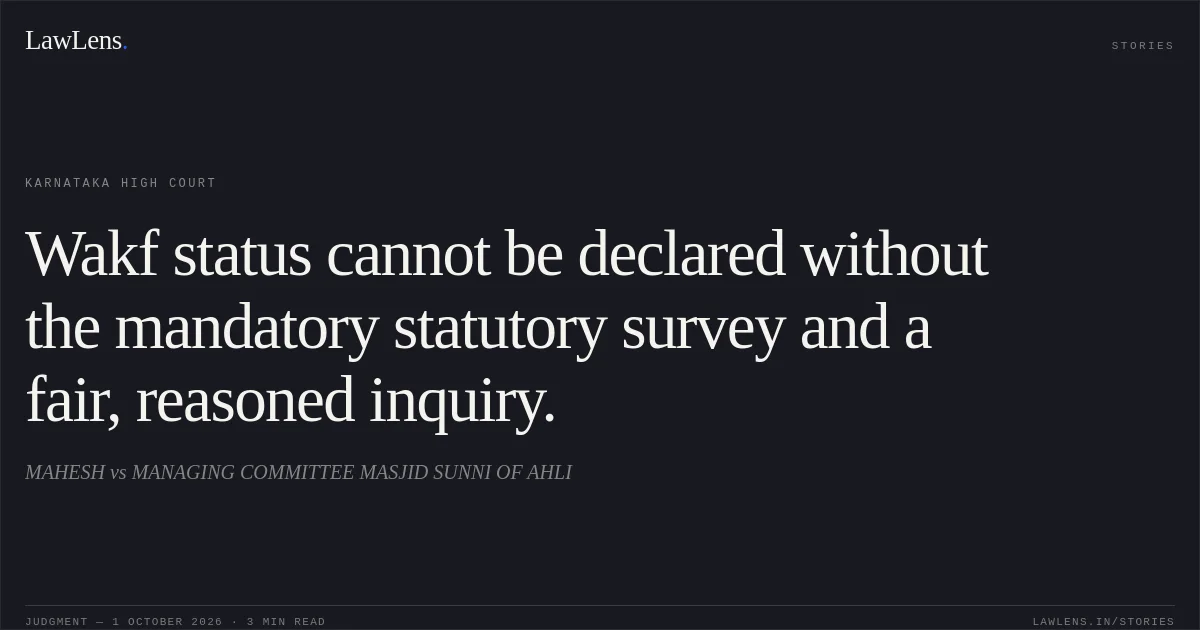
The dispute concerned Sy.No.32, measuring 1 acre 19 guntas in Bhadrapur Village.
Source reference: no citationThe petitioners claimed it was recorded and used as a Hindu cremation ground, while the respondents asserted that it had long been used as a Muslim Idgah and burial ground.
Source reference: no citationThe Karnataka State Board of Wakfs declared the land Wakf property on 7 January 2000, followed by registration and Gazette publication; the Wakf Tribunal upheld that action on 9 October 2007.
Source reference: no citationThe petitioners challenged both decisions, alleging that the statutory survey and publication procedure had not been followed.
Source reference: no citationThe Tribunal itself recorded that no Section 4 survey had been conducted and publication had not been made in accordance with Section 5.
Source reference: para. 2–11, 29–30Issues
1. Whether the Board’s declaration and Gazette notification were legally sustainable in the absence of the survey and publication procedures contemplated by Sections 4 and 5 of the Wakf Act, 1995.
Source reference: para. 29–30, 40–412. Whether the Board had validly determined under Section 40 that Sy.No.32 was Wakf property, having regard to the material concerning its historical use and the official records.
Source reference: para. 31–383. Whether the Court should conclusively determine the character of Sy.No.32 or remit the matter for fresh determination by the competent authority.
Source reference: para. 42–43Law Applied
Sections 4 and 5 of the Wakf Act, 1995 require a survey and the prescribed consideration and publication of the list of Wakfs; the survey is a substantive safeguard for ascertaining a property’s character, not a formality.
Source reference: para. 29Sections 36 and 37 provide for registration and maintenance of the register of Auqaf, but registration or an entry in the register does not itself establish that a property is Wakf.
Source reference: para. 32Section 40 empowers the Board to decide whether property is Wakf, but that power requires a proper, quasi-judicial enquiry, an opportunity for affected persons to be heard, and a reasoned decision based on relevant material.
Source reference: para. 33The petitioners cited several authorities, including T.N. Wakf Board v. Hathija Ammal and Salem Muslim Burial Ground Protection Committee v. State of Tamil Nadu; however, the Court’s stated reasoning principally rests on the statutory provisions and the record in this case.
Source reference: para. 13–14Reasoning
The Court found that no Section 4 survey had been conducted and that the Gazette publication did not comply with Section 5; the Tribunal had itself noted these deficiencies but nevertheless affirmed the declaration.
Source reference: para. 29–30The Board’s reliance on registration provisions and alleged user could not cure the procedural defects or replace the enquiry required by Section 40.
Source reference: para. 31–33The Board’s decision also failed to show consideration of the Peace Committee’s findings and the State Government’s earlier position that Sy.No.32 had not been allotted as a Muslim burial ground, while Sy.No.34 had been granted for that purpose.
Source reference: para. 34–37In view of the competing claims about historical use, the Court declined to determine the land’s ultimate character and instead directed a fresh determination on the complete record.
Source reference: para. 38–42Holding
The petition was allowed in part.
The Board’s order dated 7 January 2000, the Gazette notification dated 10 March 2000, and the Tribunal’s order dated 9 October 2007 were quashed; the matter was remitted to the competent Wakf authority for a fresh, reasoned determination after hearing the affected parties and considering the specified records, to be completed within four months.
Source reference: para. 43–44The parties were directed to maintain the status quo concerning Sy.No.32’s nature, possession, and use, and the Court left open the question whether it is Wakf property, an Idgah or burial ground, or a cremation ground.
Source reference: para. 44Acts & Sections Cited
6 provisions across 1 statute referred to in this judgment. Each provision opens on LawLens.
Unified Waqf Management, Empowerment, Efficiency and Development Act, 19956
Original Court PDF
MAHESHvsMANAGING COMMITTEE MASJID SUNNI OF AHLI
Click to open original judgment
Original judgment, available to read, download and summarize on LawLens.in