01Facts
The child survivor, born 05.05.2002, was 15 years and 6 months old on the date of occurrence, 03.11.2017, and studying in Class 11.
¶ 4 / pp. 2–3 · ¶ 13 / p. 7Her date of birth was proved by Ex.P.2 and the original birth certificate, Ex.C.1, which was marked by consent.
¶ 13 / p. 7The appellant, then about 32 years old, allegedly enticed her from her home. He took her to his house, where penetrative sexual assault occurred on 03.11.2017.
¶ 4 / pp. 2–3They travelled via Thiruvananthapuram, stayed at the house of A2 (Murugan) on 04.11.2017, and later rented a house and lived as husband and wife, with repeated penetrative assault.
¶ 4 / pp. 2–3The child was rescued on 23/24.11.2017.
¶ 4.1 / p. 3 · ¶ 14 / p. 8The Special Court acquitted A2–A4 and convicted the appellant under Section 6 POCSO Act and Section 366A IPC.
¶ 5 / pp. 3–4 · ¶ 6 / p. 4The appellant was sentenced to 20 years' RI and ₹10,000 fine under Section 6 POCSO and 7 years' RI and ₹3,000 fine under Section 366A IPC.
¶ 6 / p. 4The appellant contended that the matter was a love affair, that the survivor's evidence was not of sterling quality because of contradictions with her Section 161(3) and Section 164(5) CrPC statements, and that the doctor (PW-14) found no signs of recent intercourse.
¶ 8–9 / pp. 5–6The State supported the conviction.
¶ 11 / pp. 6–702Issues
i.1. Whether the survivor's testimony is reliable and of sterling quality, notwithstanding alleged contradictions with her earlier statements under Sections 161 and 164 CrPC.
¶ 8, 14–17 / pp. 5, 8–11ii.2. Whether the plea of a "love affair" and the medical opinion of no recent sexual intercourse displace the prosecution case under Section 6 POCSO.
¶ 9, 17.1, 17.2 / pp. 5–6, 10–11iii.3. Whether the conviction under Section 6 POCSO Act is sustainable.
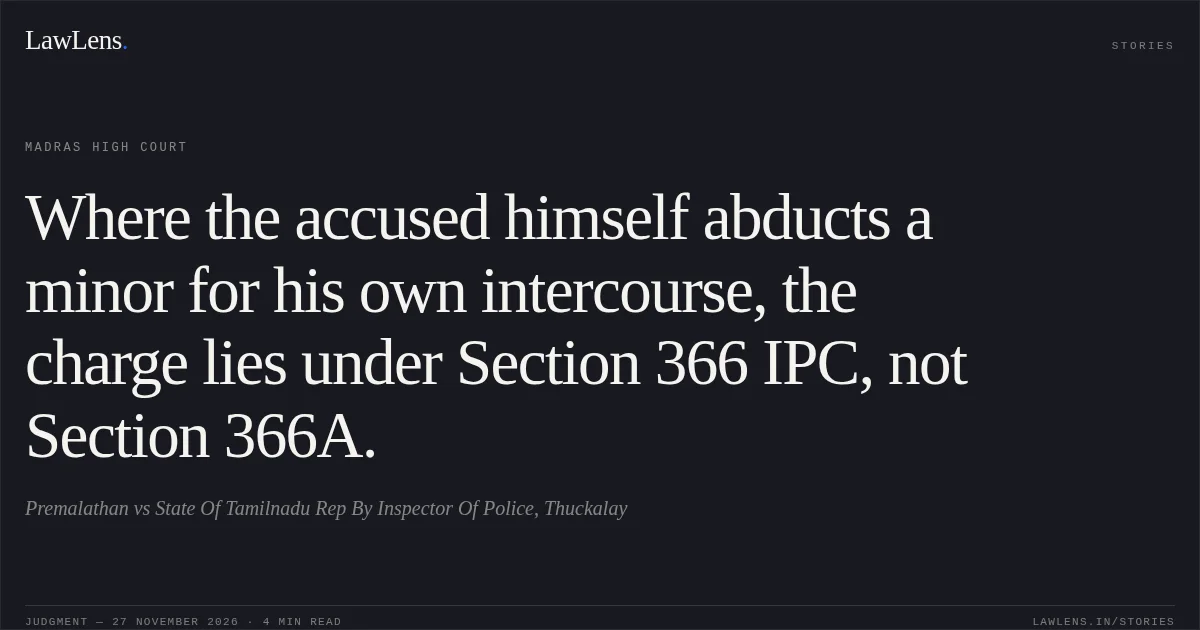
¶ 18 / pp. 11–12iv.4. Whether Section 366A IPC is the correct charge where the accused himself abducted the minor for his own sexual intercourse.
¶ 19–20 / pp. 12–13v.5. Whether the sentence imposed is appropriate.
¶ 21–22 / pp. 13–1503Law Applied
Section 2(1)(d) POCSO Act defines a person under 18 as a "child", and her consent is immaterial.
¶ 13 / p. 7 · ¶ 17.1 / pp. 10–11Section 29 POCSO Act raises a presumption against the accused, which the appellant did not rebut.
¶ 17 / p. 10Under Section 145 of the Indian Evidence Act, a witness may be contradicted by a prior written statement only after her attention is drawn to the relevant parts.
¶ 16 / pp. 9–10Statements under Sections 161 and 164 CrPC are not substantive evidence and may be used only for contradiction or corroboration in accordance with law.
¶ 16 / pp. 9–10Medical evidence is merely corroborative, and penetration to any extent suffices, so the hymen's condition is not decisive.
¶ 17.2 / p. 11Under Section 366A IPC, the offence applies where a minor is induced to go to another person for illicit intercourse. Where the offender himself abducts the minor for his own intercourse or marriage, the correct provision is Section 366 IPC.
¶ 19 / p. 12 · ¶ 19.1 / pp. 12–13Under Article 20(1) of the Constitution, the higher minimum sentence introduced by the 2019 amendment to Section 6 POCSO cannot apply to an offence committed in 2017, when the minimum was 10 years.
¶ 21.1 / pp. 13–14Section 428 CrPC governs set-off.
¶ 22 / pp. 14–15The appellant relied on Beeru v. State of NCT of Delhi (Del. HC, 2013), Sham Singh v. State of Haryana (SC, 2018) and Santhosh v. State of Maharashtra (Bom. HC, Nagpur, 2025) for the proposition that rupture of the hymen does not prove intercourse.
¶ 9–10 / p. 6The court distinguished these authorities as turning on the absence of ocular support from the survivor.
¶ 17.2 / p. 11Provisions in the judgment · 12 · Linked ones open on LawLens
Bharatiya Nagarik Suraksha Sanhita, 2023 Section 415
Protection of Children from Sexual Offences Act, 2012 Section 2Section 5Section 6Section 17Section 29
Indian Penal Code, 1860 Section 109Section 366
Code of Criminal Procedure, 1973 Section 161Section 162Section 164Section 428
04Reasoning
The court held that the alleged contradictions were not properly put to the survivor under Section 145 of the Evidence Act. Her earlier statements could not therefore be treated as substantive contradictions.
¶ 15–16 / pp. 9–10Even if established, the discrepancy concerned only the number of occasions of intercourse, not the core fact of enticement and repeated sexual intercourse over about three weeks. It was therefore a natural variation and did not impair her credibility.
¶ 17 / p. 10The appellant led no evidence and did not rebut the Section 29 presumption.
¶ 17 / p. 10The "love affair" plea was rejected because the survivor was a minor, so her consent was legally irrelevant under the POCSO Act and the IPC.
¶ 17.1 / pp. 10–11The doctor's opinion on the absence of "recent" intercourse did not exclude earlier intercourse and could not override the survivor's reliable ocular account.
¶ 17.2 / p. 11The appellant's authorities were distinguished because the survivor's evidence in this case supported the prosecution.
¶ 17.2 / p. 11On the charge, the court found that the appellant himself abducted the child for his own intercourse. Section 366A, which requires intent that the minor be forced or seduced to intercourse with another person, was therefore inapplicable.
¶ 19–19.1 / pp. 12–13The factual matrix of abduction was unchanged, so the modification caused no prejudice.
¶ 19–19.1 / pp. 12–13On sentence, the court weighed the appellant's age (32), the absence of force in the taking or the assault, and the lack of adverse antecedents.
¶ 21 / p. 13The court reduced the POCSO sentence to the pre-2019 minimum of 10 years.
¶ 21.1 / pp. 13–1405Holding
The court held that the survivor's testimony is reliable and that the prosecution proved penetrative sexual assault beyond reasonable doubt. The conviction under Section 6 POCSO Act is upheld.
¶ 18, 22 / pp. 11–12, 14The conviction under Section 366A IPC is modified to Section 366 IPC, because the appellant abducted the minor for his own intercourse.
¶ 19–20 / pp. 12–13The appeal is partly allowed.
¶ 23 / p. 15The POCSO sentence is reduced from 20 years to 10 years' RI with ₹10,000 fine, in default six months' SI.
¶ 21.1, 22 / pp. 13–14The Section 366 IPC sentence is five years' RI with ₹3,000 fine, in default six months' SI.
¶ 22 / p. 14Both sentences run concurrently, with set-off under Section 428 CrPC.
¶ 22 / pp. 14–15Original Court PDF
PremalathanvsState Of Tamilnadu Rep By Inspector Of Police, Thuckalay
Click to open original judgment
Original judgment, available to read, download and summarize on LawLens.in