Facts
The applicant was appointed as a Track Maintainer IV in May 2013
Source reference: p. 2On 31.12.2014, a major penalty charge memo (SF-V) was issued for unauthorized absence totaling 186 days between June and December 2014
Source reference: p. 2, 6Despite receiving the charge memo, the applicant did not participate in the inquiry, leading to an ex-parte proceeding
Source reference: p. 3, 11On 08.04.2015, while disciplinary proceedings were pending, the applicant submitted his resignation, stating he was selected for a post in the Telangana State Police and found the railway job too "hard"
Source reference: p. 3, 7The Disciplinary Authority (DA) removed the applicant from service on 08.02.2016
Source reference: p. 3This order was upheld by both the Appellate Authority (AA) and the Revising Authority (RA)
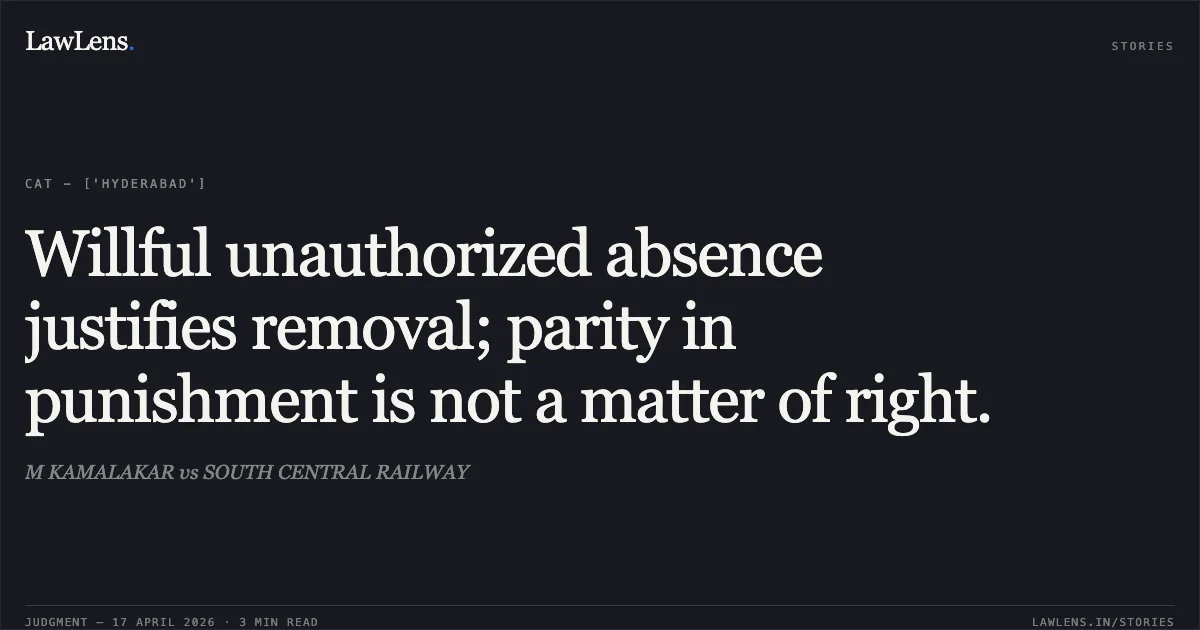
Source reference: p. 3The applicant later sought reinstatement, citing parity with another employee, G. Swamy, who received a lesser penalty for similar unauthorized absence
Source reference: p. 4Following a direction from the Tribunal in a previous OA (No. 343/2021) to consider his representation, the General Manager rejected the plea via a speaking order dated 17.08.2021
Source reference: p. 4-5Issues
1. Whether the order of removal from service was arbitrary or illegal given that the applicant had tendered his resignation prior to the penalty order
Source reference: p. 32. Whether the applicant was entitled to parity in punishment with another employee, G. Swamy, under the principle of non-discrimination
Source reference: p. 4, 103. Whether unauthorized absence constitutes "wilful" misconduct when the employee intends to join another service
Source reference: p. 5Law Applied
The court applied Rules 3.1(i), (ii), and (iii) of the Railway Services (Conduct) Rules, 1966, regarding devotion to duty and unbecoming conduct
Source reference: p. 13Procedural compliance was evaluated under the Railway Servants (Discipline & Appeal) Rules, 1968
Source reference: p. 11The court relied on UOI v. Parmanand (1989), which restricts a Tribunal’s interference with the quantum of penalty imposed by competent authorities
Source reference: p. 12Furthermore, it applied the principle from Railway Board RBE No. 20/2007, stating that parity cannot be claimed based on a potentially wrongful or lenient decision in another case
Source reference: p. 10The court also cited C. Jacob v. Director of Geology (2008) regarding the non-revival of stale claims through repeated representations
Source reference: p. 14Reasoning
The Tribunal found that the applicant’s unauthorized absence (totaling 729 days over his entire tenure) was a clear violation of duty in a safety-sensitive post
Source reference: p. 6, 8Regarding the resignation, the Tribunal noted that as per extant rules, a resignation cannot be accepted while disciplinary (DAR) proceedings are pending
Source reference: p. 12The applicant’s own admission—that he found the work too difficult and was pursuing other employment—undermined his claim that the absence was due to "compelling circumstances" under the Krishnakant B. Parmar doctrine
Source reference: p. 7, 13On the issue of parity, the Tribunal held that disciplinary proceedings are quasi-judicial and depend on the specific facts of each case; the applicant failed to prove his situation was identical to G. Swamy’s
Source reference: p. 10, 15Finally, the Tribunal observed that the applicant did not allege any procedural lapses in the inquiry, and the repeated representations to the General Manager did not create a fresh cause of action for a stale claim
Source reference: p. 13-14Holding
The Tribunal held that there was no merit in the Original Application.
It ruled that unauthorized absence without prior permission is a misconduct that warrants removal, especially when the employee shows no interest in the service
Source reference: p. 15The court dismissed the plea for parity, affirming that administrative authorities have the discretion to determine the quantum of punishment
Source reference: p. 10Consequently, the OA was dismissed, and the impugned orders of removal and the rejection of the mercy appeal were upheld
Source reference: p. 15No costs were awarded
Source reference: p. 15Acts & Sections Cited
1 provisions across 1 statute referred to in this judgment. Each provision opens on LawLens.
Administrative Tribunals Act, 19851
Original Court PDF
M KAMALAKARvsSOUTH CENTRAL RAILWAY
Click to open original judgment
Original judgment, available to read, download and summarize on LawLens.in