01Facts
On 20 August 2016, the complainant, Chellammal, was attacked while at her agricultural field: the appellant allegedly snatched her gold chain and nose stud and cut her ears to remove her gold studs.
¶ 18–24She identified the appellant in court and identified the recovered jewels as hers.
¶ 46, 48, 51The Sessions Court convicted him under Sections 394 and 397 of the Indian Penal Code (IPC), sentencing him to ten years’ rigorous imprisonment under Section 394 and seven years’ rigorous imprisonment under Section 397, to run concurrently.
¶ 15–16He appealed under Section 374(2) of the Code of Criminal Procedure
¶ 15–1602Issues
i.1. Whether the evidence was sufficient to sustain the appellant’s conviction for robbery causing hurt under Section 394 IPC
¶ 17, 44–53ii.2. Whether the appellant’s conduct and the injuries proved justified a conviction and sentence under Section 397 IPC
¶ 54–58iii.3. Whether the sentence imposed under Section 394 IPC warranted appellate interference
¶ 59–6003Law Applied
Section 394 IPC applies where a person voluntarily causes hurt while committing or attempting to commit robbery; it permits imprisonment for life or rigorous imprisonment up to ten years, and a fine.
p. 21 · ¶ 55Section 397 IPC prescribes a minimum sentence of seven years where, at the time of robbery or dacoity, the offender uses a deadly weapon, causes grievous hurt, or attempts to cause death or grievous hurt; the Court treated it as a sentencing provision rather than a separate substantive offence.
p. 21 · ¶ 55Under Section 27 of the Indian Evidence Act, 1872, only the part of an accused’s statement that distinctly relates to a fact discovered is admissible; identification of the recovered jewels was relevant under Section 9, and Section 114(a) permits a presumption concerning a person found in possession of stolen goods soon after the theft if that possession is not explained.
pp. 18–19 · ¶ 50–52Provisions in the judgment · 8 · Linked ones open on LawLens
Code of Criminal Procedure, 1973 Section 374Section 207Section 209Section 313Section 428
Indian Penal Code, 1860 Section 392Section 394Section 397
04Reasoning
The Court accepted PW1’s identification of the appellant, noting that he had previously attended repair work at her field and had received payment from her shortly before the robbery, giving her prior acquaintance with him.
p. 17 · ¶ 46It also relied on the recovery of the jewels following the appellant’s disclosure, corroborated by the Village Administrative Officer and Village Assistant, and on PW1’s identification of the jewels; the appellant offered no explanation for possessing them.
pp. 18–19 · ¶ 48, 51–53The Court therefore found robbery causing hurt proved under Section 394.
It held Section 397 inapplicable because the prosecution had not established use of a deadly weapon in the relevant sense, the scythe was used to cut the victim’s ears and remove the studs, and the injuries were not certified as grievous.
pp. 21–22 · ¶ 56–58Considering the circumstances of the attack, it found no reason to reduce the ten-year sentence under Section 394.
p. 22 · ¶ 59–6005Holding
The appeal was partly allowed.
p. 23 · ¶ 61The conviction and sentence under Section 397 IPC were set aside, but the conviction and ten-year sentence under Section 394 IPC were sustained.
p. 23 · ¶ 61The appellant was granted set-off under Section 428 CrPC, his bail bond was cancelled, and the Trial Court was directed to secure him to serve the remaining sentence.
p. 23 · ¶ 61Original Court PDF
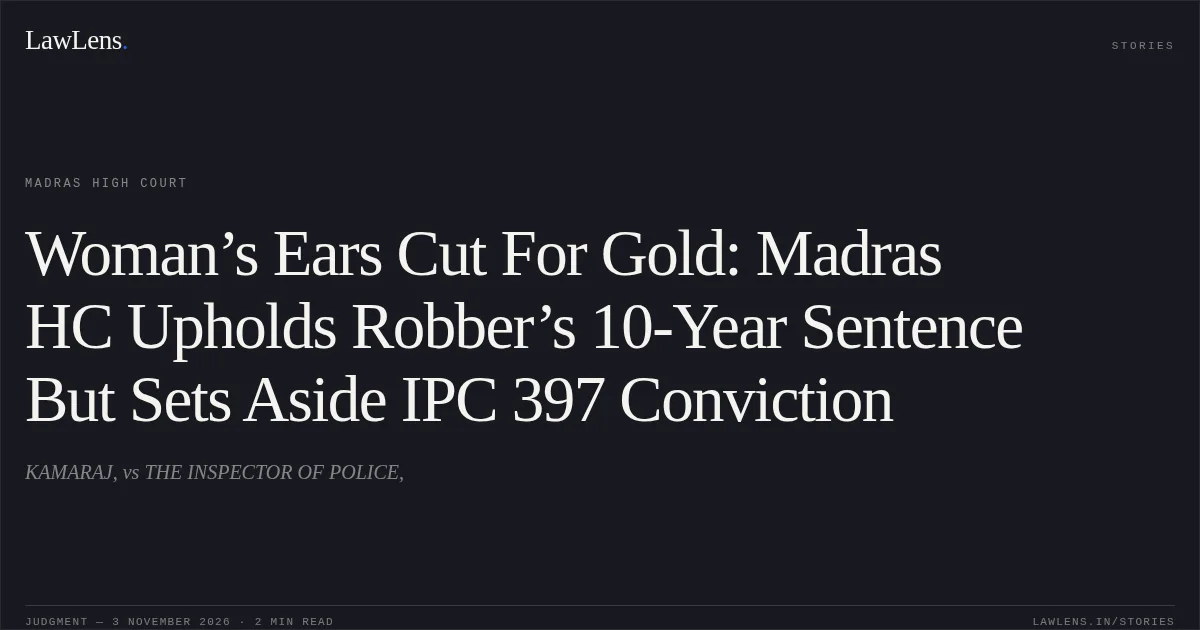
KAMARAJ,vsTHE INSPECTOR OF POLICE,
Click to open original judgment
Original judgment, available to read, download and summarize on LawLens.in