01Facts
The petitioners, who were the husband and in-laws of the second respondent, challenged their conviction in C.C. No. 113 of 2019 for offences arising from a complaint alleging cruelty, criminal intimidation and a dowry demand.
p. 3 · ¶ 2–3The Magistrate convicted them on 27 August 2026 and imposed sentences including three years’ imprisonment under Section 498-A IPC and one year under Section 4 of the Dowry Prohibition Act
p. 3 · ¶ 2–3The petitioners appealed, and suspension of sentence was granted, though sureties had not yet been produced.
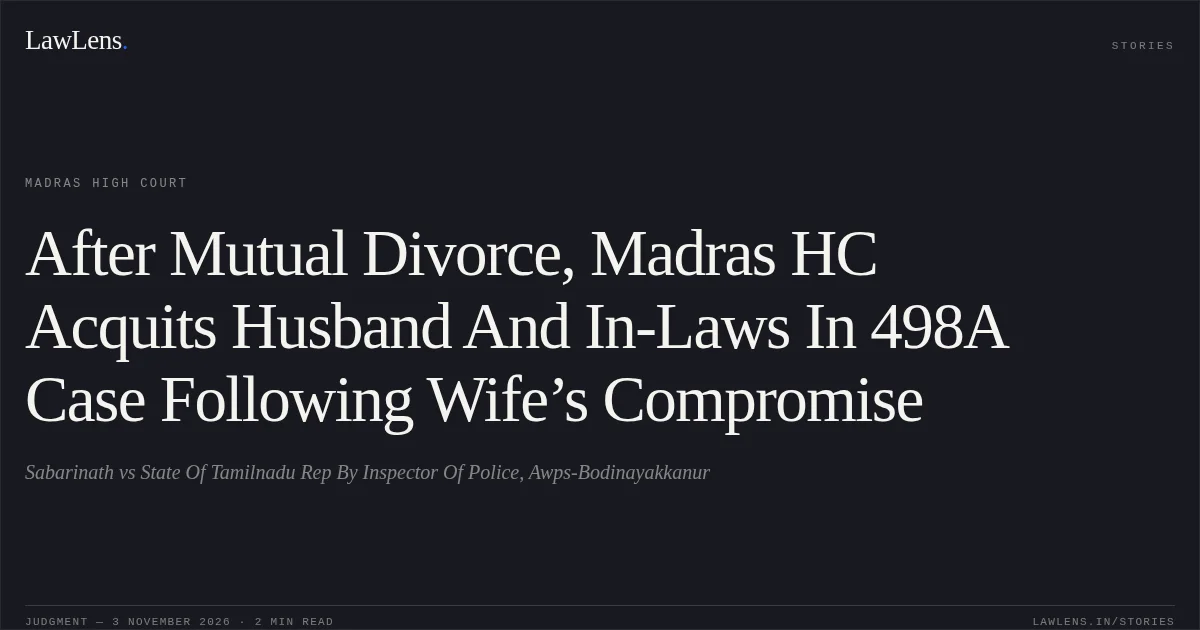
p. 4 · ¶ 4The spouses had obtained a divorce by mutual consent and entered into a joint compromise.
p. 4 · ¶ 5–6The second respondent appeared before the High Court and stated that she had no objection to the conviction and sentence being set aside.
p. 4 · ¶ 5–602Issues
i.1. Whether, in light of the parties’ joint compromise and the complainant’s stated lack of objection, the conviction and sentence should be set aside
p. 2, 4, prayer and para. 6ii.2. Whether the petitioners should be acquitted and permitted to withdraw the fine deposited in the trial court
p. 5, operative order, clauses (b) and (d)03Law Applied
The judgment identifies the offences as Sections 498-A and 506(1) IPC and Section 4 of the Dowry Prohibition Act; it records that the sentences imposed included imprisonment under Section 498-A IPC and Section 4 of that Act
p. 3 · ¶ 2–3It cites no precedent or specific statutory provision governing the High Court’s power to set aside the conviction on compromise, and articulates no separate legal test.
Its stated basis for relief is the parties’ compromise and the complainant’s position
pp. 4–5 · ¶ 5–7Provisions in the judgment · 2 · Linked ones open on LawLens
Indian Penal Code, 1860 Section 506
Dowry Prohibition Act, 1961 Section 4
04Reasoning
The Court noted that the spouses had obtained a mutual-consent divorce and entered into a joint compromise, and that the complainant personally confirmed she had no objection to setting aside the conviction and sentence.
p. 4 · ¶ 5–6Considering those circumstances, the Court allowed the petition and set aside the trial court’s judgment; it did not provide further statutory or precedential analysis
pp. 4–5 · ¶ 7 and operative order05Holding
The High Court set aside the conviction and sentence in C.C. No. 113 of 2019 and acquitted the petitioners
pp. 5, operative order, clauses (a)–(b)It directed that the joint compromise memo form part of the order and permitted the petitioners to withdraw the fine deposited with the Magistrate without awaiting the complainant’s no-objection
pp. 5, operative order, clauses (c)–(d)The criminal original petition was allowed, and the connected miscellaneous petitions were closed.
p. 5, operative order, clause (e)Original Court PDF
SabarinathvsState Of Tamilnadu Rep By Inspector Of Police, Awps-Bodinayakkanur
Click to open original judgment
Original judgment, available to read, download and summarize on LawLens.in