01Facts
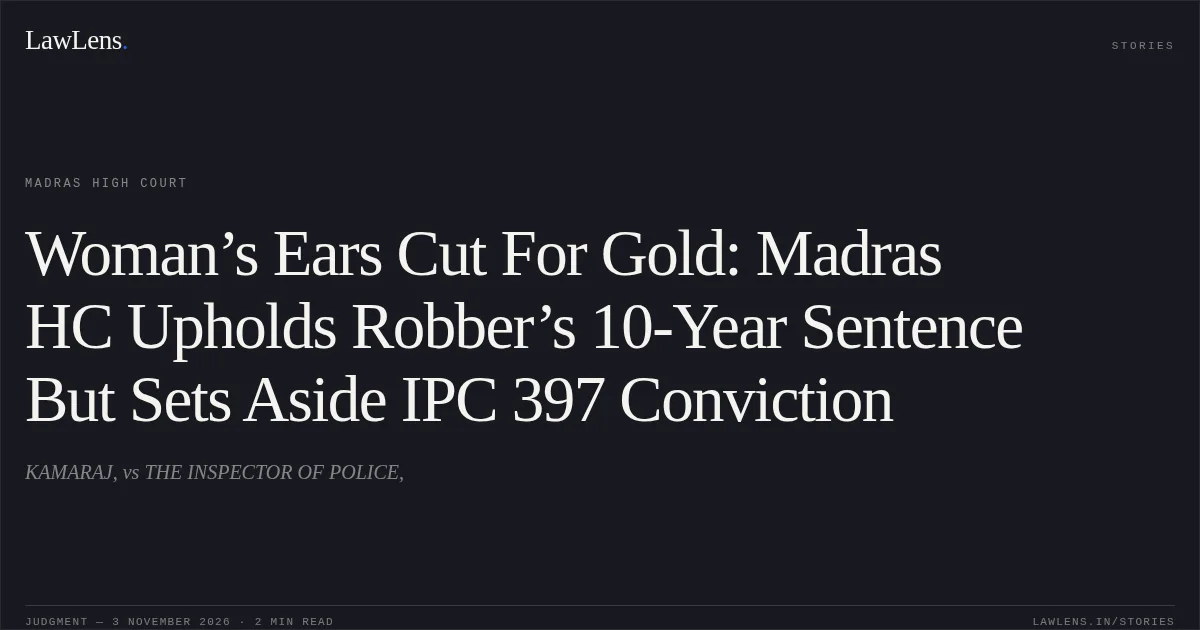
The appellant was convicted by the Fast Track Mahila Court, Dindigul, of offences under Sections 457, 376 and 397 of the Indian Penal Code (IPC), arising from an incident at a Primary Health Centre where two nurses were on night duty.
pp. 4–6The prosecution alleged that he entered the Centre at night, threatened the nurses with a knife, raped P.W.2, and took a gold chain and silver anklets.
pp. 6–9The rape allegation was not included in P.W.1’s initial complaint or in the statements recorded from P.W.1 and P.W.2 on 9 June 2015; P.W.2 raised it in a further statement on 12 June 2015.
pp. 15–16The prosecution also relied on the recovery of the stolen jewellery from the appellant.
pp. 17–18On appeal under Section 374 Cr.P.C., the High Court considered whether the convictions and sentences were sustainable.
pp. 5–602Issues
i.Whether the prosecution proved the charge of rape under Section 376 IPC beyond reasonable doubt, despite the delayed disclosure and absence of corroboration.
pp. 15–17, 21ii.Whether the evidence, including the recovery of the stolen jewellery, sustained the convictions under Sections 457 and 397 IPC.
pp. 17–18, 21–22iii.Whether the conviction and sentence imposed by the trial court were sustainable overall.
p. 603Law Applied
The Court considered Sections 457, 376 and 397 IPC, concerning lurking house-trespass or house-breaking by night, rape, and robbery or dacoity with an attempted or actual use of a deadly weapon, respectively.
pp. 4–6Under Section 114(a) of the Indian Evidence Act, 1872, a court may presume that a person found in possession of stolen goods soon after a theft is the thief or a knowing receiver, unless that person satisfactorily accounts for the possession.
p. 18Applying the witness-reliability categories in Vadivelu Thevar v. State of Madras, as reiterated in Sunil Kumar v. State (Govt. of NCT of Delhi), evidence that is neither wholly reliable nor wholly unreliable calls for corroboration in material particulars.
pp. 20–21The Court also noted that Indian courts do not apply falsus in uno, falsus in omnibus, and may separate reliable evidence from unreliable evidence.
p. 20It considered the defence’s cited authorities on doubtful recovery and appreciation of a victim’s testimony, but found them inapplicable or distinguishable on the facts.
pp. 18–20Provisions in the judgment · 11 · Linked ones open on LawLens
Code of Criminal Procedure, 1973 Section 164Section 207Section 313Section 374Section 428
Indian Penal Code, 1860 Section 366Section 376Section 392Section 397Section 452Section 457
04Reasoning
The Court found serious doubt about the rape allegation because it was absent from the initial complaint and the first statements, was raised only in P.W.2’s further statement after the appellant’s arrest, and was not corroborated by medical evidence; the Court also relied on the absence of injuries and the witnesses’ conduct in assessing the account.
pp. 15–17, 21It therefore set aside the Section 376 conviction.
pp. 15–17, 21By contrast, it accepted the evidence that the appellant entered the Centre and took the jewellery, and found that the recovered gold chain and anklets corroborated P.W.1’s and P.W.2’s evidence.
pp. 17–18, 21The appellant gave no satisfactory explanation for possessing them, permitting the presumption under Section 114(a).
pp. 17–18, 21The judgment’s discussion at paragraph 51 refers to Sections 452 and 397, whereas its charges and final order refer to Sections 457 and 397.
pp. 4, 21–2205Holding
The appeal was partly allowed: the conviction and sentence under Section 376 IPC were set aside, while the convictions and sentences under Sections 457 and 397 IPC were upheld.
p. 22The sentences were directed to run concurrently, and the appellant was granted set-off under Section 428 Cr.P.C.; the connected criminal miscellaneous petition was closed.
p. 22Original Court PDF
AndavanvsThe Inspector of Police
Click to open original judgment
Original judgment, available to read, download and summarize on LawLens.in