Facts
The petitioner, Ramchandra Baghri, filed a writ petition under Article 226 of the Constitution of India challenging an appellate order dated 28.11.2024 (Annexure P/23) passed by the Commissioner, Indore Division.
Source reference: para. 1, 8This order set aside previous revenue court decisions and remanded the matter to the Tehsildar, Rau, with directions to restore the revenue records to their status prior to 21.07.2016 and pass a fresh, speaking order on the merits of mutation proceedings under Section 177 of the Madhya Pradesh Land Revenue Code, 1959, after affording due opportunity of hearing.
Source reference: para. 2, 19The dispute concerns agricultural land in Village Rau (Survey Nos. 686/4/1/1, 688/4/1/1, and 688/5), originally owned by the late Ms. Nargis and Mrs. Jairubai.
Source reference: para. 3The petitioner claims uninterrupted possession for 30 years and title based on an alleged Will dated 11.08.2011 (Annexure P/11) purportedly executed by Ms. Nargis.
Source reference: para. 4, 9Respondent No. 4, Jehangir D. Mehta, claims to be a Class-II legal heir of Ms. Nargis and was granted Letters of Administration (MCC No. 465/2011 dated 08.12.2015) by the High Court, which expressly excluded the subject land due to pending civil disputes.
Source reference: para. 5, 10A civil suit for declaration of title and possession (Civil Suit No. 30A/2014), instituted by the petitioner, is currently pending before the Civil Judge, Junior Division, Indore.
Source reference: para. 6, 17Respondent No. 4 contends the Will is fabricated, citing earlier litigation where it was not disclosed, and argues the petitioner was merely a servant/watchman as per a police complaint dated 28.06.2007 (Annexure R/1).
Source reference: para. 11, 12, 15Issues
1. Whether the impugned appellate order dated 28.11.2024 is arbitrary, illegal, or violates principles of natural justice?
Source reference: para. 82. Whether the High Court, in its writ jurisdiction under Article 226, should interfere with an order of remand in revenue proceedings when complex disputed questions of fact and a substantive civil suit concerning title are pending?
Source reference: para. 14, 15, 17Law Applied
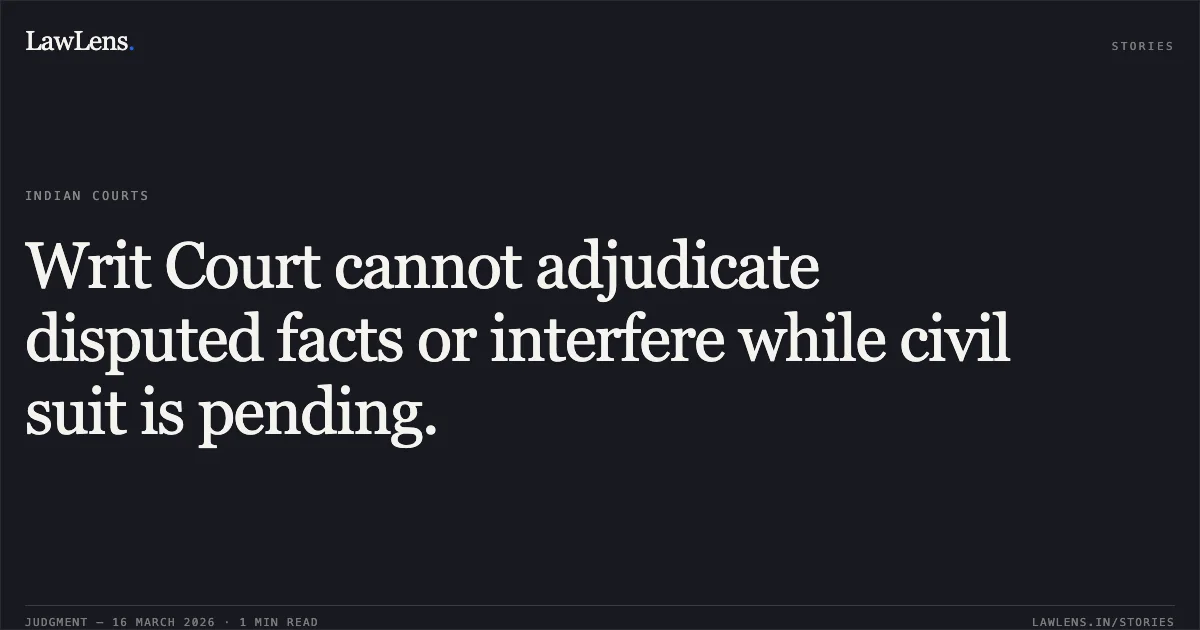
The High Court primarily applied the principles governing the exercise of writ jurisdiction under Article 226 of the Constitution of India, specifically emphasizing that a writ court cannot conduct a roving inquiry or mini-trial to adjudicate highly contested questions of fact and is not equipped to evaluate evidentiary disputes.
Source reference: para. 15, 16It also relied on the principle that the existence of an efficacious alternative remedy, actively being pursued (like a pending civil suit for title), generally precludes interference in ancillary proceedings.
Source reference: para. 17Furthermore, the court applied the fundamental principle of land revenue law that mutation proceedings, including those under Section 177 of the Madhya Pradesh Land Revenue Code, 1959, are summary in nature for fiscal purposes and do not create, extinguish, or declare title, remaining subject to the final judgment of a Civil Court.
Source reference: para. 18Reasoning
The Court analyzed the petition by first considering the scope of Article 226 jurisdiction, concluding that it is not suitable for adjudicating the highly contested questions of fact present, such as the genuineness of the alleged Will, the nature of the petitioner's possession, and the devolution of title.
Source reference: para. 15, 16These issues necessitate oral and documentary evidence, cross-examination, and forensic examination—processes outside the purview of writ jurisdiction.
Source reference: para. 15, 16Secondly, the Court noted the petitioner's existing Civil Suit No. 30A/2014, which is actively pursuing an efficacious alternative remedy for title declaration.
Source reference: para. 17The Court found that parallel adjudication or interference in ancillary revenue proceedings by the High Court would be neither legally permissible nor judicially prudent.
Source reference: para. 17Finally, the Court reiterated that mutation entries are summary and fiscal, not determinative of title, and would remain subject to the Civil Court's final judgment.
Source reference: para. 18The Court found no manifest illegality or jurisdictional error with the Commissioner's remand order, noting it merely directed restoration of revenue entries and a fresh, speaking order after hearing all interested parties, adhering to natural justice.
Source reference: para. 19, 20Holding
The High Court concluded that no case for interference under Article 226 of the Constitution of India was made out, given the pendency of the civil suit, the existence of disputed questions of fact, and the limited fiscal nature of the remanded revenue proceedings.
The Court held that the impugned order dated 28.11.2024 passed by the Commissioner, Indore Division, Indore, was legally sound and suffered from no jurisdictional infirmity.
Source reference: para. 21Consequently, the Writ Petition was dismissed, and any interim relief granted earlier stood vacated.
Source reference: para. 22Acts & Sections Cited
1 provisions across 1 statute referred to in this judgment. Each provision opens on LawLens.
MP Land Revenue Code 19591
Original Court PDF
Ramchandra BaghrivsThe State Of Madhya Pradesh
Click to open original judgment
Original judgment, available to read, download and summarize on LawLens.in