01Facts
Six petitioners challenged Annexure-A, a permission dated 28.02.2025 issued by Respondent No. 3 (Executive Engineer, Panchayat Raj Engineering Sub-Division) for laying a pipeline from the private property of Respondents 7 and 8 to another premises of the same private respondent
¶ 1 · p. 5The writ petition also sought a mandamus directing Respondent No. 6 (Police Sub-Inspector, Brahmavara) to prevent Respondents 7 and 8 from carrying out pipeline work through the panchayat road or transporting water from Hanehalli Village to Heradi Village
pp. 1–4, prayer (b)The petitioners' grounds were (i) the statutory power of Respondent No. 3 to permit private pipelines and water lines between villages, and (ii) depletion of ground water caused by the permission
¶ 3 · pp. 5–6The private respondent's counsel submitted that the pipeline was complete, that the private respondent bore the expenses, that the road was restored to its original state, and that no damage was caused to the public works roads
¶ 4 · p. 602Issues
i.1. Whether the permission granted under Annexure-A, and the statutory power of Respondent No. 3 to permit installation of a private pipeline and water lines between villages, warrant judicial review in these proceedings
¶ 3 · pp. 5–6 · ¶ 5 · p. 6ii.2. Whether the petitioners' contentions regarding depletion of ground water arising from the permission can be considered in these proceedings
¶ 5 · pp. 6–7 · ¶ 6 · p. 703Law Applied
The judgment does not cite any statute, rule, or precedent in its reasoning
The writ petition was filed under Articles 226 and 227 of the Constitution read with Rule 14(1) of the High Court of Karnataka (Public Interest Litigation) Rules, 2018, which identifies the procedural basis for the petition
caption · p. 1The court's reasoning rests on the principle that adjudication is confined to the relief actually sought in the writ petition, so that contentions outside the impugned order and prayers are not considered
¶ 5 · pp. 6–7The court also relied on the factual position that the work was complete and that no damage had been caused to the road in question, as submitted by counsel
¶ 4 · p. 6 · ¶ 5 · pp. 6–704Reasoning
The court noted that Annexure-A is a permission specifically for laying a pipeline
¶ 4 · p. 6It accepted counsel's submissions that the work was complete, that costs were borne by the private respondent, that the road was reinstated, and that no damage was caused to the road on which the work was done
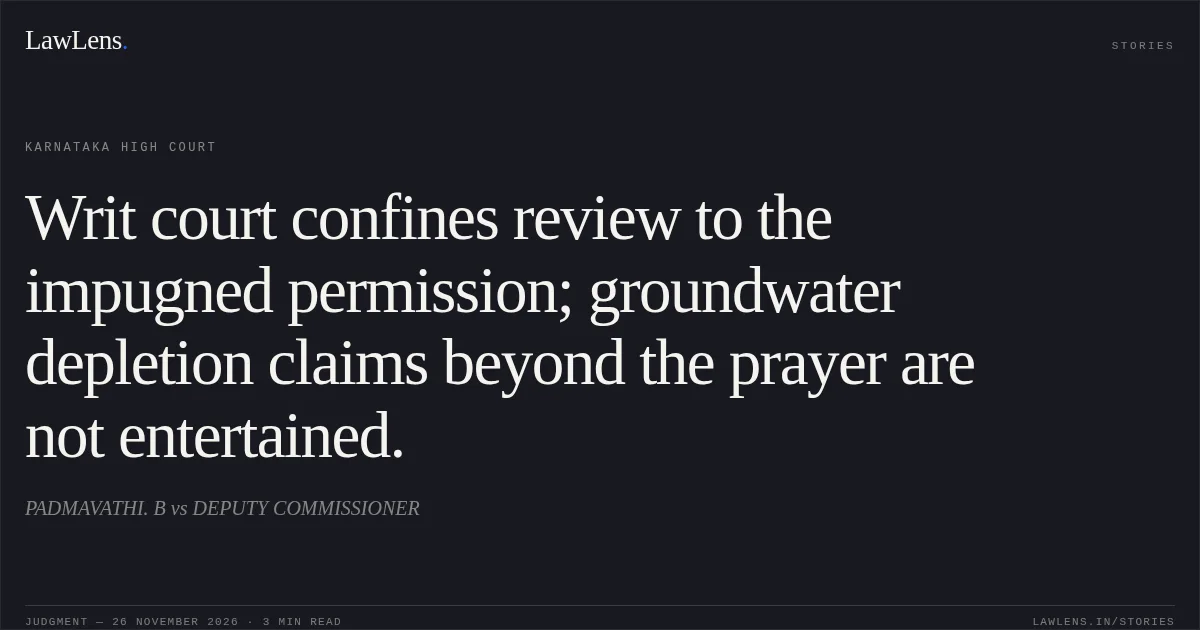
¶ 4 · p. 6Because the prayer was confined to Annexure-A, and because the factual basis for any road-related challenge was found to be absent, the court held that the ground-water contention could not be considered in these proceedings
¶ 5 · pp. 6–7The court did not record any reasoning on the scope of Respondent No. 3's statutory power to permit private pipelines or water lines between villages. It also did not address the prayer directed at Respondent No. 6
05Holding
The court did not answer either framed issue on its merits. It held that the ground-water contention could not be considered in this writ petition, because the prayer was limited to Annexure-A and the pipeline work was complete without road damage
¶ 5 · pp. 6–7The writ petition was accordingly closed. The court expressly clarified that it had not considered, and recorded no finding on, the depletion of ground water. No specific directions or further relief were granted against any respondent
¶ 5 · p. 7 · ¶ 6 · p. 7 · no citationOriginal Court PDF
PADMAVATHI. BvsDEPUTY COMMISSIONER
Click to open original judgment
Original judgment, available to read, download and summarize on LawLens.in