Facts
The petitioner challenged the order dated 27 October 2022 passed by the fourth respondent and the order dated 30 January 2025 passed by the second respondent, seeking quashing of the dismissal from service and consequential reinstatement with back wages and attendant benefits.
Source reference: p.1The disciplinary authority, identified by the Court as the Principal District Judge, Cuddalore, had imposed the punishment of dismissal on the basis of charges held proved.
Source reference: para.2The petitioner had not preferred the available statutory appeal before the High Court.
Source reference: para.2Issues
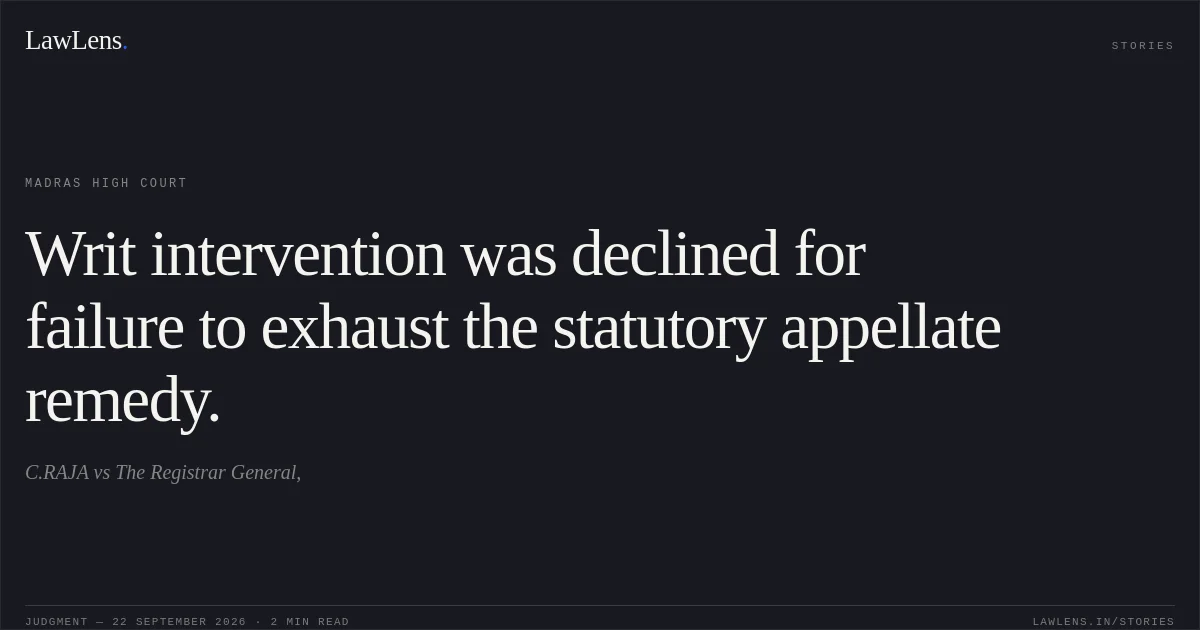
Whether the writ petition challenging the dismissal from service could be entertained when the petitioner had not exhausted the available statutory appellate remedy?
Source reference: para.2–4Whether the petitioner should be permitted to file the statutory appeal notwithstanding the delay, with the merits to be considered by the appellate authority?
Source reference: para.4Law Applied
The Court applied the principle that a writ petition under Article 226 of the Constitution is ordinarily not entertained where an efficacious alternative statutory remedy, particularly an appeal against a disciplinary order, remains available.
Source reference: para.2Exhaustion of the statutory appellate remedy is especially important where disputed facts, documents, and evidence require reconsideration by the appellate authority.
Source reference: para.2Reasoning
The petitioner directly invoked the writ jurisdiction to challenge the dismissal order without first filing the statutory appeal available before the High Court.
Source reference: para.2Since the disciplinary action was founded on charges held proved and the appellate authority could examine the disputed factual and evidentiary issues on the basis of the record, the Court held that the appellate remedy ought to be pursued first.
Source reference: para.2Accordingly, rather than examining the merits of the dismissal, the Court granted liberty to the petitioner to file the statutory appeal and directed that the delay should not be raised as an impediment to its consideration.
Source reference: para.4Holding
The Court declined to examine the challenge to the dismissal on merits because the petitioner had not exhausted the statutory appellate remedy.
The writ petition was disposed of with liberty to the petitioner to file the statutory appeal before the High Court within 30 days from receipt of the order.
Source reference: paras.4–5If filed, the appeal was directed to be taken on file without reference to delay and decided on merits and in accordance with law as expeditiously as possible.
Source reference: paras.4–5No costs were awarded.
Source reference: p.3Original Court PDF
C.RAJAvsThe Registrar General,
Click to open original judgment
Original judgment, available to read, download and summarize on LawLens.in