Facts
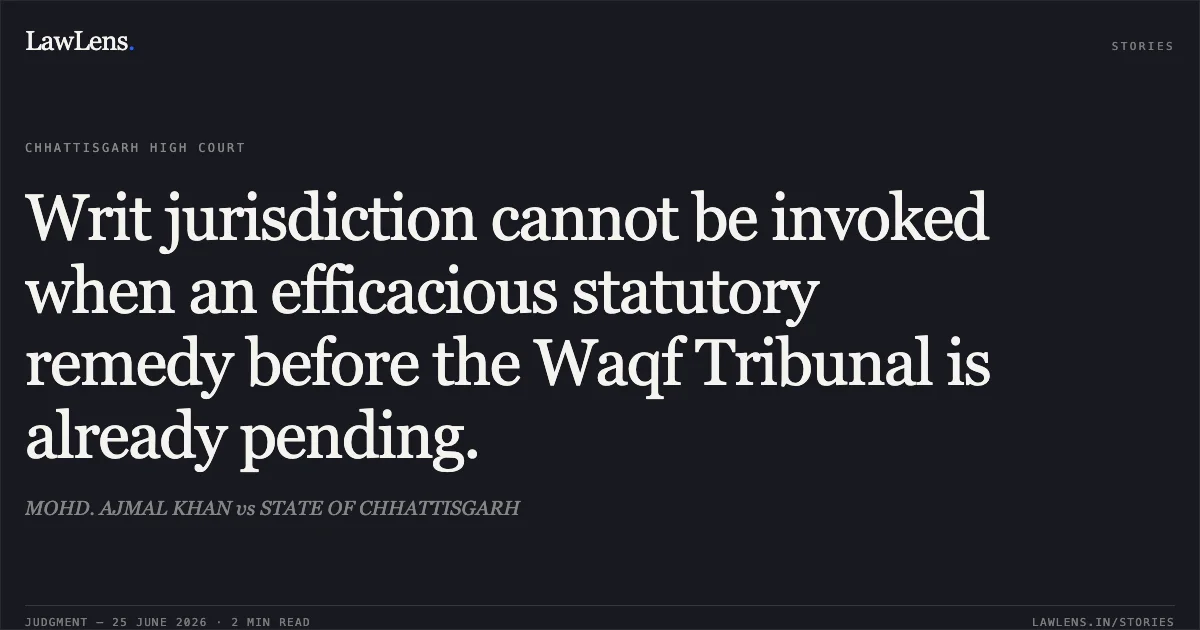
The Petitioner challenged the construction of shops on Waqf property (Nazul Sheet No. 17, Bhukhand No. 185) at Kawardha.
Source reference: para 1Despite a recommendation dated 18.03.2026 by the Chief Executive Officer of the Chhattisgarh State Waqf Board to stop the construction, Respondent No. 4 (the Mutawalli) allegedly continued the work, and Respondent No. 3 (District Collector) failed to act.
Source reference: para 1The Petitioner had already filed an application under Section 83(2) of the Waqf Act, 1995, before the Chhattisgarh Waqf Tribunal in January 2026, which remained pending due to a purported lack of quorum.
Source reference: para 2The State argued that the Tribunal was fully functional and seized of the matter.
Source reference: para 3Issues
1. Whether the High Court should exercise its extraordinary jurisdiction under Article 226 of the Constitution of India when a statutory alternative remedy before the Waqf Tribunal has already been invoked and is pending.
Source reference: para 3, 72. Whether a direction for the expeditious disposal of the pending proceedings before the Waqf Tribunal is warranted.
Source reference: para 5, 9Law Applied
The Court emphasized the principle of exhausting an efficacious alternative statutory remedy provided under the Waqf Act, 1995.
Source reference: para 3Specifically, Section 83 of the Waqf Act, 1995, establishes the Waqf Tribunal as the competent body to adjudicate all questions and disputes relating to Waqf property, its management, and administration.
Source reference: para 3, 7The Court also applied the procedural principle that parallel proceedings for the same cause of action should not be maintained simultaneously in different forums.
Source reference: para 4, 8Reasoning
The Court observed that the core of the dispute—unauthorized construction and management of Waqf property—falls squarely within the jurisdiction of the Waqf Tribunal.
Source reference: para 7Since the Petitioner had already approached the Tribunal under Section 83(2) of the Waqf Act in January 2026, the Court found no justification for entertaining a writ petition on the same merits.
Source reference: para 7, 8While the Petitioner claimed a lack of quorum at the Tribunal, the State Counsel clarified that the Tribunal was currently functioning with all three members.
Source reference: para 3Consequently, the Court determined that rather than adjudicating the merits, the appropriate course of action was to ensure that the statutory body already seized of the matter resolves it within a reasonable timeframe.
Source reference: para 9Holding
The High Court declined to entertain the writ petition on merits and relegated the Petitioner to pursue the pending statutory remedy.
The Court directed the competent Waqf Tribunal to consider and decide the pending proceedings/application strictly in accordance with the law within a period of two months from the date of receipt of the order.
Source reference: para 9The petition was disposed of with no order as to costs.
Source reference: para 11Acts & Sections Cited
1 provisions across 1 statute referred to in this judgment. Linked provisions open on LawLens.
Waqf (Amendment) Act, 20251
Original Court PDF
MOHD. AJMAL KHANvsSTATE OF CHHATTISGARH
Click to open original judgment
Original judgment, available to read, download and summarize on LawLens.in