Facts
The petitioner purchased a truck for ₹44,00,000 in 2019, of which ₹35,00,000 was financed by Tata Motors Finance Ltd. at an interest rate of 7.5%.
Source reference: p.2, para. 2He claimed to have paid ten instalments but defaulted on the remaining instalments during the COVID-19 pandemic, relying on governmental and RBI relief measures, including the loan moratorium.
Source reference: p.2, para. 2Tata Motors Finance allegedly repossessed the truck, bearing registration no. BR-10-GB-3945, on 10 December 2021 through recovery agents or “goons”.
Source reference: pp.2–3, paras. 2–3The petitioner sought a direction to the Senior Superintendent of Police, Bhagalpur, to seize the vehicle from the finance company and release it to him.
Source reference: p.1, para. 1He had not, however, lodged any prior complaint or report before the Senior Superintendent of Police alleging illegal seizure or police inaction.
Source reference: p.12, para. 9Issues
Whether a writ petition under Article 226 of the Constitution is maintainable against a private financing company for alleged illegal repossession of a vehicle arising from non-payment of loan dues.
Source reference: pp.10–12, paras. 8–10Whether the High Court could direct the Senior Superintendent of Police to seize the vehicle from the private finance company and hand it over to the petitioner in the absence of any prior complaint or report to the police authorities.
Source reference: p.12, paras. 9–10Whether the RBI guidelines and the principles stated in ICICI Bank v. Shanti Devi Sharma justified the relief sought by the petitioner in the present contractual dispute.
Source reference: pp.3–9, paras. 4–7Law Applied
The Court applied Article 226 of the Constitution, holding that writ jurisdiction against a private body depends principally on the performance of a public duty or public function, and that a private financier concerned only with its borrowers and contractual dues is ordinarily not amenable to writ jurisdiction.
Source reference: pp.10–11, paras. 3, 7–8 of S. Sobha v. Muthoot Finance Ltd.It relied on S. Sobha v. Muthoot Finance Ltd., MANU/SC/0115/2025, for the principle that a private financial institution is not “State” under Article 12 and is not subject to writ jurisdiction where the dispute is purely contractual and no public duty is involved.
Source reference: pp.9–11, paras. 8–10The Court also considered ICICI Bank v. Shanti Devi Sharma, (2008) 7 SCC 532, which requires banks and their recovery agents to follow RBI and BCSBI guidelines, maintain decency and decorum, respect borrowers’ privacy, and avoid abusive recovery practices; however, it distinguished that decision as arising in the context of proceedings under the SARFAESI Act involving high-handed repossession.
Source reference: pp.3–9, paras. 4–7The Court further applied the principle that police directions cannot ordinarily be issued in a private civil dispute without a prior complaint disclosing a cognizable offence or police inaction.
Source reference: p.12, paras. 9–10Reasoning
The Court treated the dispute as one between the borrower and the private financing company concerning repayment of loan dues and repossession of the hypothecated vehicle.
Source reference: p.12, para. 9Although the petitioner alleged that recovery agents had illegally seized the truck, he had not first approached the Senior Superintendent of Police or produced any material showing that the police had failed to act on a complaint.
Source reference: p.12, para. 9Consequently, there was no basis for directing the police to seize the vehicle from the finance company.
Source reference: p.12, para. 9The Court held that Tata Motors Finance was not performing a public function in recovering contractual loan dues and that the dispute did not involve infringement of a fundamental right or violation of natural justice.
Source reference: p.12, para. 10The RBI guidelines and Shanti Devi decision did not alter the position because those principles did not, in the circumstances of this case, convert the private contractual dispute into an enforceable public-law claim, particularly where the cited decision arose in a different SARFAESI context.
Source reference: pp.3–9, paras. 6–7Holding
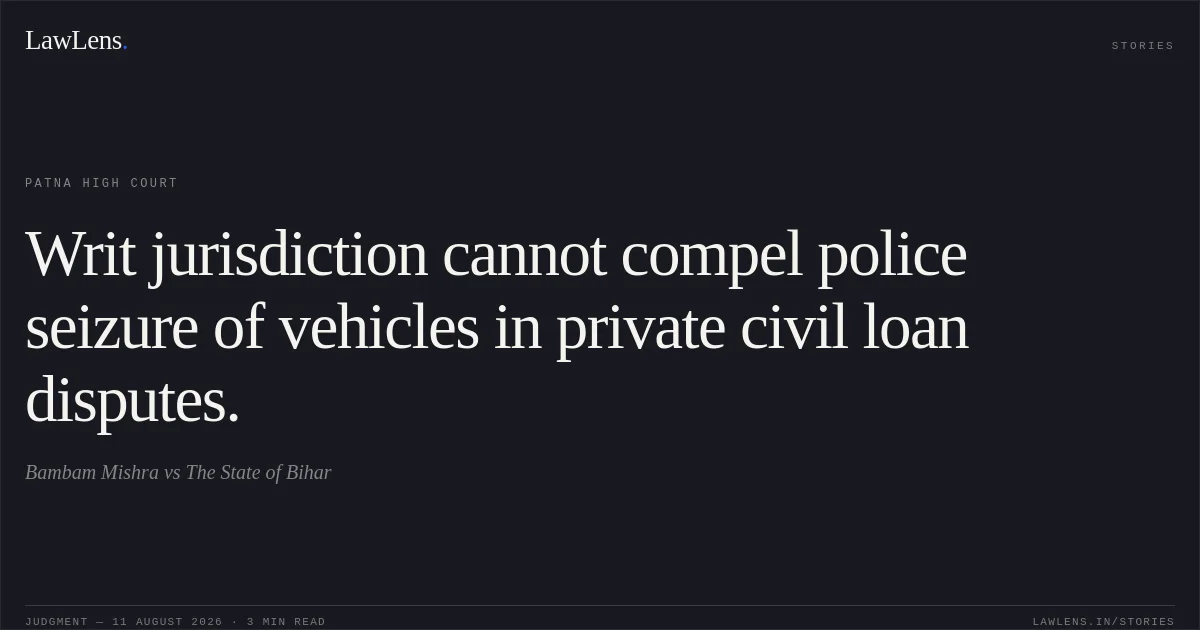
The writ petition was held not maintainable against the private financing company.
The High Court declined to direct the Senior Superintendent of Police to seize the truck or release it to the petitioner, observing that the petitioner had alternative civil remedies and had not first made any complaint to the police authorities.
Source reference: p.12, paras. 9–10The writ petition was accordingly dismissed as devoid of merit.
Source reference: p.12, para. 11Original Court PDF
Bambam MishravsThe State of Bihar
Click to open original judgment
Original judgment, available to read, download and summarize on LawLens.in