01Facts
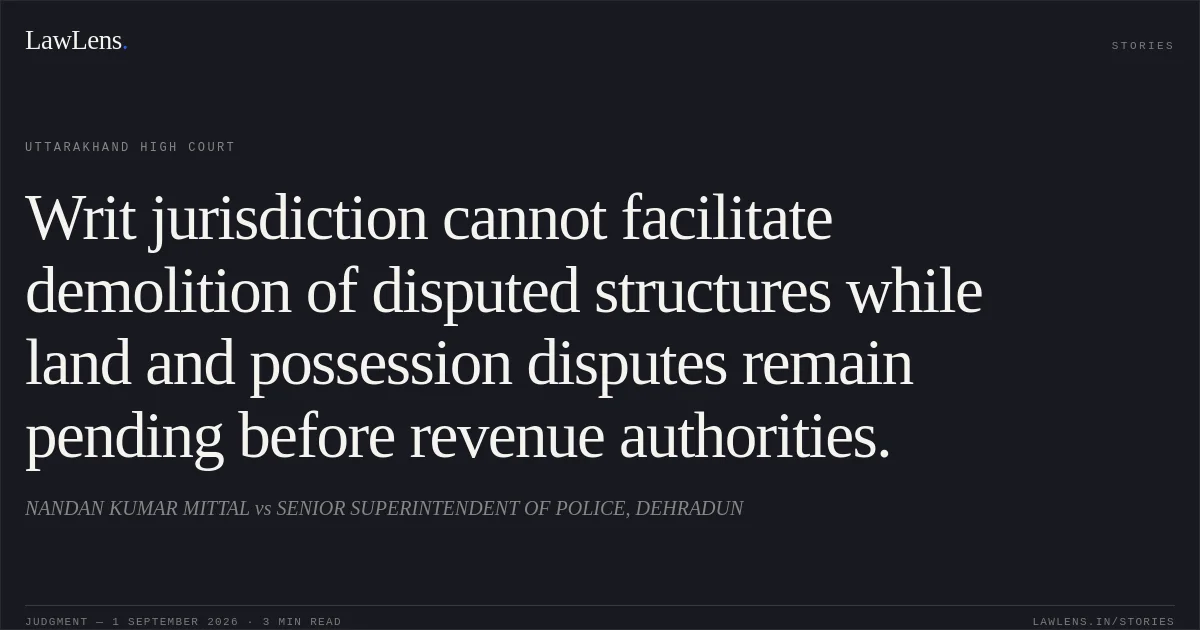
The petitioner claimed ownership and bhumidhari rights over land bearing Khasra No. 511 at Village Badowala, Tehsil Doiwala, District Dehradun.
¶ 3–5He alleged that Dabal Singh and Yashpal Singh were parking vehicles on a culvert/slab situated on his property and sought police protection to demolish the structure.
¶ 3–5The petitioner claimed to have made several representations to the police authorities, deposited ₹14,284 towards police-deployment charges, and approached the Chief Minister’s Online Grievance Portal and other authorities.
¶ 3–5He also alleged that Dabal Singh had assaulted him and fired at him.
¶ 3–5On the Court’s direction, the State produced written instructions stating that the slab had been constructed by the Zila Panchayat and was allegedly situated on Dabal Singh Bhandari’s land.
¶ 6–8The State further informed the Court that a dispute concerning possession, demarcation, and the existence and location of the gul/canal was pending before the Sub-Divisional Magistrate, Doiwala, in Case No. 04/18–19 under Section 229-B, with the next date fixed for 22 September 2026.
¶ 6–8The petitioner additionally sought refund of the amount deposited for police deployment, as the service had not been provided.
¶ 1002Issues
i.Whether the High Court, in exercise of its writ jurisdiction under Article 226 of the Constitution, should direct the police to provide protection for demolition of a culvert/slab when ownership, possession, demarcation, and the location of the structure are disputed and pending before a Revenue Authority?
¶ 12–13ii.Whether the petitioner was entitled to refund of ₹14,284 allegedly deposited towards police-deployment charges for a service that was not rendered?
¶ 10, 1403Law Applied
The Court applied the principle that writ jurisdiction under Article 226 of the Constitution of India is not ordinarily appropriate for adjudicating disputed questions of fact concerning title, possession, demarcation, or the location and existence of disputed property.
¶ 12Where an efficacious remedy is available before the competent Civil or Revenue Court, parties must pursue that remedy for determination of their substantive rights.
¶ 9, 13, 16The Court also applied the principle that police assistance may be provided for maintaining law and order, subject to the orders of the competent Revenue or Magistrate authority, but cannot be used to facilitate unilateral demolition of a structure whose ownership and location are disputed.
¶ 8, 13In relation to the deposited amount, the competent police authority was required to examine whether the amount had in fact been paid for an unrendered service and to refund the admissible amount in accordance with the applicable rules and procedure.
¶ 14Provisions in the judgment · 1
the Act (alias, unresolved) Section 229B
04Reasoning
The Court found that the petitioner’s request for police protection was inseparably connected with unresolved disputes regarding land ownership, possession, demarcation, and the location of the gul/canal and slab.
¶ 7–8, 12Since those matters were already pending before the competent Revenue Authority under Section 229-B proceedings, they could not appropriately be determined in writ proceedings.
¶ 7–8, 12Granting police protection for demolition would effectively facilitate the petitioner’s unilateral assertion of title and possession before the Revenue Authority had adjudicated the dispute.
¶ 13Accordingly, the Court declined to issue a mandamus for police deployment or demolition and directed the parties to pursue their remedies before the appropriate forum.
¶ 13However, because the petitioner claimed that he had paid ₹14,284 for police services that were never rendered, the Court directed the Senior Superintendent of Police to examine the claim and refund the admissible amount in accordance with law.
¶ 1405Holding
The writ petition was disposed of without granting police protection or permitting demolition of the disputed culvert/slab.
¶ 12–13, 16The Court held that the questions of ownership, possession, demarcation, and the location of the structure must be adjudicated by the competent Civil or Revenue Court, particularly since proceedings were already pending before the Sub-Divisional Magistrate.
¶ 12–13, 16The Senior Superintendent of Police, Dehradun, was directed to examine the petitioner’s claim for refund of ₹14,284, or any other amount actually deposited for police deployment, and to refund the admissible amount, preferably within one month from production of a certified copy of the order.
¶ 14Pending applications, if any, were also disposed of.
¶ 17Original Court PDF
NANDAN KUMAR MITTALvsSENIOR SUPERINTENDENT OF POLICE, DEHRADUN
Click to open original judgment
Original judgment, available to read, download and summarize on LawLens.in