01Facts
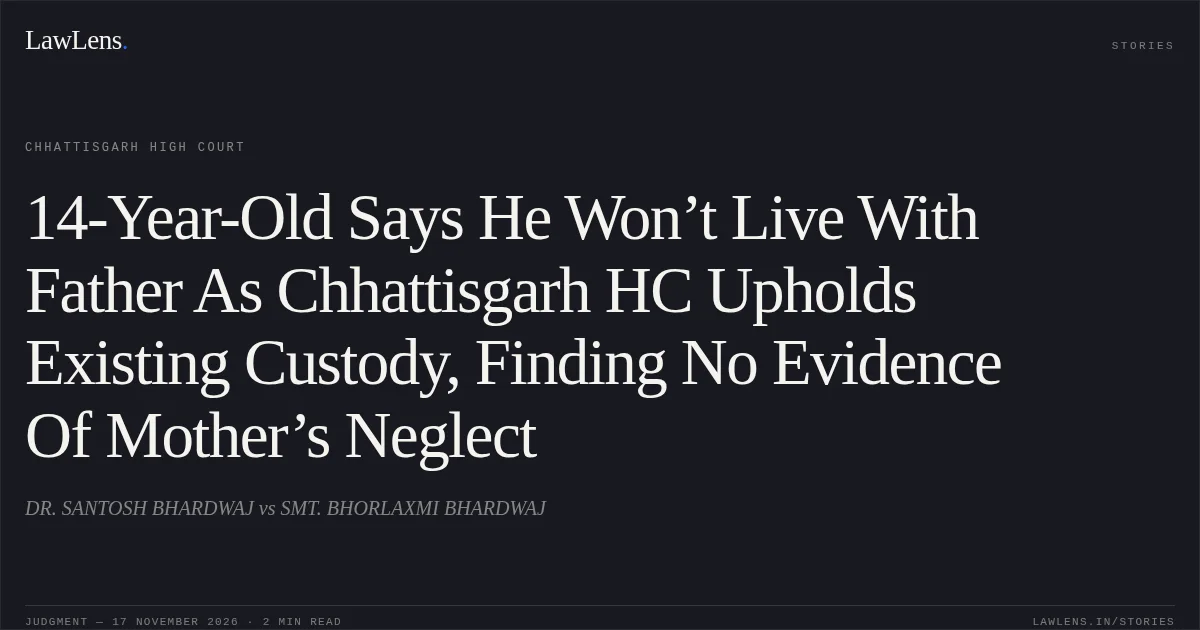
The parties’ marriage was dissolved by decree of divorce dated 29 April 2023. Their minor son, Aarav, born on 22 May 2013, was residing with his mother and maternal grandparents. Under a Lok Adalat settlement dated 13 May 2023, the father agreed to pay ₹15,000 per month as maintenance and was granted Sunday visitation.
pp. 2–4 · ¶ 3–4The father sought appointment as guardian and transfer of custody under Sections 7 and 10 of the Guardians and Wards Act, 1890, alleging that the mother’s employment and the grandparents’ age impaired the child’s care and education. The mother opposed the application, asserting that the child was properly cared for and educated.
pp. 3–6 · ¶ 5–9The Family Court dismissed the application; the father appealed under Section 19(1) of the Family Courts Act, 1984.
pp. 1–2, 6–7 · ¶ 1, 10–1302Issues
i.1. Whether the father established sufficient grounds for appointment as guardian of the minor under Section 7 of the Guardians and Wards Act, 1890.
p. 9 · ¶ 16ii.2. Whether the Family Court’s order dismissing the father’s application warranted appellate interference.
p. 9 · ¶ 1603Law Applied
Under Sections 7 and 10 of the Guardians and Wards Act, 1890, an application for appointment of a guardian must be determined by the child’s welfare and best interests.
pp. 11–12 · ¶ 22–23In Nil Ratan Kundu v. Abhijit Kundu, (2008) 9 SCC 413, the Supreme Court held that welfare is paramount in custody and guardianship decisions; courts must consider the child’s comfort, health, education, intellectual development, surroundings, and moral welfare. A child’s intelligent preference is relevant where the child is mature enough to express one, though it is not decisive by itself.
pp. 11–12 · ¶ 22–23Provisions in the judgment · 4 · Linked ones open on LawLens
Family Courts Act, 1984 Section 19
Guardians and Wards Act, 1890 Section 7Section 10
Code of Criminal Procedure, 1973 Section 125
04Reasoning
The father’s claims that the mother’s employment impaired care and that the child’s education had deteriorated were not supported by cogent evidence; the father was also professionally engaged, and no material established neglect or harm to the child’s education or welfare.
pp. 12–13 · ¶ 24–26, 28The child, then about 14, told the Court he was unwilling to live with his father. The Court treated that preference as relevant alongside the absence of evidence of neglect and concluded that changing custody without demonstrated welfare benefits risked emotional distress.
pp. 13–14 · ¶ 27–30The existing visitation arrangement and the mother’s lack of objection to the father meeting the child further weighed against transferring custody.
pp. 10–11 · ¶ 20 · p. 14 · ¶ 3005Holding
The Court held that the father had not established grounds for appointment as guardian or transfer of custody and found no illegality or material irregularity in the Family Court’s decision.
pp. 14–15 · ¶ 31The appeal was dismissed and the Family Court’s order affirmed, with no order as to costs.
p. 15 · ¶ 32The father was permitted to meet and spend time with the child on special occasions and during long vacations, subject to the child’s prior willingness, the parties’ mutual convenience, and the child’s educational schedule and comfort.
p. 15 · ¶ 33Original Court PDF
DR. SANTOSH BHARDWAJvsSMT. BHORLAXMI BHARDWAJ
Click to open original judgment
Original judgment, available to read, download and summarize on LawLens.in