01Facts
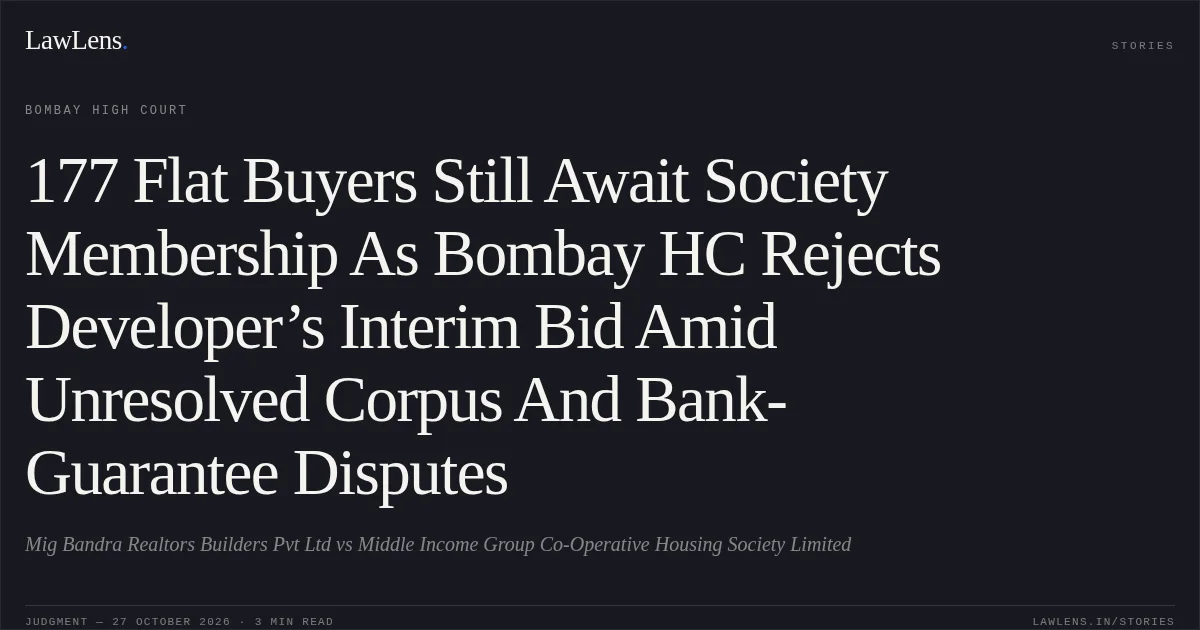
The parties entered into a Development Agreement for redevelopment of the Respondent Society’s property.
After the Society purported to terminate the agreement, the parties settled their arbitration in Consent Terms dated 27 December 2021, followed by a Consent Award dated 4 January 2022.
¶ 2, 10The Petitioner sought a mandatory injunction under Section 9 of the Arbitration and Conciliation Act, 1996, directing the Society to admit 177 flat purchasers as members.
¶ 1, 3–9It contended that the purchasers’ proportionate corpus, share money and sinking fund had been paid, and that the Society was imposing conditions not contained in the agreement or Consent Terms.
¶ 1, 3–9The Society disputed the corpus calculation and timing of payment, and contended that bank guarantees had expired before the periods or milestones specified in the Consent Terms.
¶ 16–32The Petition was dismissed.
¶ 8402Issues
i.1. Whether the Petitioner established the exceptional grounds required for a mandatory interim injunction directing the Society to admit the purchasers as members under Section 9 of the Arbitration Act.
¶ 33–37, 74–78ii.2. Whether the dispute over the Excess Amount, corpus calculation and delayed corpus payments established that the Petitioner had complied with, or was excused from, its obligations under the Consent Terms.
¶ 43–58, 75iii.3. Whether expiry of the bank guarantees raised an unresolved question as to the revival of termination, preventing the Court from granting the requested relief.
¶ 59–70, 75iv.4. Whether Section 163 of the Maharashtra Co-operative Societies Act, 1960, or non-joinder of the flat purchasers independently barred the Petition.
¶ 79–8203Law Applied
Section 9 of the Arbitration and Conciliation Act permits interim measures after an arbitral award is made but before enforcement under Section 36; however, it is a protective jurisdiction and ordinarily cannot substitute for execution or finally determine disputed rights.
¶ 35Under Dorab Cawasji Warden v. Coomi Sorab Warden, (1990) 2 SCC 117, an interim mandatory injunction requires a stronger case than an ordinary prima facie case, serious injury not adequately compensable in money, and a balance of convenience supporting relief.
¶ 36Under Deoraj v. State of Maharashtra, (2004) 4 SCC 697, where interim relief would substantially grant the final relief, a very strong prima facie case and exceptional circumstances demonstrating that refusal would cause greater injustice are required.
¶ 37Periyakkal v. Dakshyani, (1983) 2 SCC 12, recognises a limited power to extend time fixed by a compromise decree to prevent serious injustice, exercisable only in a proper case and not merely because a party seeks it.
¶ 69The relevant contractual terms—Clauses 9.5 and 9.9 of the Development Agreement and Clause 20 of the Consent Terms—require admission of purchasers upon compliance with the stipulated documentary and payment requirements, while permitting refusal where the required proportionate corpus remains unpaid.
¶ 38–43Provisions in the judgment · 7 · Linked ones open on LawLens
Arbitration and Conciliation Act, 1996 Section 9Section 17Section 36Section 37
Maharashtra Co-operative Societies Act, 1960 Section 163
Code of Civil Procedure, 1908 Section 151
Life Insurance Corporation (Modification of Settlements) Act, 1976 Section 2
04Reasoning
Clauses 9.5 and 9.9 supported the Petitioner’s contention that the Society could not impose an additional condition tied to the Clause 10 Excess Amount; that monetary dispute was distinct from the corpus obligation under Clause 20.
¶ 45–49But the Petitioner had not established, for purposes of the requested mandatory relief, that the full corpus was correctly calculated and paid: the applicable rate and formula remained disputed, and the payments relied upon began after possession had been handed over, contrary to Clause 20’s stated timing requirement.
¶ 50–58The bank guarantees had also expired before the periods or milestones relied upon by the Society, raising unresolved questions under Clauses 3 and 4 of the Consent Terms; the Petitioner’s offer to provide replacement guarantees did not establish that the earlier obligations had been performed or that termination could not revive.
¶ 61–68Because admitting the purchasers would substantially grant the relief sought and could be difficult to reverse, the unresolved compliance and termination issues meant the Petitioner had not met the heightened Dorab and Deoraj standards.
¶ 72–78The Section 163 objection and non-joinder objection did not independently defeat the Petition.
¶ 80–8205Holding
The Court held that the Petitioner had not shown the very strong and clear case required for a mandatory injunction under Section 9, given the unresolved issues concerning the Clause 20 corpus, payment timing, bank guarantees and possible revival of termination.
¶ 75–78, 83The Petition was dismissed, with no order as to costs.
¶ 84The Court left open the parties’ substantive rights and the amounts payable under Clauses 10 and 20, and did not affect the purchasers’ independent remedies under the MCS Act.
¶ 84–85Original Court PDF
Mig Bandra Realtors Builders Pvt LtdvsMiddle Income Group Co-Operative Housing Society Limited
Click to open original judgment
Original judgment, available to read, download and summarize on LawLens.in