01Facts
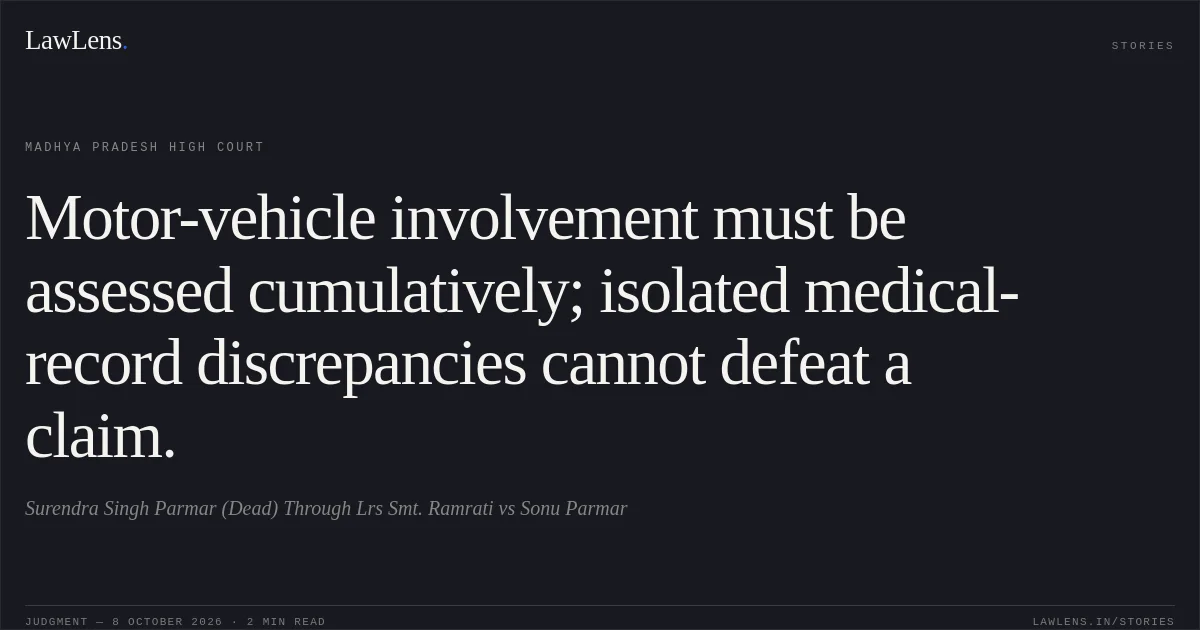
The appeal under Section 173(1) of the Motor Vehicles Act, 1988, challenged a Motor Accident Claims Tribunal award in favour of the claimants, on the ground that the insured vehicle had been falsely implicated.
¶ 1The alleged accident occurred on 11 October 2016; the injured woman died on 3 November 2016, and the FIR identifying the offending vehicle was lodged on 12 February 2017.
¶ 2, 8Her grandson, Ankit Verma, claimed to have witnessed the accident.
¶ 3The insurer relied on the absence of any contemporaneous disclosure identifying the vehicle, including in the hospital records and the merg intimation, and on the delay in lodging the FIR.
¶ 6–8The claimants relied on Anita Sharma v. The New India Assurance Company Limited concerning the applicable standard of proof in motor accident claims.
¶ 502Issues
i.1. Whether the claimants established, on a preponderance of probabilities, that the alleged vehicle was involved in the accident, or whether it had been falsely implicated.
¶ 3, 6–10ii.2. Whether the Tribunal’s award should be set aside in light of the witness’s failure to explain the delayed disclosure and identification of the offending vehicle.
¶ 7–1103Law Applied
Section 173(1) of the Motor Vehicles Act, 1988, provides for an appeal against an award of a Claims Tribunal.
¶ 1As stated in Anita Sharma v. The New India Assurance Company Limited, (2021) 1 SCC 171, motor accident claims are decided on a preponderance of probabilities, not proof beyond reasonable doubt; courts should assess the material on record rather than apply criminal-trial standards or fault claimants merely for not examining particular eyewitnesses.
¶ 5That standard does not require acceptance of a claim where the evidence and surrounding circumstances undermine its credibility.
¶ 9Provisions in the judgment · 1 · Linked ones open on LawLens
Motor Vehicles Act, 1988 Section 173
04Reasoning
The Court found Ankit Verma’s account doubtful because, despite claiming to have witnessed the accident and accompanying his grandmother, he gave no explanation for not identifying the offending vehicle to medical personnel, the police, or in the merg intimation.
¶ 6–8The hospital prescriptions did not establish that he took her to hospital, and the Court noted that a police outpost was located within the hospital premises.
¶ 6–7It also considered the approximately three-month delay between the death and the FIR identifying the vehicle unexplained.
¶ 8–10On these circumstances, the Court treated Ankit Verma as a planted witness and concluded that the claim of vehicle involvement was not reliable, notwithstanding the standard of proof applicable to MACT claims.
¶ 9–1005Holding
The Court allowed the insurer’s appeal and set aside the Tribunal’s award, concluding that the offending vehicle had been falsely implicated and that the claimant witness’s conduct was doubtful.
¶ 11The Tribunal’s record was directed to remain intact.
¶ 12Original Court PDF
Shriram General Insurance Co.Ltd.vsKusum Verma
Click to open original judgment
Original judgment, available to read, download and summarize on LawLens.in