01Facts
The plaintiff, a consultant to the first defendant (D1), Vyas Builders Pvt. Ltd., undertook to clear a mortgage over 4.6 acres at Kallikuppam and market the land.
¶ 2(a)He then worked for about ten years on the project, clearing encroachers, litigation, compound walls and patta records.
¶ 2(b)D1 and the second defendant (D2), Loyal Housing Development Pvt. Ltd., executed a Joint Development Agreement on 21.03.2010 under which D2 would construct and hand over 77,000 sq. ft. to D1.
¶ 2(c)In lieu of unpaid services, D1 agreed to give the plaintiff 9,597 sq. ft. across Plot Nos. 2, 43, 15, 18, 75 and 74, by way of an MoU dated 11.04.2014 (Ex.P4) and a General Power of Attorney dated 10.04.2014 (Ex.P3).
¶ 2(c)–(d)D2 built flats on Plots 2 and 43, and eight flats were sold through the plaintiff, with a claimed shortfall of Rs.27 lakhs.
¶ 2(d)The project halted in December 2017 and the remaining plots were not developed.
¶ 2(d)The plaintiff claimed Rs.1,97,94,000 (Rs.27 lakhs plus Rs.1,70,94,000 construction cost at Rs.2,000/sq. ft.) with 24% interest.
¶ 2(f) · ¶ 1 of prayerD1 did not file a written statement and forfeited its right to do so.
¶ 3D2 denied privity of contract with the plaintiff and pleaded that any payments were made on D1's behalf under the JDA.
¶ 4The bank (D3) did not contest and no relief was sought against it.
¶ 5Additional issues were framed on 21.07.2026.
¶ 7The plaintiff examined himself (P.W.1) and marked Ex.P1–P22; D2 examined D.W.1 and marked Ex.D1–D7.
¶ 802Issues
i.1. Whether the plaintiff has any privity of contract with D2, and whether D2 is bound by the MoU dated 11.04.2014 and liable to construct or pay construction cost to the plaintiff.
¶ 13 · ¶ 14 · Issues a–jii.2. Whether the plaintiff is entitled to recover the suit claim jointly and severally against D1 and D2.
¶ 15–19 · Additional Issue (i)iii.3. Whether D2 is liable to pay Rs.27,00,000 as balance sale consideration for the eight flats sold on Plots 2 and 43.
¶ 19 · Additional Issue (ii)iv.4. Whether the MoU (Ex.P4) is admissible despite deficient stamp duty and non-registration, and whether the suit is barred by limitation.
¶ 15–17v.5. Whether D1's objections regarding the lack of Board Resolution and lack of proper authority can be entertained.
¶ 1803Law Applied
The court relied on the principle of privity of contract, holding that a party cannot be bound by a contract to which it is not a party absent a contrary agreement.
¶ 13 · ¶ 14The court applied Section 36 of the Indian Stamp Act, 1899, which bars a party from challenging the admissibility of a deficiently stamped instrument after it has been admitted in evidence without objection.
¶ 15Since a registered GPA was executed contemporaneously, the MoU effected no transfer of title and could be admitted to found a claim.
¶ 16The court applied the law of limitation, treating payments made in 2018 as keeping the cause of action alive so that a 2020 suit was within time.
¶ 17The court drew on Order VIII Rules 3 and 5 CPC and the Supreme Court decisions in Muddasani Venkata Narsaiah, Jaspal Kaur Cheema and Thangam v. Navamani Ammal, which hold that pleadings must be specifically denied and that evasive denials amount to admissions.
¶ 9(e) · ¶ 20The court relied on the principle that a forfeited defendant cannot raise technical objections that could have been taken only in a written statement.
¶ 18Provisions in the judgment · 2 · Linked ones open on LawLens
Registration Act, 1908 Section 49
Indian Stamp Act, 1899 Section 36
04Reasoning
The court held that D2 was not bound by the MoU, which was executed only between the plaintiff and D1, and D2 had no contractual relationship with the plaintiff.
¶ 13Payments by D2 to the plaintiff from the sale of flats on Plots 2 and 43 were made on D1's behalf under the JDA, and did not amount to an agreement by D2 to construct flats for the plaintiff.
¶ 14Since D2 had pointed to D1 as the party in breach of the JDA, the plaintiff's remedy lay against D1 alone.
¶ 14As to D1, the court held that D1, having forfeited its written statement, could not later challenge the MoU's stamping or registration after Ex.P4 was admitted without objection.
¶ 15The registered GPA meant that the MoU transferred no title, so it could be relied on for the claim.
¶ 16The court found the Board Resolution objection to be a technical plea that should have been raised in a written statement. D1's cross-examination of P.W.1 also admitted the MoU's execution.
¶ 18On limitation, bank statements showed payments into 2018, so the cause of action survived and the 2020 filing was in time.
¶ 17Quantification was accepted because the construction cost was pegged at the rate actually incurred on Plots 2 and 43, and the Rs.27 lakh shortfall was supported by bank statements that were not rebutted.
¶ 1905Holding
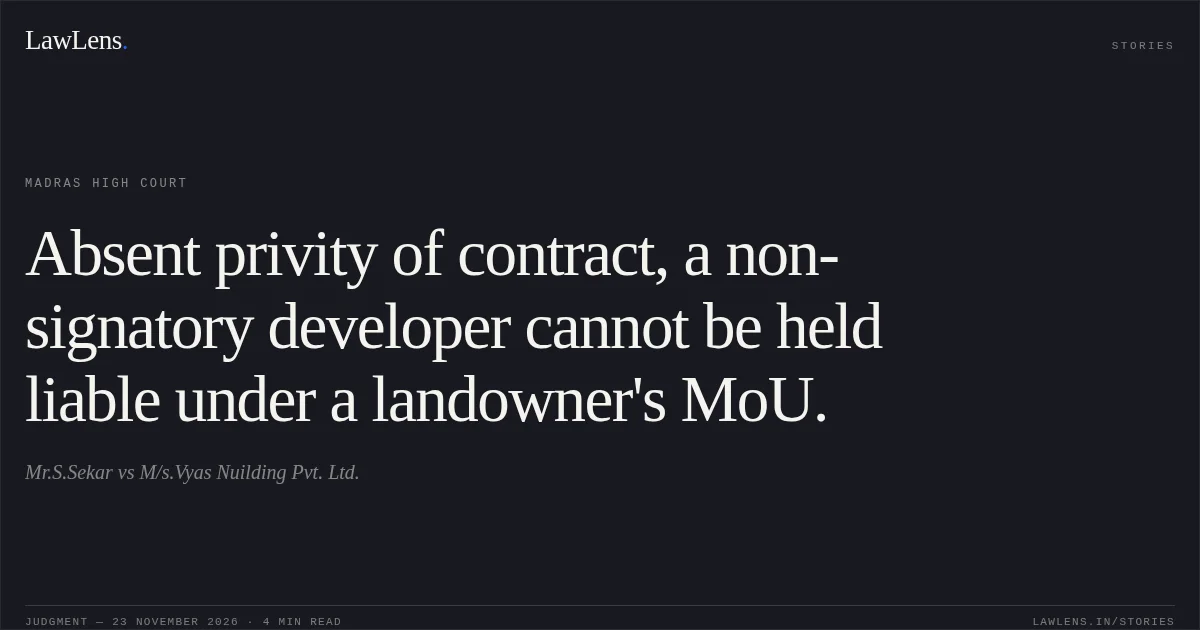
The court held that the suit against D2 was not maintainable because there was no privity of contract, so D2 is not liable on the construction claim or the Rs.27 lakh claim.
¶ 13 · ¶ 14The court held that the plaintiff is entitled to a decree against D1 alone, on the MoU, for Rs.1,97,94,000, and that the MoU was admissible notwithstanding the stamping and registration objections and was not time-barred.
¶ 15–19The suit is decreed against D1 for Rs.1,97,94,000 with interest at 12% p.a. from the date of plaint to the date of decree and 6% p.a. thereafter until realisation, with costs payable by D1.
¶ 21The suit is dismissed against D2 with no order as to costs for D2.
¶ 21Original Court PDF
Mr.S.SekarvsM/s.Vyas Nuilding Pvt. Ltd.
Click to open original judgment
Original judgment, available to read, download and summarize on LawLens.in