01Facts
The petitioner was a Clerk with the respondent Board. He was charge-sheeted on 21.11.2001 under Rule 14 of the CCS (CCA) Rules, 1965, for furnishing a false matriculation certificate to obtain appointment.
¶ 2The first Inquiry Officer's report dated 11.03.2003 held the charges unproved.
¶ 2The Disciplinary Authority found that the report had not appreciated material documents and, by letter dated 16.05.2005, remitted the matter to the Inquiry Officer under Rule 15(1) to re-examine documents already on record.
¶ 3 · no citation for RA-III beyond para. 13The second report dated 14.07.2005 held the charges proved.
¶ 3The petitioner objected that the second report was dictated by the Disciplinary Authority and that he was not associated after remand.
¶ 4The Disciplinary Authority rejected the objections and imposed dismissal by order dated 24.01.2006.
¶ 5The Appellate Authority dismissed the statutory appeal on 18.03.2006.
¶ 6The Judicial Magistrate First Class (VI), Shimla acquitted the petitioner of offences under Sections 420, 467, 468 and 471 IPC by judgment dated 01.10.2011, and the appellate court affirmed the acquittal on 08.07.2015.
¶ 7, 10, 19The Board's case is that the certificate was originally issued to the petitioner's younger brother, and that rubbing and over-typing was found in the roll number and date-of-birth entries.
¶ 802Issues
i.1. Whether the Disciplinary Authority could remit the matter to the Inquiry Officer under Rule 15(1) of the CCS (CCA) Rules, 1965 for a fresh report when nothing new had emerged.
¶ 12, 13ii.2. Whether the inquiry report is vitiated because the petitioner was not associated after the remand, in breach of the principles of natural justice.
¶ 14iii.3. Whether the petitioner's acquittal in the criminal case renders the dismissal order and the appellate order unsustainable.
¶ 12, 18, 19, 21iv.4. Whether the impugned orders warrant interference under Article 226 of the Constitution.
¶ 22, 2303Law Applied
Rule 15(1) of the CCS (CCA) Rules, 1965 permits the Disciplinary Authority, if it is not the Inquiring Authority, to remit a case for further inquiry and report for reasons recorded in writing.
¶ 13, 15R.K. Gupta v. Union of India (1981) was distinguished on the ground that the petitioner was never exonerated by a Disciplinary Authority order and that the Rules expressly provide for remand.
¶ 15Canara Bank v. Swapan Kumar Pani (2006) and Coal India v. Ananta Saha (2011) were distinguished because no second inquiry or exoneration attaining finality was involved.
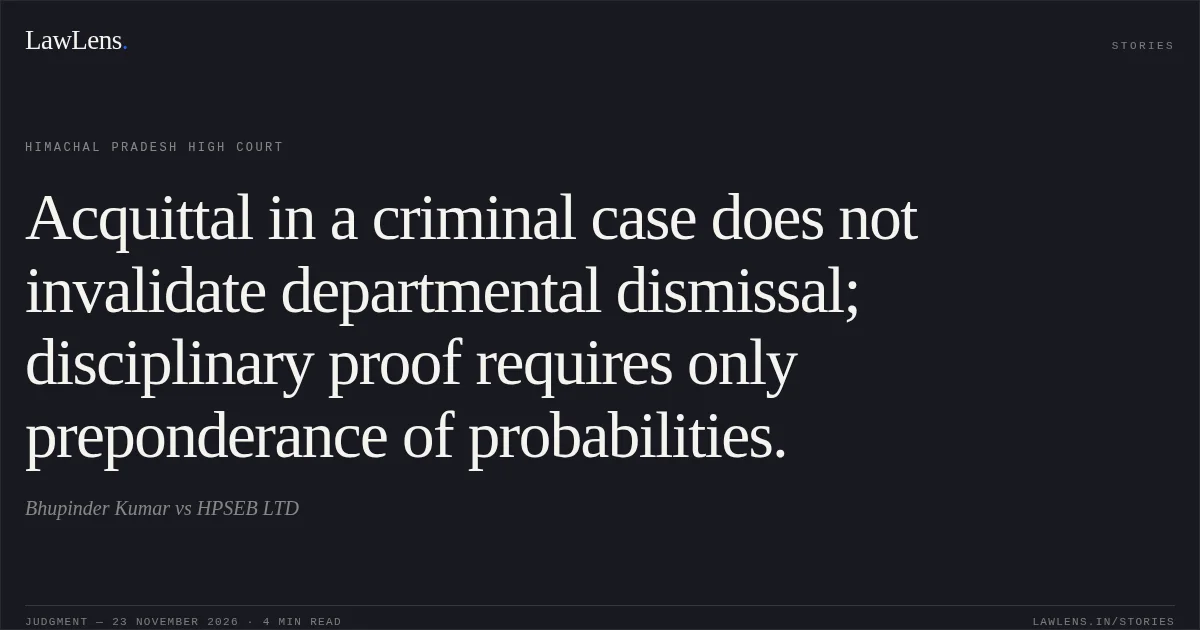
¶ 16, 17State of Rajasthan v. Heem Singh (2021), quoting Southern Railway Officers Assn. v. Union of India and State v. S. Samuthiram, holds that acquittal in a criminal case does not by itself invalidate disciplinary punishment, and that "honourable acquittal" depends on the nature of the acquittal.
¶ 19State Bank of India v. K.S. Vishwanath (2022) holds that criminal and disciplinary standards of proof differ, so an acquittal on benefit of doubt does not invalidate a completed disciplinary proceeding.
¶ 20State of A.P. v. S. Sree Rama Rao, AIR 1963 SC 1723, limits the High Court under Article 226 to examining competence, procedure, and natural justice, and does not permit it to act as an appellate court on the evidence.
¶ 22Ram Lal v. State of Rajasthan (2024), relied on by the petitioner, was held inapplicable because there the charge was not proved.
¶ 19Provisions in the judgment · 4 · Linked ones open on LawLens
Indian Penal Code, 1860 Section 420Section 467Section 468Section 471
04Reasoning
The court held that the Disciplinary Authority's remand was valid under Rule 15(1). The Inquiry Officer had applied a strict criminal standard of proof, whereas a departmental inquiry turns on preponderance of probabilities. The re-examination was confined to documents already on record, so no new material was introduced.
¶ 13The natural justice challenge failed because no fresh evidence was collected after remand and the petitioner did not contend that the inquiry deviated from the CCS (CCA) procedure. His only grievances were the remand itself and the absence of association, and the court held that the first ground failed and the second did not vitiate an inquiry based wholly on existing record.
¶ 14The court held that the Ram Lal and Heem Singh line governs. The criminal acquittal was on benefit of doubt, not on a finding that the charge was false, and it does not automatically invalidate the disciplinary finding, particularly where the inquiry established that the petitioner obtained employment through a document issued to his brother.
¶ 19–21The court noted that the Disciplinary Authority and the Appellate Authority each gave reasoned orders, and declined to reappraise the evidence under Article 226 in the absence of procedural illegality, perversity, or violation of natural justice.
¶ 22, 2305Holding
Remand under Rule 15(1) for re-appreciation of existing record is valid and not an illegality.
¶ 13Non-association after remand does not violate natural justice where no fresh material was collected.
¶ 14R.K. Gupta, Swapan Kumar Pani, Ananta Saha and Ram Lal are distinguishable on their facts.
¶ 15–19The criminal acquittal on benefit of doubt does not ipso facto invalidate the dismissal order, and the impugned orders dated 24.01.2006 and 18.03.2006 do not warrant interference under Article 226. The petition is dismissed.
¶ 21, 23, 24No order as to costs.
¶ 24Original Court PDF
Bhupinder KumarvsHPSEB LTD
Click to open original judgment
Original judgment, available to read, download and summarize on LawLens.in