01Facts
The petitioner holds a B.Sc. (Non-Medical), a B.Ed. from Himachal Pradesh University with Mathematics and Physical Science as teaching subjects, a Master of English from IGNOU (63.14%), and HP TET qualification.
¶ 2(C), 3, 4The Himachal Pradesh Rajya Chayan Aayog, Hamirpur, issued Advertisement No. 14/2026 dated 02.11.2026 inviting applications for English Teachers (Post Code 26046) and other posts in CBSE-Affiliated Schools of Excellence, under the Scheme dated 19.01.2026 (Annexure P-4).
¶ 3Under Paragraph 5 of the Scheme, the eligibility for the English post is M.A. (English) with 50% marks in graduation, B.Ed., and English as a compulsory subject in B.Ed.
¶ 4, 5, 9The petitioner's B.Ed. did not include English as a compulsory subject, so she was held ineligible.
¶ 4The petitioner challenged Paragraph 5 as arbitrary and violative of Articles 14 and 16, sought reconsideration of her candidature, production of the underlying rules and material, and provisional permission to apply.
¶ 2The Advocate General defended the condition on the ground that science graduates do not study English at undergraduate level, so the B.Ed. condition compensates for that gap. He added that the same condition applies to the Mathematics post.
¶ 6, 7, 802Issues
i.1. Whether the requirement of English as a compulsory subject in B.Ed., prescribed in Paragraph 5 of the Scheme for the post of English Teacher, is arbitrary and violative of Articles 14 and 16 of the Constitution.
¶ 2(A), 4, 9ii.2. Whether the Court should interfere with the eligibility criteria prescribed under a recruitment policy, given that such matters fall within the State's policy domain.
¶ 11, 14iii.3. Whether the petitioner's non-fulfilment of the condition renders the condition itself unlawful, and whether she is entitled to reconsideration of her eligibility under the HPU B.Ed. Regulations.
¶ 2(B)–(C), 10, 1303Law Applied
The Court relied on Articles 14 and 16 of the Constitution as the standard for testing the arbitrariness of the impugned condition.
¶ 2(A), 9The Court applied the principle from P.U. Joshi & Others v. Accountant General, Ahmedabad (2003) 2 SCC 632, under which the prescription of qualifications and other conditions of service pertains to policy and lies within the State's exclusive discretion, subject to constitutional limitations. Courts and tribunals therefore cannot direct the State to adopt particular eligibility criteria, and the State may alter qualifications.
¶ 11Applying this principle, the Court held that judicial interference is warranted only where a prescribed criterion transgresses constitutional limitations.
¶ 1404Reasoning
The Court first examined the structure of Paragraph 5 and found that it does not exclude science graduates. It permits candidates without an English or Humanities graduation to apply if they hold an M.A. in English with 50% marks, a B.Ed., and English as a compulsory B.Ed. subject.
¶ 10Because the English requirement addresses the gap created by the petitioner's science background, the Court held that the B.Ed. condition is not alien to the post of English Teacher and is a rational qualification for it.
¶ 12The Court rejected the argument that the HPU B.Ed. does not offer English as a compulsory subject, holding that this institutional limitation does not make the prescribed qualification per se unlawful.
¶ 10The Court further held that the petitioner's ineligibility does not establish that the criterion is bad in law.
¶ 13Applying P.U. Joshi, the Court declined to interfere with a policy choice on qualifications that lies within executive competence and that does not transgress constitutional limits.
¶ 11, 14The Court did not separately address the Mathematics-parity point, although it had been raised in the Advocate General's submissions.
¶ 705Holding
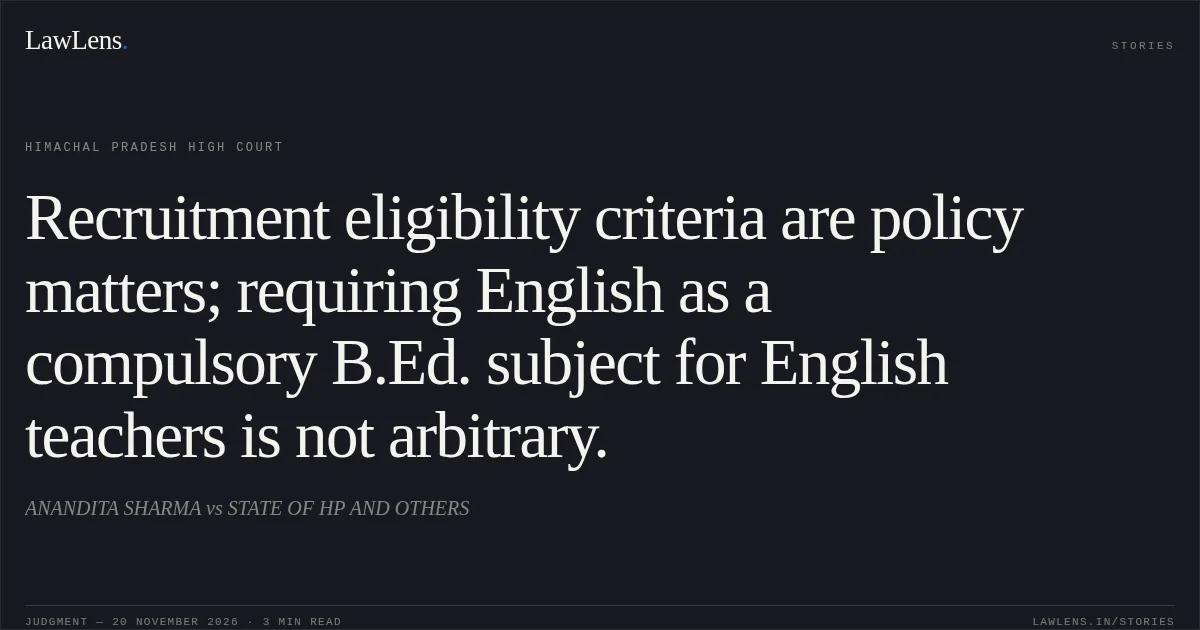
The Court held that the requirement of English as a compulsory subject in B.Ed., prescribed in Paragraph 5 of the Scheme for the post of English Teacher, is not arbitrary or violative of Articles 14 and 16, and that the petitioner's ineligibility does not render the criterion unlawful.
¶ 9, 12, 13The petition was dismissed for want of merit, with pending miscellaneous applications disposed of. The prayers for reconsideration of the petitioner's eligibility and for provisional permission to apply were therefore rejected, and no direction was issued for production of records.
¶ 14Original Court PDF
ANANDITA SHARMAvsSTATE OF HP AND OTHERS
Click to open original judgment
Original judgment, available to read, download and summarize on LawLens.in