01Facts
The petitioners, HHC No. 483 (Raghuvir Singh) and HHC No. 847 (Arvind Kumar), were escorting under-trial accused Ranjit Kumar alias Raju from Pathankot to Dharamshala. On 16.08.2008, the accused escaped from their custody at the Pathankot bus stand.
¶ 3The petitioners were charge-sheeted, and a departmental enquiry under Rule 14 of the CCS (CCA) Rules, 1965 was conducted. The Enquiry Officer held the charges of dereliction of duty and carelessness proved.
¶ 4After considering the petitioners' replies to the show cause notice, the Disciplinary Authority imposed a penalty of forfeiture of five years' service on a permanent basis by order dated 07.03.2009.
¶ 5The Appellate Authority dismissed the statutory appeals on 07.05.2009, and the Revisional Authority dismissed the revisions on 07.10.2009.
¶ 6 · ¶ 7The petitioners were acquitted by the Judicial Magistrate First Class, Pathankot, on 23.05.2011, with the benefit of doubt.
¶ 8 · ¶ 20Their representation to the Disciplinary Authority dated 31.08.2012 was returned on 15.09.2012, with a direction to approach the Revisional Authority.
¶ 8 · ¶ 17The writ petitions were filed in April 2013.
¶ 17The petitioners contended that the findings were perverse, that the same evidence had led to acquittal, and that the penalty should be quashed.
¶ 9The respondents pleaded limitation, delay and laches, and that the departmental and criminal proceedings are distinct.
¶ 10 · ¶ 11 · ¶ 1202Issues
i.1. Whether the High Court, exercising jurisdiction under Article 226 of the Constitution, can interfere with the findings of a departmental enquiry and the penalty imposed, where the enquiry was conducted in accordance with law and natural justice.
¶ 15 · ¶ 18ii.2. Whether the petitioners' acquittal in the criminal case, granted on the benefit of doubt, entitles them to quash the departmental penalty.
¶ 19 · ¶ 20 · ¶ 21 · ¶ 22 · ¶ 23 · ¶ 24 · ¶ 25iii.3. Whether Rule 16.3 of the Punjab Police Rules, 1934, bars departmental punishment after acquittal on the same charge.
¶ 26 · ¶ 27iv.4. Whether the writ petitions are barred by delay and laches.
¶ 28 · ¶ 2903Law Applied
State of Andhra Pradesh v. S. Sree Rama Rao, AIR 1963 SC 1723, holds that a High Court under Article 226 is not an appellate forum over departmental enquiry findings. It may interfere only where the enquiry is by an incompetent authority, violates the prescribed procedure or natural justice, or the findings are perverse, and it will not re-appreciate evidence where some legal evidence supports the finding.
¶ 15State of Rajasthan v. Heem Singh, (2021) 12 SCC 569, and Southern Railway Officers Assn. v. Union of India hold that acquittal in a criminal case does not by itself invalidate a disciplinary penalty, and that the standards of proof differ, as the disciplinary standard is preponderance of probabilities.
¶ 21 · ¶ 38-40 of Heem Singh as quoted in para. 21State Bank of India v. K.S. Vishwanath, (2022) 15 SCC 190, holds that acquittal by giving the benefit of doubt does not render a completed disciplinary proceeding invalid.
¶ 22Ram Lal v. State of Rajasthan, (2024) 1 SCC 175, permits interference with penalty where the prosecution has "miserably failed" to prove the charge; it was distinguished.
¶ 19 · ¶ 24Rule 16.3 of the Punjab Police Rules, 1934, bars departmental punishment on the same charge after a criminal acquittal, but it applies only to acquittal before punishment.
¶ 26 · ¶ 27The doctrine of delay and laches applies to writ petitions.
¶ 28 · ¶ 29Provisions in the judgment · 4 · Linked ones open on LawLens
Indian Penal Code, 1860 Section 379Section 411Section 223Section 224
04Reasoning
The enquiry was conducted under Rule 14 with notice, cross-examination and an opportunity to defend, and the Disciplinary Authority supplied the enquiry report and considered the replies before imposing the penalty. Because the enquiry was procedurally sound and the penalty was affirmed by two statutory authorities, the Court could not act as an appellate forum or substitute its view on proportionality.
¶ 16 · ¶ 18The Magistrate extended the benefit of doubt because no witness deposed to the petitioners' negligence, which was not a finding that the prosecution "miserably failed". Ram Lal was therefore held inapplicable, and the same evidence leading to different outcomes is permissible because the standards of proof differ.
¶ 20 · ¶ 24 · ¶ 22 · ¶ 25The penalty was imposed before the acquittal, so the bar on proceeding "after" acquittal could not apply. The petitioners, if they believed the proceedings should not continue, should have approached the Court before the penalty was imposed.
¶ 27The penalty became final with the revisional order of 07.10.2009, yet the petitions were filed in April 2013, after an unexplained delay of about four years, and the representation to a non-competent authority did not justify the delay.
¶ 27 · ¶ 2905Holding
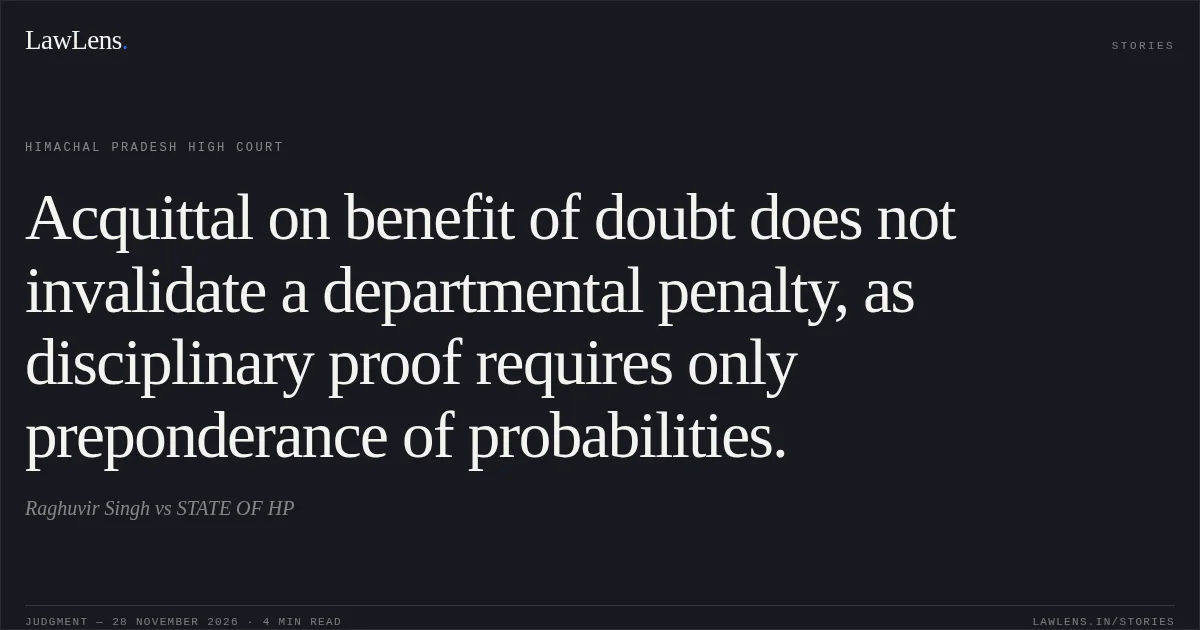
The High Court will not interfere under Article 226 with an enquiry conducted in accordance with law and affirmed by two appellate tiers. Acquittal by benefit of doubt in a criminal trial does not ipso facto invalidate a departmental penalty, and Ram Lal does not apply absent a finding that the prosecution miserably failed. Rule 16.3 of the Punjab Police Rules does not apply where the penalty predates the acquittal. The petitions are also barred by unexplained delay and laches.
¶ 18 · ¶ 23 · ¶ 24 · ¶ 25 · ¶ 27 · ¶ 29Both writ petitions are dismissed on merits and on delay and laches, with no order as to costs, and pending applications are disposed of.
¶ 31Original Court PDF
Raghuvir SinghvsSTATE OF HP
Click to open original judgment
Original judgment, available to read, download and summarize on LawLens.in