01Facts
The petitioner was appointed as a Lecturer (School Cadre) on 12.09.1986 and worked on tenure basis until regularization on 3.11.1995.
¶ 2On regularization, he was given the benefit of his tenure service for pay fixation and annual increments, and he drew the higher pay from 1995 to 2015.
¶ 2Shortly before his superannuation, he filed the present petition seeking full arrears on increments accrued during the tenure period (1986–1995), relying on Thakuri Devi v. State of H.P. (Latest HLJ 2010 (HP) 549) and a communication dated 27.09.1977.
¶ 2The State's reply affidavit stated that tenure service was counted for increments, but arrears were restricted to three years before the petitioner's earlier writ petition, CWP No. 3675 of 2010.
¶ 4The petitioner filed no rejoinder.
¶ 5The earlier writ was decided on 02.07.2010, granting increments and arrears for 36 months.
¶ 7The matter had been transferred to the State Administrative Tribunal and, after its abolition, re-transferred to this Court.
¶ 102Issues
i.1. Whether the petitioner is entitled to full arrears for 1986–1995 arising from annual increments on tenure service, despite the earlier judgment dated 02.07.2010 restricting arrears to 36 months.
¶ 7 · ¶ 10(i)ii.2. Whether the belated claim, raised after about 20 years, is barred by delay, as the claim is not a continuing wrong.
¶ 7, final limbiii.3. Whether the earlier judgment dated 02.07.2010, which had attained finality, bars the petitioner from raising a claim for further arrears that was not granted or pressed in the earlier round.
¶ 7, first to fourth limbs · ¶ 10(ii)03Law Applied
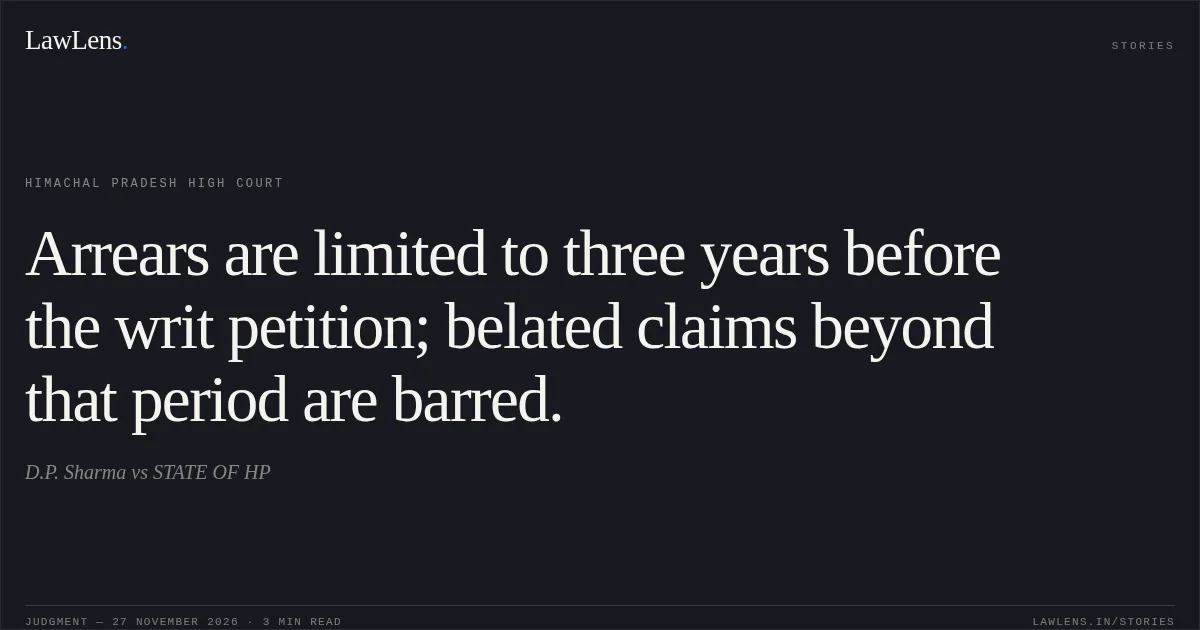
Union of India v. Tarsem Singh (2008) 8 SCC 648 holds that delay affects consequential claims for arrears. Where a claim is made after an unexplained long delay, arrears should be restricted to three years before the writ petition or from the date of demand, whichever is lesser, and interest should not be granted.
¶ 7, quoting Tarsem Singh · ¶ 8The finality of the earlier judgment dated 02.07.2010 in CWP No. 3675 of 2010 applies, as it had not been challenged and contained no mandate for full consequential benefits.
¶ 7, first to third limbs · ¶ 10(ii)A party who had the opportunity to seek a relief in earlier litigation and did not obtain it has no locus or right to raise it in fresh proceedings.
¶ 7, fourth limbA petitioner who remained a "fence sitter" cannot claim arrears after a lapse of 20 years.
¶ 7, sixth limbThe claim for arrears for 1986–1995 is not a continuing wrong.
¶ 7, final limb04Reasoning
The petitioner had already obtained arrears for 36 months under the 2010 judgment, which had become final.
¶ 7That judgment contained no direction for full consequential benefits, and its silence cannot be used to revive a claim after two decades.
¶ 7, third limbThe petitioner's reliance on Thakuri Devi and the 1977 communication did not alter this, as the Court did not engage with those authorities.
¶ 7The petitioner filed no rejoinder to rebut the State's stand on the three-year limitation on arrears.
¶ 5At the hearing, counsel could not offer any submission to displace the findings in para. 7.
¶ 8The 1986–1995 arrears were a stale, non-continuing claim, and the Tarsem Singh principle independently required restriction of arrears.
¶ 7, final limb05Holding
The petitioner's claim for full arrears for 1986–1995 on annual increments and pay re-fixation is inadmissible, and the earlier judgment dated 02.07.2010, which restricted arrears to 36 months and had attained finality, disentitles him from claiming the entire past arrears.
¶ 10(i)–(ii)The writ petition is dismissed, and the parties are directed to bear their own costs.
¶ 10(iii)The pending applications, if any, stand disposed of.
¶ 10Original Court PDF
D.P. SharmavsSTATE OF HP
Click to open original judgment
Original judgment, available to read, download and summarize on LawLens.in