01Facts
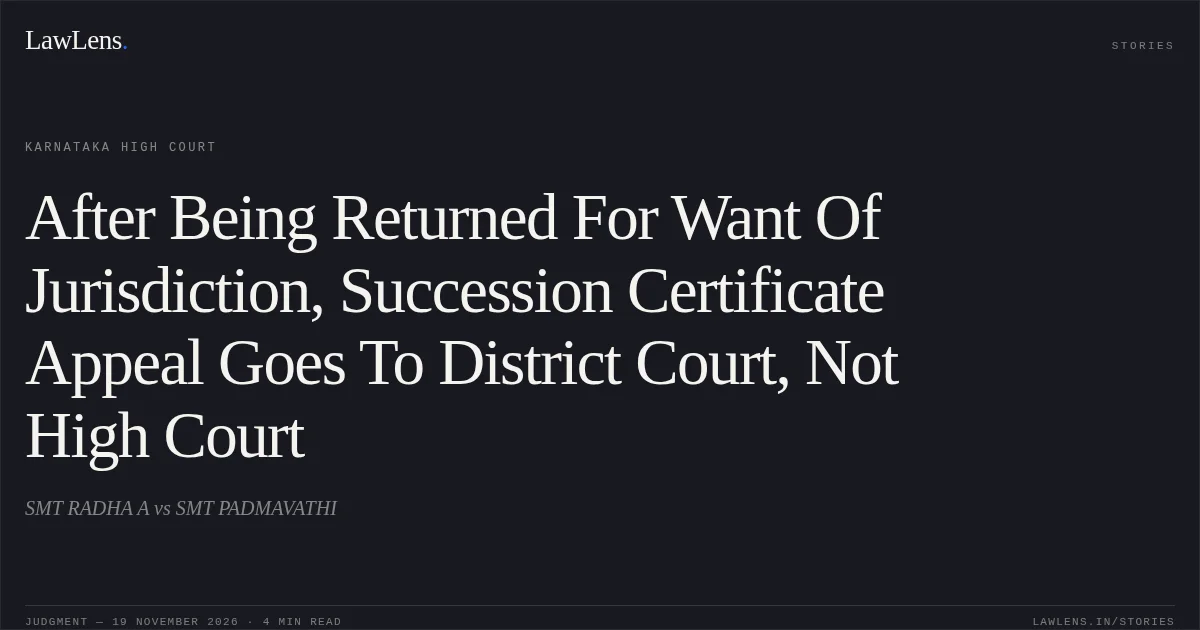
The appellant, Smt. Radha A, filed P&SC No. 9/2015 before the Principal Senior Civil Judge and CJM, Mangaluru, under Section 372 of the Indian Succession Act, 1925 ("the Act"), seeking a succession certificate in her favour.
¶ 1 · p. 2The petition was dismissed on 27.06.2017.
p. 2The appellant then filed R.A.(FR) No. 61/2017 before the Principal District and Sessions Judge, D.K., Mangaluru, under Order 41 Rules 1 and 2 r/w Section 151 CPC. That court returned the appeal for want of jurisdiction.
¶ 1 · p. 2The appellant then filed the present appeal under Section 384 of the Act before the High Court.
p. 2Respondent No. 2 had already appeared before the High Court, and notice to her was dispensed with on 24.08.2022.
p. 1The appellant contended that Section 388 of the Act permits the State Government to invest inferior courts with District Judge powers under Part X, which governs succession certificates.
¶ 2 · p. 3The Court noted that the Karnataka Civil Courts Act, 1964 ("Civil Courts Act") was amended by Karnataka Act 28 of 1978, which inserted Section 23-A and omitted Sections 265 and 388 of the Act.
¶ 3 · p. 3A High Court notification dated 29.03.1979 invested all officers presiding over Civil Judge and Munsiff courts with District Judge powers under Section 388 of the Act, within their territorial and pecuniary limits.
¶ 3 · pp. 3–402Issues
i.1. Whether an appeal against an order passed by the Principal Senior Civil Judge exercising powers under Part X of the Indian Succession Act, 1925, lies to the High Court or to the jurisdictional District Court, in view of Section 23-A of the Karnataka Civil Courts Act, 1964.
¶ 2–3 · pp. 3–4 · ¶ 6 · p. 8ii.2. Whether the High Court is competent to retain the appeal or must transfer it to the District Court for adjudication.
¶ 6 · p. 8 · ¶ 7 · p. 903Law Applied
Section 388 of the Indian Succession Act, 1925, which confers concurrent jurisdiction on District Judges in succession certificate matters under Part X, and the proviso to Section 388(2), which governs appeals from orders of inferior courts.
¶ 2–3 · p. 3Section 23-A of the Karnataka Civil Courts Act, 1964, inserted by Karnataka Act 28 of 1978, under which the High Court may invest Civil Judges and Munsiffs (and, as stated, Senior Civil Judges) with District Judge powers under the Indian Succession Act, and under which appeals from such subordinate courts lie to the Civil Judge (Senior Division) or District Court, with a second appeal to the High Court under sub-section (3) read with Section 100 CPC.
¶ 3–4 · pp. 3–4 · ¶ 5 · pp. 4–7The High Court notification dated 29.03.1979 investing subordinate judicial officers with District Judge powers under Section 388.
¶ 3 · pp. 3–4The decision in S. Pratap Kumar v. Thamas B. Choudi & Anr., 2001 SCC OnLine Kar 276, which held that an appeal from a Civil Judge (Sr. Dn.) lies to the District Judge, and a second appeal lies to the High Court only against the first appellate order.
¶ 5 (quoting paras 6–8, 14–16) · pp. 4–8Article 254(2) of the Constitution, read with Entry 5 of the Concurrent List, under which the State Civil Courts Act, having received Presidential assent, prevails over the inconsistent Central Act in Karnataka.
¶ 5 (quoting para. 14) · pp. 6–7Provisions in the judgment · 7 · Linked ones open on LawLens
Indian Succession Act, 1925 Section 384Section 372Section 388Section 265
Code of Civil Procedure, 1908 Section 151Section 100
KARNATAKA CIVIL COURTS ACT, 1964 Section 23
04Reasoning
Sections 265 and 388 of the Act were omitted by the 1978 amendment, and Section 23-A of the Civil Courts Act took their place.
¶ 3 · p. 3The 1979 notification and Section 23-A together confer District Judge powers under Part X on subordinate judicial officers, and the appellate hierarchy for such orders is fixed by Section 23-A(2) and (3).
¶ 3–5 · pp. 3–8Relying on Pratap Kumar, the Court held that an order by a Civil Judge (Senior Division) in the exercise of such powers is appealable to the District Judge, not directly to the High Court.
¶ 5 · pp. 5–8The High Court's jurisdiction arises only in second appeal under Section 100 CPC.
¶ 5 (quoting para. 16) · p. 8Because the appellant's challenge is to an order of the Principal Senior Civil Judge, the first appeal lies to the District Court. The High Court therefore could not hear it as a first appeal under Section 384 of the Act.
¶ 5 · pp. 5–8The Court did not address whether the appellant's earlier filing before the Principal District Judge was itself correctly constituted; it noted only that that court returned the appeal for want of jurisdiction.
¶ 1 · p. 2Given this, the Court considered the proper course to be transfer of the matter to the jurisdictional District Court, to be adjudicated as a first appeal.
¶ 6 · p. 8 · ¶ 7(ii) · p. 905Holding
The appeal against the order of the Principal Senior Civil Judge under Part X of the Indian Succession Act is governed by Section 23-A of the Karnataka Civil Courts Act and the 1979 notification, and therefore lies to the jurisdictional District Court as a first appeal, not to the High Court.
¶ 5–6 · pp. 4–8The Court disposed of the present MFA, directed that the matter be transferred to the jurisdictional District Court for adjudication as a first appeal, and listed the parties to appear before the District Court on 07.12.2026.
¶ 7(i)–(iii) · p. 9Original Court PDF
SMT RADHA AvsSMT PADMAVATHI
Click to open original judgment
Original judgment, available to read, download and summarize on LawLens.in