01Facts
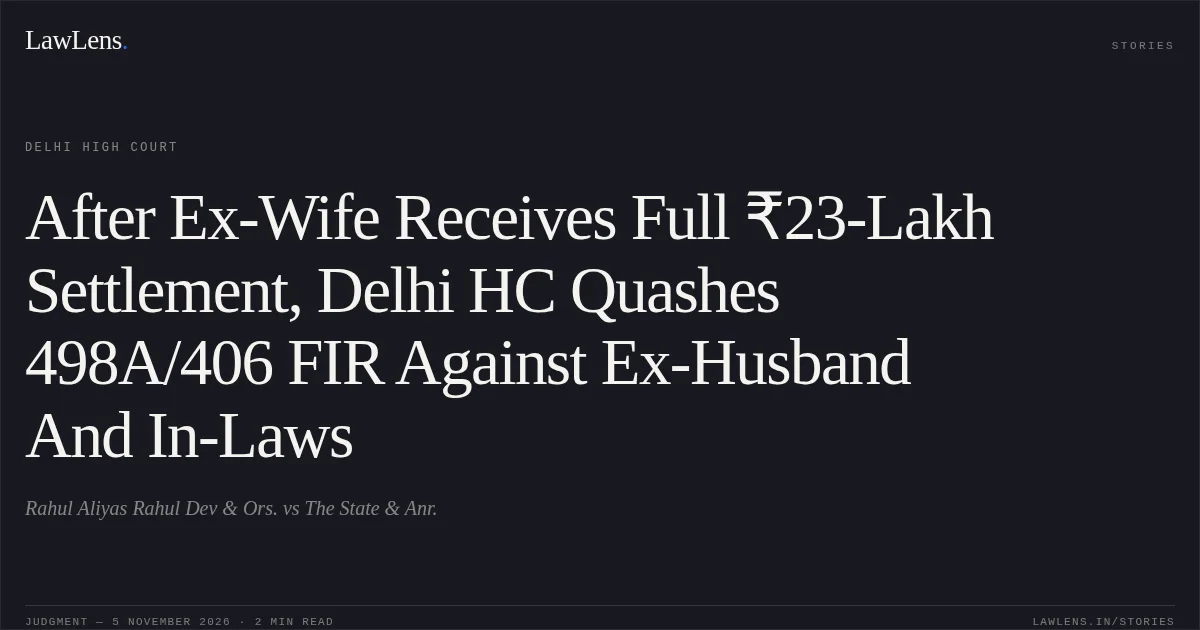
The petitioners sought quashing of FIR No. 436/2023, registered at P.S. Jagat Puri under Sections 498A, 406 and 34 of the Indian Penal Code, 1860.
p. 1Petitioner No. 1 was the complainant’s former husband; Petitioners Nos. 2 and 3 were her former in-laws. The parties married on 3 December 2019 and have a minor son who resides with the complainant.
pp. 1–2On 20 March 2025, the former spouses entered into a settlement before the Counselling Cell, Family Court, Karkardooma. The complainant confirmed that the settlement was voluntary and free from pressure.
p. 5Of the agreed sum of ₹23,00,000, ₹20,00,000 had been paid earlier, and the remaining ₹3,00,000 was paid by bank draft at the hearing. A divorce decree had also been passed.
p. 5The complainant and petitioners were identified by the investigating officer.
p. 502Issues
i.1. Whether the High Court should exercise its inherent jurisdiction to quash the FIR and consequential proceedings for matrimonial offences where the parties have settled their dispute.
pp. 5–6ii.2. Whether the settlement was sufficiently voluntary and acted upon to warrant quashing of the criminal proceedings.
p. 503Law Applied
The petition concerned offences under Sections 498A, 406 and 34 of the IPC.
p. 1Relying on Gian Singh v. State of Punjab, (2012) 10 SCC 303, the Court applied the principle that the High Court’s inherent power to quash criminal proceedings is distinct from the statutory power to compound offences and may be exercised to secure the ends of justice or prevent abuse of process.
pp. 5–6In cases with an overwhelmingly private or civil character, including matrimonial disputes, proceedings may be quashed after settlement where the nature and gravity of the offence permit it and continuation would be unjust; heinous and serious offences affecting society are not ordinarily quashed merely because the parties have settled.
pp. 5–6Provisions in the judgment · 3 · Linked ones open on LawLens
Indian Penal Code, 1860 Section 406Section 34
Code of Criminal Procedure, 1973 Section 320
04Reasoning
The Court treated the dispute as purely matrimonial and noted that the settlement had been reached through the Family Court’s Counselling Cell, affirmed voluntarily by the complainant, and performed by payment of the full agreed amount. It also noted that a divorce decree had been passed.
p. 5Applying Gian Singh, the Court concluded that the dispute was private in nature and that there was no impediment to quashing the proceedings on the basis of the completed settlement.
pp. 5–605Holding
The Court allowed the petition and quashed FIR No. 436/2023, together with all proceedings emanating from it.
p. 6Original Court PDF
Rahul Aliyas Rahul Dev & Ors.vsThe State & Anr.
Click to open original judgment
Original judgment, available to read, download and summarize on LawLens.in