01Facts
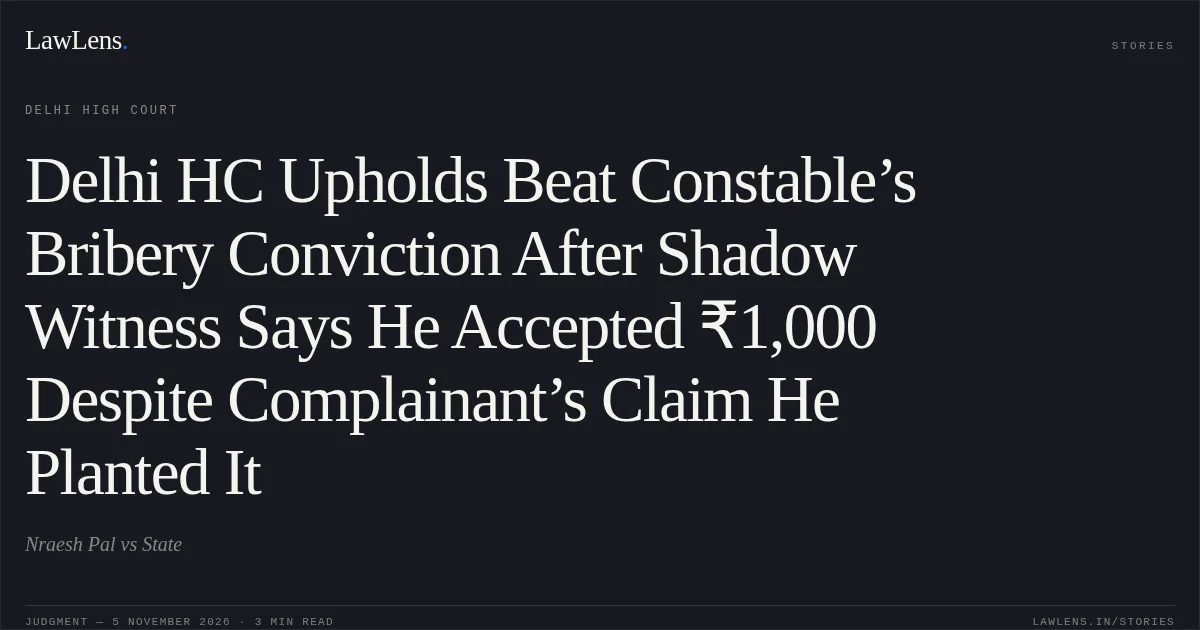
Naresh Pal, a Delhi Police constable, was accused of demanding ₹5,000 from a soft-drink factory owner, Lakhan Singh, and accepting ₹1,000 as an initial payment.
p. 1After Singh complained to the Anti-Corruption Branch, a trap was arranged using two phenolphthalein-treated ₹500 notes.
p. 1Singh did not support the prosecution’s allegation of demand at trial; he testified that Pal refused the money and that Singh put the notes into Pal’s pocket.
p. 1Shadow witness Radha Kishan (PW-7) testified that Singh handed an object to Pal and Pal accepted it, but said Pal put it in his trouser pocket; the notes were recovered from Pal’s shirt pocket.
p. 1The Trial Court convicted Pal under Sections 7 and 13(1)(d), read with Section 13(2), of the Prevention of Corruption Act, 1988, and sentenced him to two years’ rigorous imprisonment and a fine for each offence.
pp. 1–4, 12–16Pal appealed.
pp. 1–4, 12–1602Issues
i.Whether the prosecution proved the facts necessary to sustain the convictions under Sections 7 and 13(1)(d), read with Section 13(2), despite the complainant’s failure to support the alleged demand and the discrepancy in PW-7’s account of where Pal placed the money
pp. 8–10, 22–23ii.Whether the recovery of the treated notes and positive chemical washes, considered with the other evidence, established knowing and voluntary acceptance or obtainment of illegal gratification
pp. 9–10, 16–20iii.Whether the objections concerning pre-trap verification, the examination under Section 313 Cr.P.C., and the sanction question warranted setting aside the conviction
pp. 20–2503Law Applied
Under Sections 7 and 13(1)(d), read with Section 13(2), of the Prevention of Corruption Act, the prosecution must prove the facts constituting the offence, including the relevant acceptance or obtainment; those facts may be proved by direct or circumstantial evidence.
pp. 8–12, 22–23Under Neeraj Dutta v. State (Government of NCT of Delhi), a complainant’s failure to support the prosecution does not itself preclude conviction, but recovery alone does not prove demand or voluntary acceptance; for Section 7, knowing and voluntary acceptance of an independently offered bribe may suffice without proof of a prior demand.
pp. 8–12, 22–23The presumption under Section 20 operates only after the foundational facts are established.
pp. 8–12, 22–23B. Jayaraj v. State of Andhra Pradesh was applied consistently with those principles.
pp. 8–12, 22–23A hostile witness’s evidence is not erased and may be relied upon to the extent it is credible and corroborated, as explained in K.P. Tamilmaran v. State by Deputy Superintendent of Police.
pp. 8–12, 22–23Questions under Section 313 Cr.P.C. are not substantive evidence and cannot cure gaps in the prosecution case.
pp. 8–12, 22–23Provisions in the judgment · 6 · Linked ones open on LawLens
Prevention of Corruption Act, 1988 Section 7Section 13Section 20
Code of Criminal Procedure, 1973 Section 313Section 319Section 428
04Reasoning
The Court accepted that PW-2 did not prove the alleged demand and that the complaint could not be treated as substantive proof of its contents.
pp. 11–21, 22–27It nevertheless relied on PW-7’s evidence that PW-2 handed an object to Pal, Pal accepted it, and PW-7 denied that the money had been thrust into Pal’s pocket despite a refusal.
pp. 11–21, 22–27Although PW-7’s account of the pocket differed from the recovery evidence, the Court treated that discrepancy as insufficient to displace his evidence of transfer and acceptance.
pp. 11–21, 22–27The recovery of the treated notes and positive washes corroborated the handling of the money, but were not treated as proof of demand by themselves.
pp. 11–21, 22–27Considering the evidence cumulatively, the Court rejected the defence account of forcible insertion and found the transaction established.
pp. 11–21, 22–27It also held that the alleged lack of pre-trap verification, failure to charge-sheet another constable, Section 313 questions, and the wording of the sanction question did not independently undermine the conviction.
pp. 11–21, 22–2705Holding
The Delhi High Court held that the prosecution had proved the offences under Sections 7 and 13(1)(d), read with Section 13(2), of the Prevention of Corruption Act beyond reasonable doubt.
pp. 27–30It upheld the conviction and dismissed the appeal against conviction.
pp. 27–30Pal was directed to surrender forthwith to serve the sentence, with the benefit of set-off under Section 428 Cr.P.C.; the appeal and pending applications were disposed of accordingly.
pp. 27–30Original Court PDF
Nraesh PalvsState
Click to open original judgment
Original judgment, available to read, download and summarize on LawLens.in