01Facts
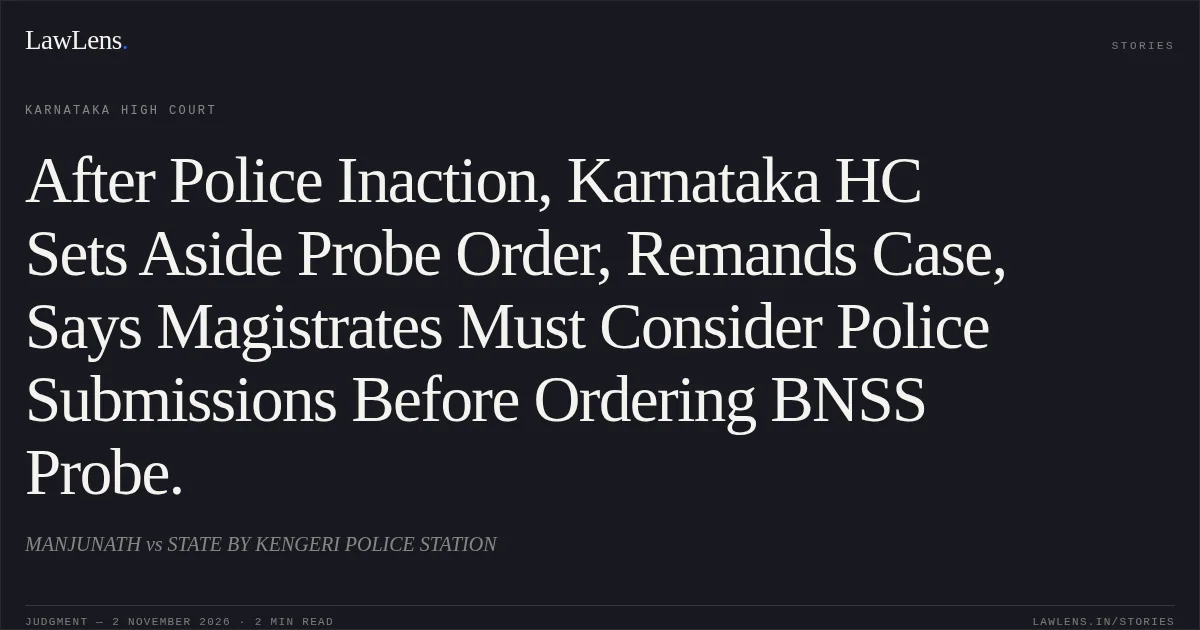
Respondent No. 2 first approached the jurisdictional police and then the Commissioner of Police, but no action was taken on her complaint. She thereafter filed a private complaint under Section 223 of the Bharatiya Nagarik Suraksha Sanhita, 2023 (BNSS). By order dated 3 March 2025, the Magistrate referred the complaint to Kengeri Police Station for investigation under Section 175(3) BNSS.
p. 2 · ¶ 2–3The petitioners challenged that referral, contending that the Magistrate had not considered the jurisdictional police officer’s submissions as required by Section 175(3) BNSS.
pp. 3–6 · ¶ 4–702Issues
i.1. Whether a Magistrate may refer a private complaint for investigation under Section 175(3) BNSS without considering the jurisdictional police officer’s submissions explaining why the complaint was not registered.
pp. 7–8 · ¶ 9–1103Law Applied
Section 175(3) BNSS empowers a Magistrate to order an investigation after considering an application supported by an affidavit under Section 173(4), making such inquiry as the Magistrate considers necessary, and considering the police officer’s submissions.
p. 3 · ¶ 4Relying on Om Prakash Ambadkar v. State of Maharashtra & Ors., Criminal Appeal No. 352 of 2020, the Court noted that Section 175(3) BNSS requires the Magistrate to consider the concerned police officer’s submissions regarding refusal to register an FIR before directing an investigation; this requirement is a change from Section 156(3) of the Code of Criminal Procedure, 1973.
pp. 4–5 · ¶ 5 · pp. 7–8 · ¶ 10–11Provisions in the judgment · 11 · Linked ones open on LawLens
Indian Penal Code, 1860 Section 506Section 504Section 406Section 420
Bharatiya Nagarik Suraksha Sanhita, 2023 Section 528Section 223Section 175Section 210Section 173
Code of Criminal Procedure, 1973 Section 482Section 156
04Reasoning
The Magistrate referred the complaint for investigation under Section 175(3) BNSS, but the referral order did not show that the jurisdictional police officer had been heard or that the officer’s reasons for not registering the complaint had been considered.
pp. 6–7 · ¶ 7Applying Om Prakash Ambadkar, the Court held that considering those submissions is mandatory and enables the Magistrate to apply judicial mind before ordering an investigation.
pp. 7–8 · ¶ 10–11The defect required the referral order to be set aside and the matter remitted; the Court made no determination on the merits of the complaint.
p. 9, order cl. (iv)05Holding
The petition was allowed. The Magistrate’s order dated 3 March 2025 was set aside, and the matter was remanded to the 6th ACJM, Bengaluru, for fresh consideration in compliance with Om Prakash Ambadkar.
p. 8 · ¶ 11 · pp. 9, order cls. (i)–(ii)The Court did not decide the merits of the complaint.
p. 9, order cl. (iv)Original Court PDF
MANJUNATHvsSTATE BY KENGERI POLICE STATION
Click to open original judgment
Original judgment, available to read, download and summarize on LawLens.in