01Facts
The respondent filed a private complaint under Section 200 Cr.P.C. alleging cheque dishonour under Section 138 of the Negotiable Instruments Act.
¶ 2–3The Magistrate allowed the respondent’s application under Section 311 Cr.P.C. to recall the complainant for further examination and production of an agreement of sale dated 9 June 2011, imposing costs of ₹500.
¶ 2–3The petitioner challenged that order, arguing that the agreement was insufficiently stamped and should have been examined and impounded before being marked in evidence.
¶ 4, 10–11By the time the High Court considered the petition, the complainant had been recalled, the agreement had been marked, and the matter was posted for judgment.
¶ 1502Issues
i.Whether a document alleged to be insufficiently stamped may be marked in evidence in criminal proceedings when its stamping is objected to.
¶ 9ii.Whether the Magistrate’s order allowing the Section 311 Cr.P.C. application should be set aside where the recall and marking of the document had already occurred.
¶ 14–1503Law Applied
Section 33 of the Karnataka Stamp Act, 1957 provides for examination and impounding of instruments that appear not to be duly stamped.
¶ 12Its proviso to subsection (2), clause (a), permits a Magistrate or Judge of a Criminal Court, in proceedings other than those specified there, not to examine or impound an instrument if the court does not think fit to do so.
¶ 12The expression “if he does not think fit so to do” entails judicial discretion; an objection to the sufficiency of stamp duty may be considered by the court.
¶ 13The petitioner relied on G.M. Shahul Hameed v. Jayanthi R. Hedge, AIR 2024 SC 3339, for the proposition that admission of an instrument in evidence requires judicial determination of its admissibility where stamping is disputed.
¶ 5–6, 11Section 311 Cr.P.C. was the basis of the application to recall the complainant.
¶ 2, 10Provisions in the judgment · 7 · Linked ones open on LawLens
Code of Criminal Procedure, 1973 Section 482Section 200Section 311
Bharatiya Nagarik Suraksha Sanhita, 2023 Section 528
Negotiable Instruments Act, 1881 Section 138
KARNATAKA STAMP ACT, 1957 Section 35Section 33
04Reasoning
The Court acknowledged that Section 33’s proviso involves judicial discretion and that the petitioner’s precedent emphasised judicial determination of a stamp-duty objection.
¶ 12–13However, the petition sought to set aside only the order allowing recall under Section 311 Cr.P.C.; it did not independently challenge the marking of the agreement or seek specific relief concerning its admission.
¶ 14Since the complainant had already been recalled and the agreement marked, setting aside the recall order would serve no purpose.
¶ 15The Court therefore did not decide the agreement’s stamp-duty sufficiency or admissibility.
¶ 1605Holding
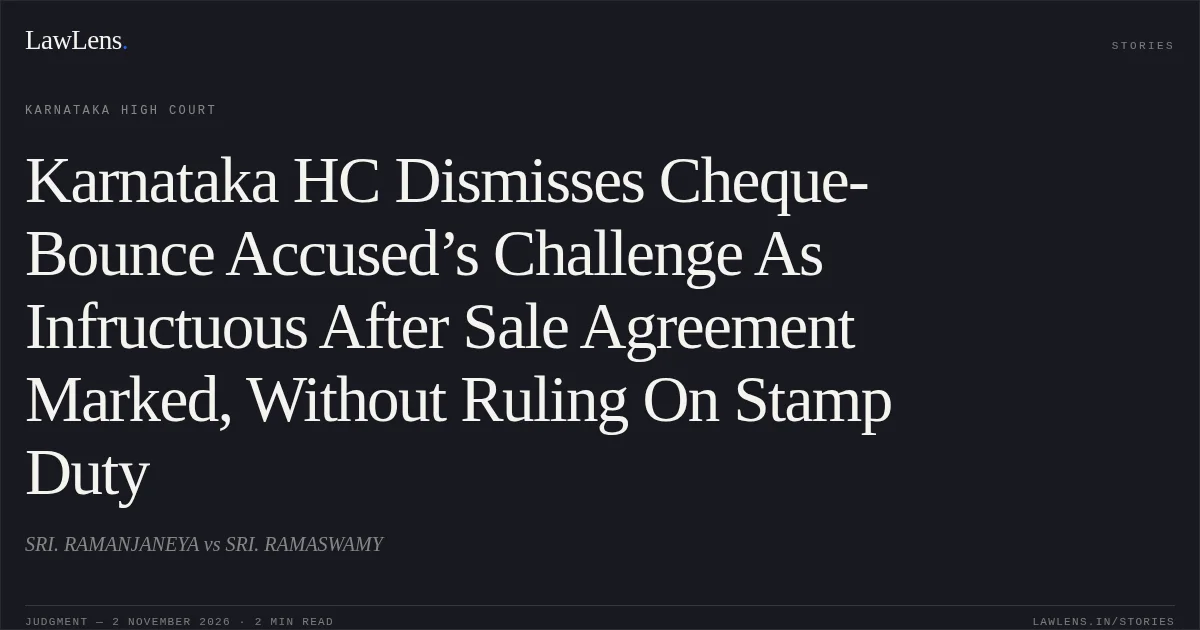
The petition was dismissed as infructuous because the relief sought against the Section 311 Cr.P.C. order had already been overtaken by events.
¶ 17The Court expressly left open the admissibility and evidentiary value of the agreement, as well as the merits of the Section 138 complaint.
¶ 18Original Court PDF
SRI. RAMANJANEYAvsSRI. RAMASWAMY
Click to open original judgment
Original judgment, available to read, download and summarize on LawLens.in