01Facts
Respondent No. 2, the wife of petitioner No. 3, lodged a complaint in 2019, leading to a charge sheet and proceedings against the petitioners under Sections 498A, 504 and 506 read with Section 34 of the IPC, and Sections 3 and 4 of the Dowry Prohibition Act, 1961.
pp. 2–3 · ¶ 2While the quashing petition was pending, the parties reached a settlement of their matrimonial disputes.
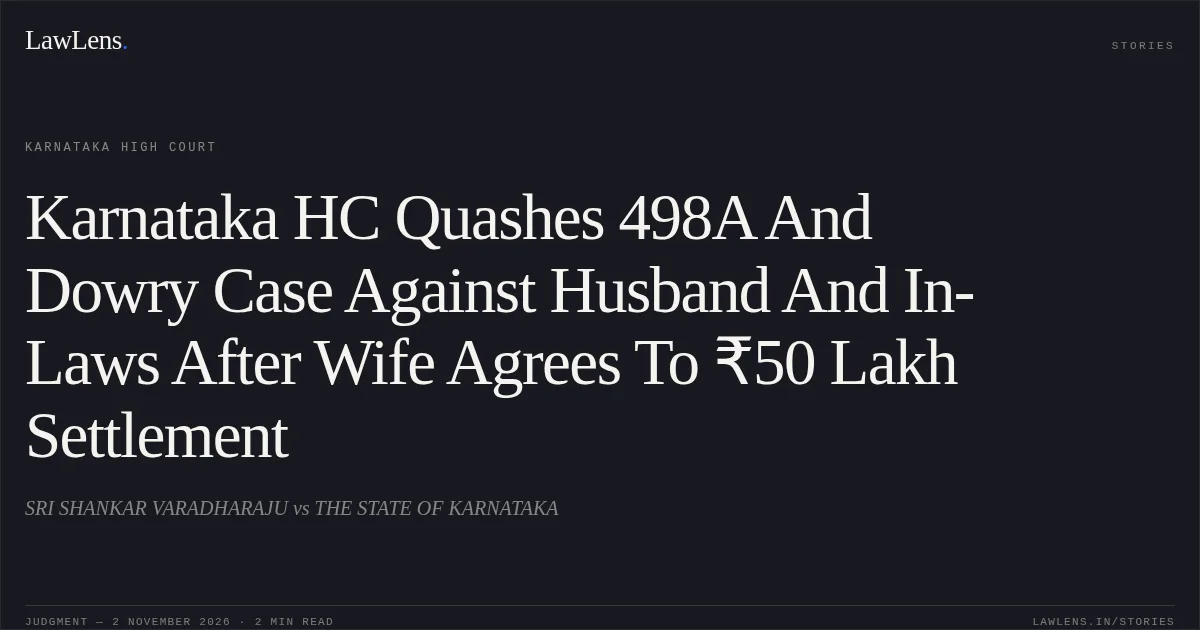
pp. 8–11 · ¶ 8–10The husband agreed to pay ₹50 lakh as full and final settlement; ₹20 lakh was paid by demand draft before the Court, with the balance payable in connection with the pending matrimonial and maintenance proceedings.
pp. 8–11 · ¶ 8–10Respondent No. 2 confirmed her voluntary consent to the settlement and to bringing the proceedings to an end.
p. 11 · ¶ 8–1002Issues
i.1. Whether the High Court should exercise its inherent jurisdiction to quash the criminal proceedings in light of the parties’ matrimonial settlement, notwithstanding that the alleged offences are non-compoundable.
pp. 6–10 · pp. 11–12 · ¶ 11–12ii.2. Whether continuation of the proceedings, after the complainant’s voluntary settlement and consent to quashing, would serve the interests of justice.
pp. 11–12 · ¶ 12–1303Law Applied
The petition invoked Section 482 of the Code of Criminal Procedure, 1973 (corresponding to Section 528 of the Bharatiya Nagarik Suraksha Sanhita, 2023), the High Court’s inherent jurisdiction to prevent abuse of the process of law and secure the ends of justice.
p. 2 · p. 12 · ¶ 12The alleged offences under Sections 498A, 504 and 506 of the IPC and Sections 3 and 4 of the Dowry Prohibition Act were treated as non-compoundable; accordingly, the Court considered quashing under its inherent jurisdiction rather than permitting statutory compounding.
pp. 8–10 · p. 12 · ¶ 12No precedent was cited.
Provisions in the judgment · 12 · Linked ones open on LawLens
Bharatiya Nagarik Suraksha Sanhita, 2023 Section 528
Code of Criminal Procedure, 1973 Section 482Section 320Section 125Section 128
Dowry Prohibition Act, 1961 Section 3Section 4
Hindu Marriage Act, 1955 Section 13
Indian Penal Code, 1860 Section 504Section 506Section 34
Protection of Women from Domestic Violence Act, 2005 Section 12
04Reasoning
The Court found that the dispute arose from the parties’ matrimonial relationship and had been voluntarily settled, with respondent No. 2 personally confirming her consent and acknowledging receipt of ₹20 lakh toward the agreed ₹50 lakh settlement.
pp. 11–12 · ¶ 8–11Although the alleged offences were serious and non-compoundable, the Court considered the matrimonial context, the settlement, and the parties’ agreed steps to resolve the related proceedings.
p. 12 · ¶ 12–13It concluded that continuing the prosecution would serve no useful purpose and would cause further hardship, and that quashing was appropriate to secure the ends of justice and prevent abuse of process.
p. 12 · ¶ 12–1305Holding
The Court allowed the criminal petition and quashed the proceedings against the petitioners in C.C. No. 30082/2019, arising out of Crime No. 81/2019, pending before the VIII ACMM Court, Bengaluru.
p. 13, orderOriginal Court PDF
SRI SHANKAR VARADHARAJUvsTHE STATE OF KARNATAKA
Click to open original judgment
Original judgment, available to read, download and summarize on LawLens.in