01Facts
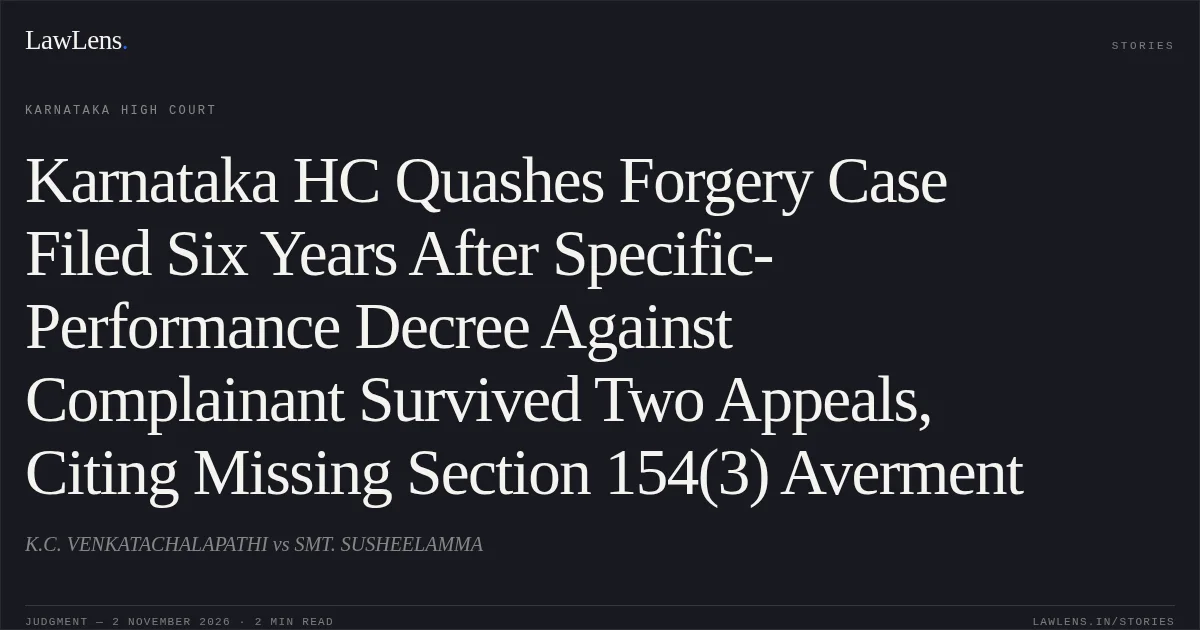
The petitioners sought to quash proceedings in PCR No. 125/2019, in which the complainant alleged cheating and fabrication of her signature on an agreement of sale dated 26 May 2007; the complaint invoked Sections 420 and 464 IPC and was referred for investigation under Section 156(3) CrPC.
¶ 2–3, 5The complainant stated that she had submitted a police complaint on 28 February 2019, but the High Court noted that the complaint did not aver compliance with Section 154(3) CrPC.
¶ 3, 6The agreement had already formed the basis of a decree for specific performance in O.S. No. 166/2007, which was affirmed in appeal and second appeal; the criminal complaint was filed after those proceedings had concluded.
¶ 4, 6–702Issues
i.1. Whether the proceedings under Section 156(3) CrPC could stand when the complaint did not aver that the complainant had approached the higher police authorities under Section 154(3) CrPC.
¶ 3, 6ii.2. Whether the criminal complaint, filed after the complainant had unsuccessfully challenged the civil decree based on the disputed agreement, amounted to an abuse of process.
¶ 4, 6–703Law Applied
Section 154(3) CrPC provides for approaching the higher police authorities where the police do not act on information about a cognizable offence; the Court, relying on Priyanka Srivastava v. State of Uttar Pradesh, (2015) 6 SCC 287, treated compliance with that requirement as material before a request for investigation under Section 156(3) CrPC.
¶ 3–4, 6The Court also exercised its inherent jurisdiction under Section 482 CrPC to prevent abuse of process and protect individual liberty.
¶ 2, 7The alleged offences were under Sections 420 and 464 IPC.
¶ 2Provisions in the judgment · 5 · Linked ones open on LawLens
Code of Criminal Procedure, 1973 Section 482Section 154Section 156
Indian Penal Code, 1860 Section 420Section 464
04Reasoning
The Court found that the complaint referred to an earlier police complaint but contained no averment of compliance with Section 154(3) CrPC, contrary to the requirement it drew from Priyanka Srivastava.
¶ 3–4, 6It also considered that the agreement alleged to be fabricated had already supported a decree for specific performance, affirmed through the appellate process, and that the criminal complaint followed those unsuccessful proceedings after a lapse of years.
¶ 4, 6–7In those circumstances, the Court regarded the complaint as an abuse of process warranting intervention under Section 482 CrPC.
¶ 705Holding
The High Court allowed the petition and quashed the proceedings against the petitioners in PCR No. 125/2019.
¶ 8Original Court PDF
K.C. VENKATACHALAPATHIvsSMT. SUSHEELAMMA
Click to open original judgment
Original judgment, available to read, download and summarize on LawLens.in