01Facts
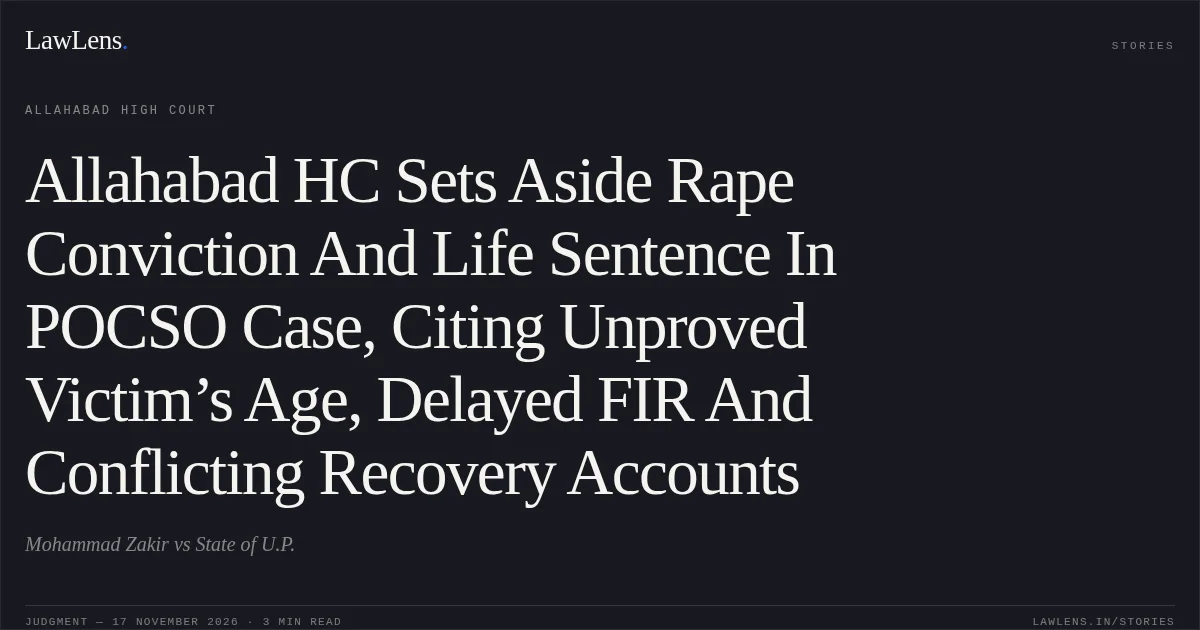
The appellant was convicted by the Sessions Judge (POCSO Act), Azamgarh, of offences under Sections 376(3), 363 and 366 IPC, with concurrent sentences, in a case arising from the alleged taking of the informant’s daughter from her home on 23 March 2020
¶ 2The FIR was registered following an application under Section 156(3) CrPC filed on 24 June 2020
¶ 7The victim initially told police that she was about 19, had eloped with the appellant voluntarily and had married him; in her later Section 164 CrPC statement, she alleged that she had been forced into the marriage
¶ 7The High Court considered inconsistencies in the accounts of the informant, victim, maternal uncle and investigating officer, the delay in reporting, the circumstances of the victim’s recovery and custody, and the evidence concerning her age
¶ 8–18, 20–22The appellant appealed against his conviction and sentence.
02Issues
i.Whether the prosecution proved beyond reasonable doubt that the appellant committed the offences for which he was convicted, given the contradictions and unexplained circumstances in the evidence
¶ 20–25ii.Whether the prosecution reliably established that the victim was a minor, where the age determination relied on school records whose basis was not proved and no medical age-assessment report was produced
¶ 14–1603Law Applied
Sections 363, 366 and 376(3) IPC prescribe offences relating to kidnapping, abduction and aggravated rape; the appellant’s trial convictions were under those provisions
¶ 2Under Section 94(2) of the Juvenile Justice (Care and Protection of Children) Act, 2015, age is determined by the prescribed documentary evidence in the statutory order and, in the absence of qualifying documents, by an ossification test or other latest medical age-determination test
¶ 15Relying on P. Yuvaprakash v. State, the Court treated a transfer certificate, without the qualifying evidence required by Section 94, as insufficient to establish age
¶ 15–16The Court also applied the principle that a prosecutrix’s sole testimony can sustain a conviction if it inspires confidence and is trustworthy, consistent and of sterling quality; it relied on Santosh Prasad @ Santosh Kumar v. State of Bihar and the “sterling witness” test discussed there with reference to Rai Sandeep alias Deepu
¶ 23The prosecution must establish guilt beyond reasonable doubt
¶ 24–25Provisions in the judgment · 10 · Linked ones open on LawLens
Indian Penal Code, 1860 Section 363Section 366Section 376
Code of Criminal Procedure, 1973 Section 313Section 164Section 156Section 161
Protection of Children from Sexual Offences Act, 2012 Section 3Section 4
Juvenile Justice (Care and Protection of Children) Act, 2015. Section 94
04Reasoning
The Court found the delay in lodging the FIR unexplained, particularly because the informant allegedly knew of the incident on the day it occurred and learned the victim’s whereabouts within two or three days
¶ 7, 10, 21The victim’s accounts differed as to whether she had left voluntarily or been forced into marriage; her account of recovery in Mumbai also conflicted with the investigating officer’s evidence that she was recovered at Hafizpur Crossing
¶ 7, 12–13The Court further identified an unexplained discrepancy concerning the victim’s custody: the investigating officer said she was handed to her parents on 4 September, while her mother accompanied her to the medical examination on 28 August and the victim said her parents were present at the Section 164 recording on 1 September
¶ 13, 17–18The school evidence did not reliably prove age because the date of birth had been supplied by the victim’s parents, the school was closed, and no qualifying birth or examination-board certificate or medical age-assessment report was produced
¶ 14–16Taken together, these matters undermined the reliability of the prosecution evidence and the victim’s testimony did not meet the cited standard for a sterling witness
¶ 20–2405Holding
The Court held that the prosecution had not proved the appellant’s guilt beyond reasonable doubt and granted him the benefit of doubt
¶ 24–25It allowed the appeal, set aside the trial court’s judgment and order, and directed the appellant’s release forthwith unless required in another case
¶ 26–28Original Court PDF
Mohammad ZakirvsState of U.P.
Click to open original judgment
Original judgment, available to read, download and summarize on LawLens.in