01Facts
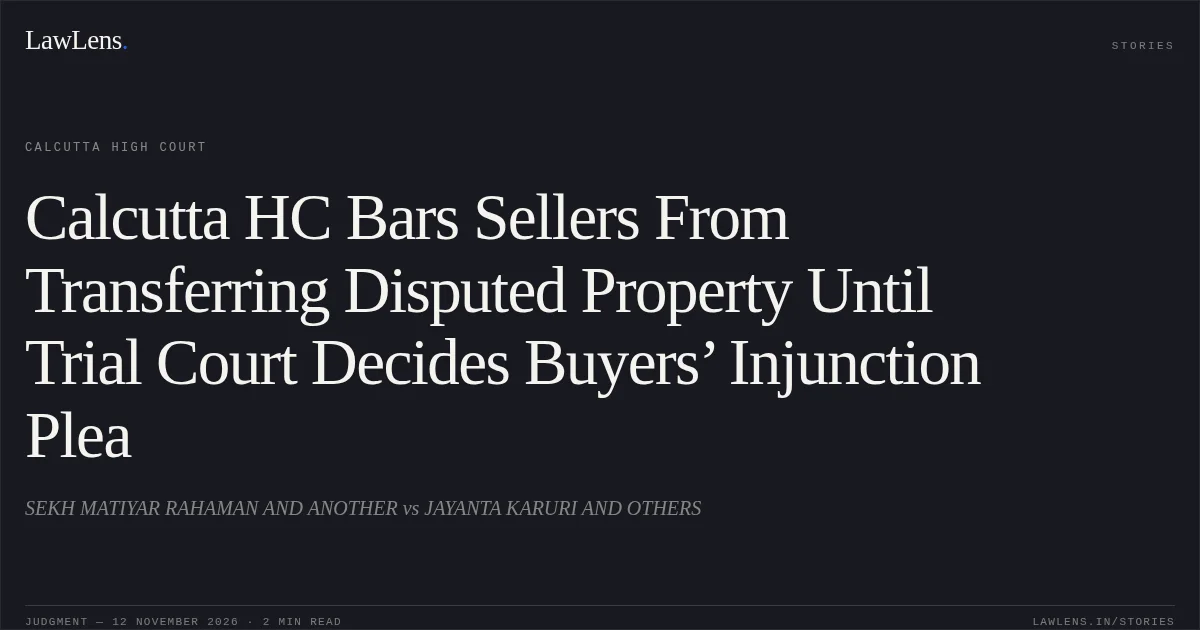
The appellants filed a suit for specific performance based on a notarized agreement for sale dated 22 May 2025 and sought an interim injunction.
¶ 11–13The Trial Court refused ad interim relief, noting that the plaintiffs had not shown that they had taken steps to comply with the agreement’s terms within the stipulated period.
¶ 11–13The appellants’ initial appeal was dismissed by the District Court for want of pecuniary jurisdiction; after withdrawing a revision against that dismissal, they brought the present appeal, explaining the delay by their mistaken choice of forum.
¶ 2–5The respondents disputed the plaintiffs’ performance, including payment of a further Rs. 2,00,000, and argued that no imminent transfer to third parties or delivery of possession had been shown.
¶ 14–1802Issues
i.Whether the delay in preferring the appeal should be condoned in light of the appellants’ earlier proceedings before a forum lacking pecuniary jurisdiction.
¶ 2–6ii.Whether the Trial Court was justified in refusing ad interim injunction in the specific-performance suit, particularly against the creation of third-party interests.
¶ 11, 19–2703Law Applied
The Court applied the proviso to Section 49 of the Registration Act, 1908, under which an unregistered contract affecting immovable property may be received as evidence of the contract in a suit for specific performance.
¶ 21It considered the injunction application under Order XXXIX Rules 1 and 2 of the Code of Civil Procedure and heard the appeal under Order XLI Rule 11.
¶ 8, 11At the ex parte stage, the Court assessed the plaintiffs’ sworn pleadings because the defendants had not yet had an opportunity to present their case.
¶ 25Provisions in the judgment · 1
Indian Registration Act, 1908 Section 49
04Reasoning
The Court found the appellants’ explanation for delay sufficient: they had pursued an appeal that was admitted but later dismissed for want of pecuniary jurisdiction, supporting their bona fides.
¶ 5On interim relief, the notarized agreement could be considered despite being unregistered, and the plaint and injunction application contained sufficient averments of urgency and readiness and willingness to pay the balance consideration.
¶ 19–24Those materials established a sufficiently strong prima facie case to restrain the defendants from creating third-party interests, although they did not establish that possession had been delivered to the appellants.
¶ 26–27The Court left the merits of the injunction application open for determination by the Trial Court.
¶ 3105Holding
The Court allowed CAN 1 of 2026 and condoned the delay.
¶ 6It partially allowed the appeal, modifying the Trial Court’s order to restrain the defendants from selling, transferring, alienating, or creating third-party interests in the suit property until the Trial Court disposes of the temporary injunction application.
¶ 28The defendants were directed to file their objections preferably within a fortnight, and the Trial Court was expected to decide the application by the end of December 2026 if that timeline was met.
¶ 29–30No order as to costs was made.
¶ 7, 33Original Court PDF
SEKH MATIYAR RAHAMAN AND ANOTHERvsJAYANTA KARURI AND OTHERS
Click to open original judgment
Original judgment, available to read, download and summarize on LawLens.in