01Facts
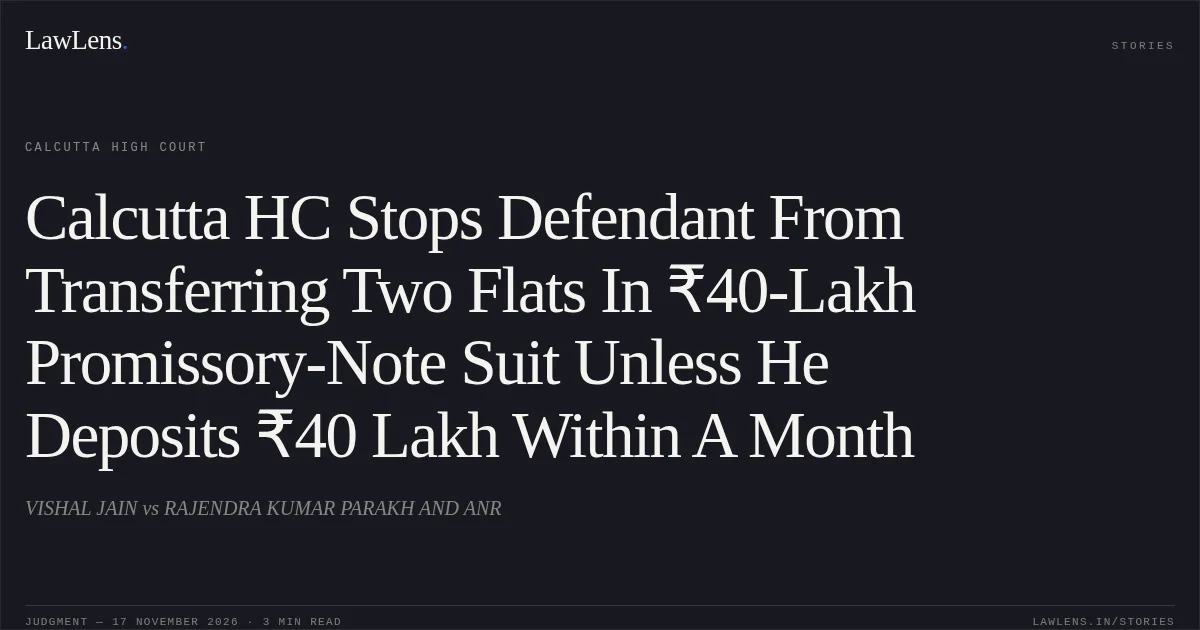
The plaintiff filed a money suit based on a demand promissory note dated 12 February 2018 for Rs. 40 lakh and sought an interim injunction restraining the defendants from dealing with specified properties.
¶ 1–4The trial court initially granted an ad interim injunction but later dismissed the temporary injunction application, relying, among other things, on the absence of an injunction prayer in the plaint and insufficient particulars of an alleged attempt to defraud creditors.
¶ 1–4, 18–19, 27–29The defendants had filed no written objection to the injunction application.
¶ 1–4, 18–19, 27–2902Issues
i.Whether an injunction under Order XXXIX Rule 1(b) CPC could be granted in a money suit to restrain dealings with the defendant’s property on an allegation that the defendant intended to defraud creditors.
¶ 30–36ii.Whether the uncontroverted allegations in the injunction application, together with the circumstances on record, justified interim relief despite the absence of an injunction prayer in the plaint.
¶ 19–22, 37–45, 57iii.Whether the injunction should be confined to the defendant no. 1’s properties and made subject to an option to deposit the claimed amount as security.
¶ 35, 58–6003Law Applied
Order XXXIX Rule 1(b) CPC permits a temporary injunction where it is shown that a defendant threatens or intends to remove or dispose of the defendant’s property with a view to defrauding creditors; the provision may apply in a money suit and is not confined to the suit property.
¶ 30–33This differs from Order XXXVIII Rule 5 CPC, which concerns attachment before judgment or security where the defendant acts with intent to obstruct or delay execution, and requires the court to specify the property and its estimated value if attachment is ordered.
¶ 32–34Section 151 CPC cannot be used to bypass the requirements of an applicable express provision.
¶ 48The Court also applied the doctrine of non-traverse to the allegations left uncontroverted by the defendants.
¶ 19, 38It considered *Kohinoor Steel Private Limited v. Pravesh Chandra Kapoor* (2010 SCC OnLine Cal 1856), *Shree Vaishnavi Ispat Ltd. v. M/s. Sharp Ferro Alloys Ltd.* (FMAT No. 75 of 2025), *Tata Chemicals Limited v. Kshitish Bardhan Chunilal Nath* ((2022) 1 High Court Cases (Cal) 275), and *Rahul S. Shah v. Jinendra Kumar Gandhi* ((2021) 6 SCC 418).
¶ 40, 44–53Provisions in the judgment · 1 · Linked ones open on LawLens
Code of Civil Procedure, 1908 Section 151
04Reasoning
The Court held that the injunction application specifically alleged that defendant no. 1 was heavily indebted and was attempting to evade the plaintiff’s dues by alienating assets.
¶ 37–41Since that allegation was not controverted, it was to be accepted as true for deciding the application; the trial court therefore erred in requiring further particulars at that stage.
¶ 37–41The allegation fell within Order XXXIX Rule 1(b), which can protect a money claim by restraining disposal of a defendant’s property, unlike the more specific attachment procedure under Order XXXVIII Rule 5.
¶ 30–34, 43The Court also found the evidence concerning a conveyance at the same premises relevant to the alleged risk of disposal, and treated the promissory note as an unconditional promise to pay Rs. 40 lakh on demand at the prima facie stage.
¶ 54–56A temporary injunction could be sought in aid of the money claim even though the plaint did not seek a permanent injunction.
¶ 5705Holding
The appeal was partially allowed, and the order dismissing the injunction application was set aside.
¶ 59The Court restrained defendant no. 1, until disposal of the suit, from selling, transferring, alienating, or creating third-party interests in his residential flats at Orbit Sky Garden, 30 Bondel Road, Kolkata, and 13 Kedar Bose Lane, Kolkata.
¶ 59Defendant no. 1 may deposit Rs. 40 lakh as security in the trial court within one month; upon deposit, the injunction will automatically stand vacated, and the funds are to be invested in an interest-bearing account pending the suit’s outcome.
¶ 60The observations are tentative and do not bind the trial court on the merits; there was no order as to costs.
¶ 62–63Original Court PDF
VISHAL JAINvsRAJENDRA KUMAR PARAKH AND ANR
Click to open original judgment
Original judgment, available to read, download and summarize on LawLens.in