01Facts
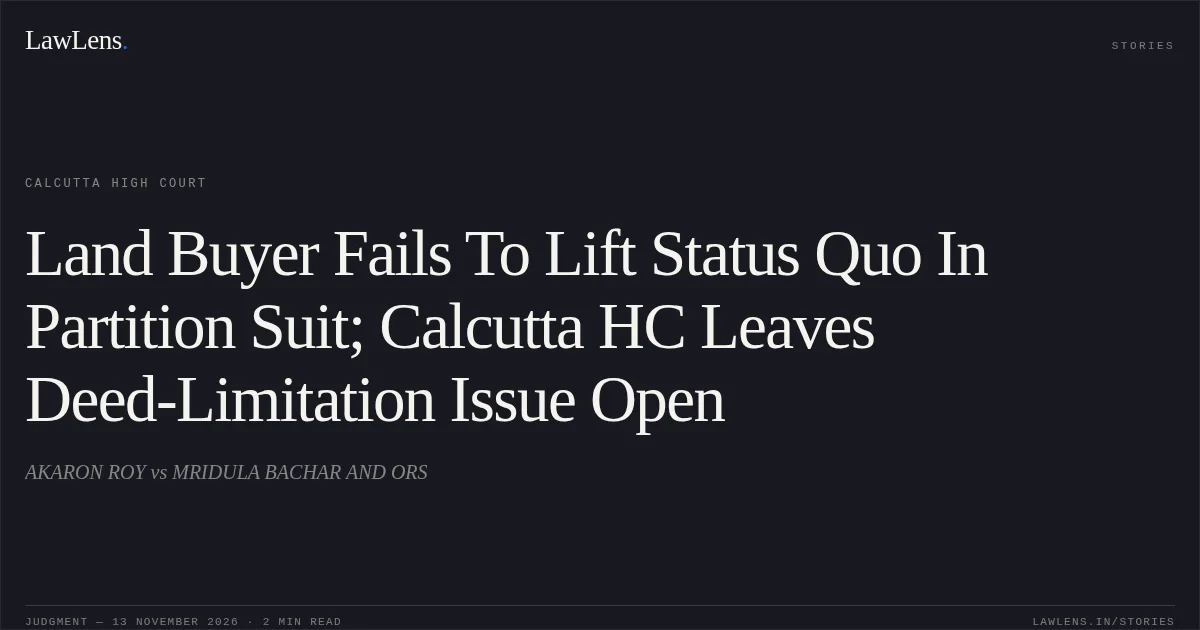
The plaintiffs brought a partition suit concerning property said to have devolved on the legal heirs of Annada Prasad Dhali, seeking, among other reliefs, declarations concerning two conveyance deeds and an injunction.
¶ 2The defendants disputed the plaintiffs’ claim to co-ownership and objected that the suit was time-barred and improperly constituted.
¶ 4, 7The trial court directed the parties to maintain status quo as to the suit property’s nature, character and possession; the District Judge dismissed the defendants’ appeal.
¶ 3, 5–6The defendants challenged the appellate decision under Article 227 of the Constitution, arguing, inter alia, that the deed challenge was time-barred, the suit suffered from defects in joinder and property description, and the status quo order was vague.
¶ 7–802Issues
i.1. Whether the interlocutory injunction could be sustained without finally deciding the defendants’ limitation and party-joinder objections.
¶ 9–13ii.2. Whether the direction to maintain status quo as to the nature, character and possession of the suit property was impermissibly vague.
¶ 1403Law Applied
Order XXXIX Rules 1 and 2 of the Code of Civil Procedure, 1908, govern the grant of temporary injunctions.
¶ 11–13The court must assess whether there is a prima facie case, whether the balance of convenience favours the applicant, and whether refusal would cause irreparable loss or injury; the parties’ conduct is also relevant.
¶ 11–13At the interlocutory stage, the court need not conduct a mini-trial on issues going to the final determination of the suit.
¶ 13The Supreme Court authorities reported at (2006) 3 SCC 312 and (2017) 3 SCC 702 were considered; the former was distinguished because the order here specified the aspects of the property to be preserved, and the latter because it concerned a final decree relating to property not described in the plaint.
¶ 14Provisions in the judgment · 2 · Linked ones open on LawLens
Code of Civil Procedure, 1908 Section 151
Specific Relief Act, 1963 Section 34
04Reasoning
The High Court treated the application as a challenge to an interim injunction, not as an occasion to determine the suit’s ultimate merits.
¶ 9–13It therefore declined to decide finally whether the deed challenge was time-barred or whether the suit was defective for joinder or omission of property, holding that such issues did not require a mini-trial at this stage.
¶ 9–13The status quo direction was sufficiently particularised because it identified the matters to be preserved—nature, character and possession—and the property to which it applied.
¶ 14The cited Supreme Court decisions did not require a different result.
¶ 1405Holding
The Court held that the District Judge’s decision upholding the temporary injunction did not warrant interference under Article 227.
¶ 15The revisional application, CO 1637 of 2025, was dismissed, and CAN 1 of 2025 was disposed of.
¶ 16Original Court PDF
AKARON ROYvsMRIDULA BACHAR AND ORS
Click to open original judgment
Original judgment, available to read, download and summarize on LawLens.in