01Facts
On 24.04.2013, the appellant was riding a motorcycle with his wife when a truck driven by Respondent No. 1 and owned by Respondent No. 2 struck it. Both suffered injuries.
¶ 2The appellant claimed a 50% permanent disability of the right leg, supported by a Disability Certificate, and monthly income of ₹15,000 from collecting and selling milk. He was aged 27 to 30 at the time.
¶ 2 · ¶ 9The Motor Accident Claims Tribunal, Gwalior, held the accident caused by rash and negligent driving. It assessed overall disability at 20%, applied a multiplier of 17, took monthly income as a notional ₹4,000, and awarded ₹2,33,130 with 7% interest from 28.06.2013.
¶ 2The appellant's appeal under Section 173(1) of the Motor Vehicles Act, 1988 was dismissed on 29.04.2015 for non-removal of defects. It was restored on 26.04.2024, subject to costs of ₹1,000 and a condition that no interest would be payable on any enhancement for the intervening period.
¶ 3The High Court enhanced compensation by ₹2,00,000 without indicating the head-wise basis.
¶ 4 · ¶ 8The appellant sought further enhancement. The insurer contended the notional income was proper and the earning capacity was not seriously affected, as the doctor opined the disability would reduce with treatment.
¶ 6Liability of the driver, owner and insurer was not challenged; only quantum was in issue.
¶ 702Issues
i.1. Whether the High Court erred in enhancing compensation by a lump sum without determining just compensation head-wise, as required by law.
¶ 8ii.2. Whether the notional monthly income of ₹4,000 adopted by the Tribunal should be replaced by the statutory minimum wage of an unskilled worker in the absence of proof of income.
¶ 9iii.3. Whether the functional disability should be assessed at a figure higher than the Tribunal's 20%, given the 50% permanent disability of the right leg and the nature of the claimant's work.
¶ 10iv.4. Whether future prospects should be added to the income and, if so, at what rate.
¶ 11v.5. Whether the claimant is entitled to enhanced amounts under the heads of loss of earnings, special diet/transport, pain and suffering, and attendant charges, and whether the medical expenses require any change.
¶ 12vi.6. Whether the rate of interest and the bar on interest for the period 29.04.2015 to 26.04.2024 should be maintained.
¶ 13–1403Law Applied
The Court relied on Sections 166 and 173 of the Motor Vehicles Act, 1988 as the statutory framework for compensation and appeal.
¶ 2–3Compensation must be assessed under distinct heads (pecuniary and non-pecuniary), with routine injury cases limited to actual treatment expenses, loss of earnings during treatment and pain and suffering, and permanent-disability-related heads awarded only where specific medical evidence supports them, and a composite increase without reasoning is impermissible (Raj Kumar v. Ajay Kumar, 2010 INSC 703).
¶ 8Where no income evidence exists, the Court adopts the minimum wage of an unskilled worker notified by the Labour Commissioner for the relevant period.
¶ 9Functional disability is assessed in light of the claimant's actual activities and mobility (Indra Bai v. Oriental Insurance Co. Ltd., 2023 INSC 624).
¶ 10Future prospects are added to the income (National Insurance Co. Ltd. v. Pranay Sethi, 2017 INSC 1068).
¶ 11Interest at 7% per annum was maintained, and the High Court's direction on non-payment of interest for the restoration period was left in operation.
¶ 13Provisions in the judgment · 2 · Linked ones open on LawLens
Motor Vehicles Act, 1988 Section 166Section 173
04Reasoning
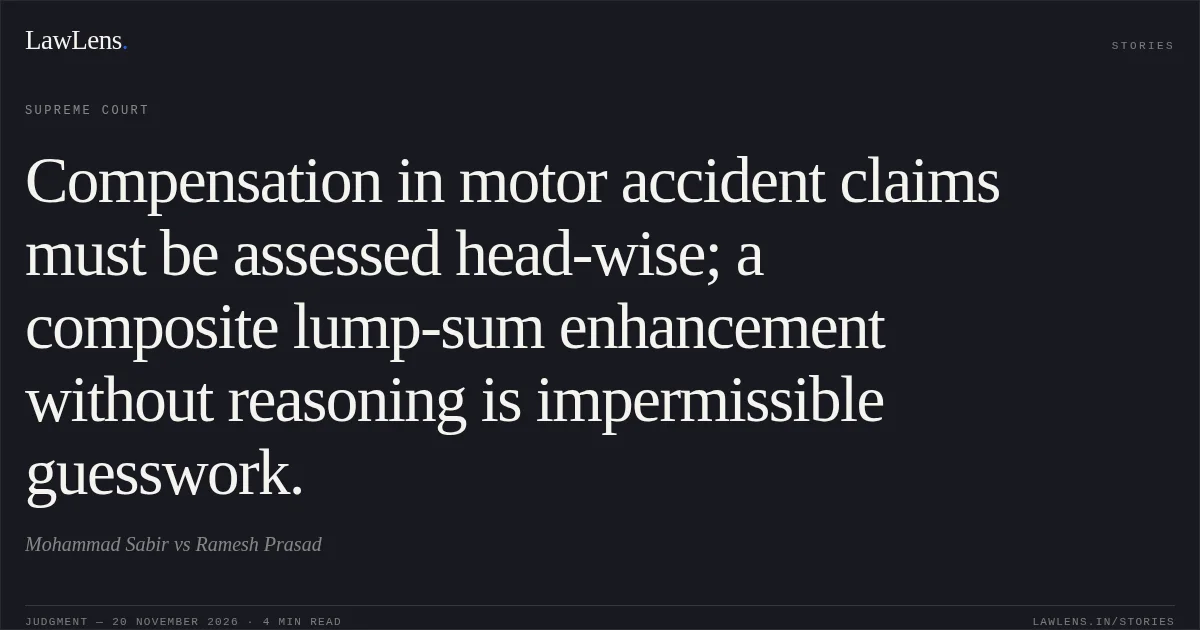
The High Court's unexplained ₹2,00,000 enhancement was guesswork and failed the Raj Kumar head-wise exercise, so the Court undertook that exercise itself.
¶ 8 · ¶ 9Because the appellant produced no income evidence, the ₹4,000 notional figure was replaced by the ₹5,270 minimum wage for an unskilled worker as of April 2013, yielding annual income of ₹63,240 and, with multiplier 17 for age 30, the base was applied.
¶ 9The 50% permanent disability of the right leg, combined with a livelihood requiring travel for milk collection and sale, would impair mobility, and functional disability was fixed at 50% rather than the Tribunal's 20%, producing a net annual figure of ₹5,37,540.
¶ 10Future prospects at 40% (₹2,15,016) were added, giving ₹7,52,556.
¶ 11Loss of earnings was assessed for six months (₹31,620). The medical expenses of ₹15,930, supported by vouchers, were left unchanged.
¶ 12Special diet and transport were enhanced to ₹50,000, pain and suffering to ₹1,00,000, and attendant charges to ₹25,000, each reasoned by the nature of injuries and the need for assistance in daily chores.
¶ 12The Court retained the High Court's ₹2,00,000 as a separate "lump sum enhancement" item in the final computation, arriving at ₹11,75,106, although the figure was not independently justified under any head despite the Court's earlier criticism of such unexplained lump sums.
¶ 8 · ¶ 1205Holding
The appellant is entitled to just compensation of ₹11,75,106 with 7% interest per annum from 28.06.2013 until realisation.
¶ 14Interest is not payable on the enhanced compensation for the period 29.04.2015 to 26.04.2024, per the High Court's direction, which continues to operate.
¶ 13 · ¶ 14The High Court's judgment dated 01.09.2025 in MA No. 548 of 2014 is modified accordingly. The appeal is allowed, with parties to bear their own costs, and pending interlocutory applications are disposed of.
¶ 14Original Court PDF
Mohammad SabirvsRamesh Prasad
Click to open original judgment
Original judgment, available to read, download and summarize on LawLens.in