01Facts
The informant (PW-1), father of a 14-year-old girl, lodged an FIR on 21.11.2018 stating that his daughter left for school that morning and did not return.
¶ 3–4She later called him from the appellant's mobile phone, saying she was en route to Bangalore. The appellant was nabbed at Lokhra, Chariduar P.S., and the victim was recovered.
¶ 3–4The Special Judge, Udalguri, in Special (POCSO) Case No. 64/2019, convicted the appellant under Section 366 IPC and Section 4 of the POCSO Act on 07.08.2023.
¶ 2, 7He was sentenced to seven years' RI under Section 366 IPC and 20 years' RI under Section 4 POCSO, with fines and concurrent running of sentences.
¶ 2, 7The victim's medical examination found the hymen intact, with no vaginal injury or marks of violence.
¶ 12, 36Radiological examination showed an age of 16–17 years.
¶ 12The victim's birth certificate was issued on 23.06.2010 and recorded a date of birth of 26.01.2004, indicating a delayed registration; no District Magistrate permission was produced.
¶ 8, 14–15The defence case (DW-1) was that the parties had a consensual love affair and eloped together, supported by DW-2 to DW-5.
¶ 20–24An ossification test on the appellant on 19.08.2026 indicated he was 17 years, 3 months, 1 day old on the date of the incident.
¶ 1802Issues
i.1. Whether the appellant kidnapped the victim so as to constitute an offence under Section 366 IPC.
¶ 11, 33ii.2. Whether the victim was a minor on the date of the incident.
¶ 12–15iii.3. Whether penetrative sexual assault under Section 4 POCSO was proved, and whether the sole testimony of the victim could sustain conviction.
¶ 25, 34–36iv.4. Whether the appellant, being a child in conflict with law at the time of the offence, could be punished in the absence of compliance with Sections 15, 18 and 19 of the Juvenile Justice Act, 2015.
¶ 26–3203Law Applied
Section 366 IPC (kidnapping/abduction with intent to compel marriage or illicit intercourse) and Section 4 POCSO (penetrative sexual assault) were applied.
¶ 2, 25Section 94 of the JJ Act, 2015 governs age determination: a birth certificate issued under the Registration of Births and Deaths Act, 1969 is conclusive proof only if genuine, and a delayed certificate requires District Magistrate permission.
¶ 14–17Under Mahadeo v. State of Maharashtra, (2013) 14 SCC 637, two years are added to or subtracted from ossification-based age estimates in favour of the accused or victim.
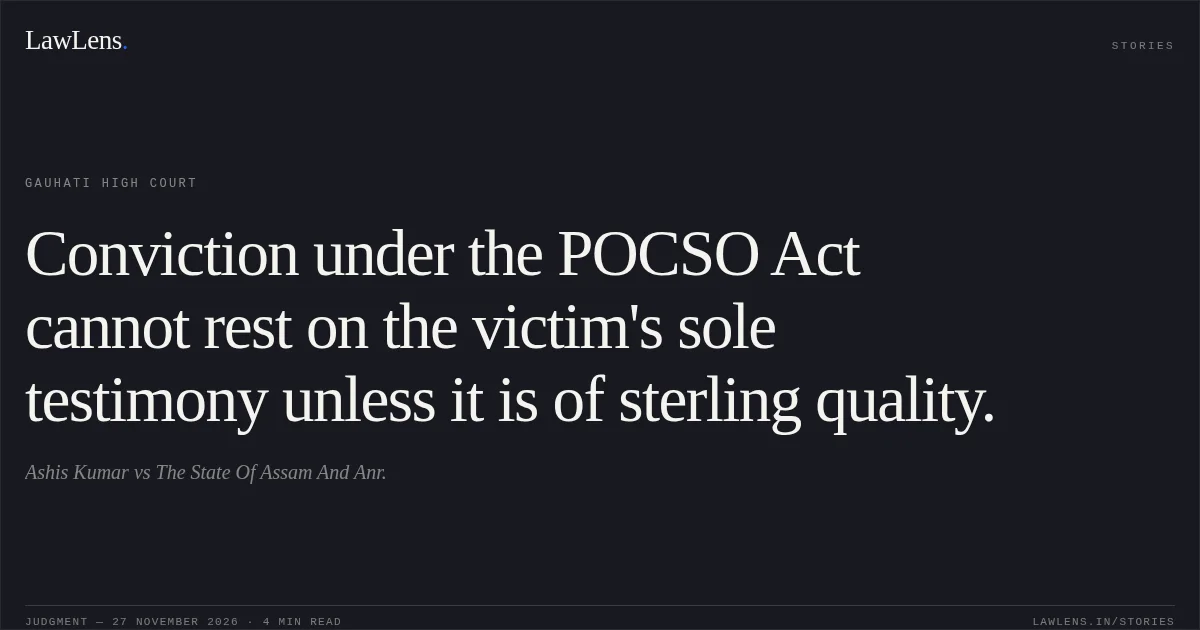
¶ 13Rai Sandeep alias Deepu v. State (NCT of Delhi), (2012) 8 SCC 21 holds that a prosecutrix's sole testimony may sustain conviction only if it is of "sterling quality", i.e., consistent, natural and free from material contradictions.
¶ 35Sections 15, 18(1)(g), 18(3) and 19 of the JJ Act govern preliminary assessment and transfer for a child aged 16 or above accused of a heinous offence, and cap punishment at three years' special home detention where those steps are not followed.
¶ 26–29Karan v. State of M.P., (2023) 5 SCC 504 holds that such a child cannot be punished beyond three years without compliance.
¶ 30Ajeet Gurjar v. State of M.P., (2023) 15 SCC 678 holds that the Section 19 procedure is mandatory, with "may" read as "shall"; Thirumoorthy v. State, (2024) 12 SCC 307 reaffirms this.
¶ 30Provisions in the judgment · 10 · Linked ones open on LawLens
Indian Penal Code, 1860 Section 366
Protection of Children from Sexual Offences Act, 2012 Section 4
Code of Criminal Procedure, 1973 Section 164Section 313
Juvenile Justice (Care and Protection of Children) Act, 2015. Section 4Section 15Section 18Section 19Section 21Section 94
04Reasoning
On kidnapping, the Court found that the victim's own telephone call to her father from the appellant's phone, the voluntary journey by bike, train and bus, and the stay in an open house amid neighbours, were inconsistent with forcible abduction.
¶ 11, 33The victim also admitted she was not forced onto the train or bus and did not raise alarm.
¶ 11, 33On minority, the Court held that the birth certificate, issued six years after the recorded date of birth, was not proven genuine in the absence of District Magistrate permission, so the victim's age could not be fixed with certainty.
¶ 14–15On penetrative sexual assault, the Court reasoned that since the victim's account was not truthful on kidnapping, her testimony on the sexual assault could not be relied upon without corroboration.
¶ 34, 36The Court further noted that the medical evidence (intact hymen, no injuries) did not support the allegation.
¶ 36On the juvenility issue, the Court held that the appellant was 17 years old at the time of the incident.
¶ 18–19The Court held that the mandatory procedure under Sections 15, 18 and 19 was not followed, and that the trial was conducted by the POCSO Court rather than a Children's Court.
¶ 29–31Because the juvenility surfaced only at appeal and the appellant had already served over three years in custody, the Court held that he could not be punished beyond that statutory cap.
¶ 31–3205Holding
The prosecution failed to prove the offences under Section 366 IPC and Section 4 POCSO beyond reasonable doubt.
¶ 37The appeal is allowed. The appellant is acquitted of all charges, and the impugned judgment dated 07.08.2023 in Special (POCSO) Case No. 64/2019 is set aside. The respondents are directed to release the appellant immediately from jail, unless he is wanted in any other case. The TCR is to be returned, and the Gauhati High Court Legal Services Committee is directed to pay the fee of the appellant's Legal Aid Counsel.
¶ 37–40Original Court PDF
Ashis KumarvsThe State Of Assam And Anr.
Click to open original judgment
Original judgment, available to read, download and summarize on LawLens.in